🦁 Freshwater Angelfish
🧾 Quick Facts
The freshwater angelfish, often recognized for its elegant appearance and serene nature, is a popular species in aquariums worldwide. Although commonly referred to as a single species, it belongs to a small group of species within the genus Pterophyllum.
- Common name(s): Freshwater Angelfish
- Scientific name: Pterophyllum (specific species varies)
- Animal type: Fish
- Typical adult size: 6–8 inches in length
- Typical lifespan: Up to 10 years in captivity
- Diet type: Omnivore; consumes insects, plant material, and smaller fish
- Activity pattern: Diurnal
- Social structure: Pairs or small groups
- Swimming highlights: Graceful and slow movers
- Intelligence/learning: Moderate; known for social interactions
- Primary habitats: Freshwater rivers and lakes
- Geographic range: Native to the Amazon Basin in South America
- Predators/threats: Larger fish, birds, and habitat destruction
- Conservation status: Not classified; varies by region
🔍 Identification & Appearance
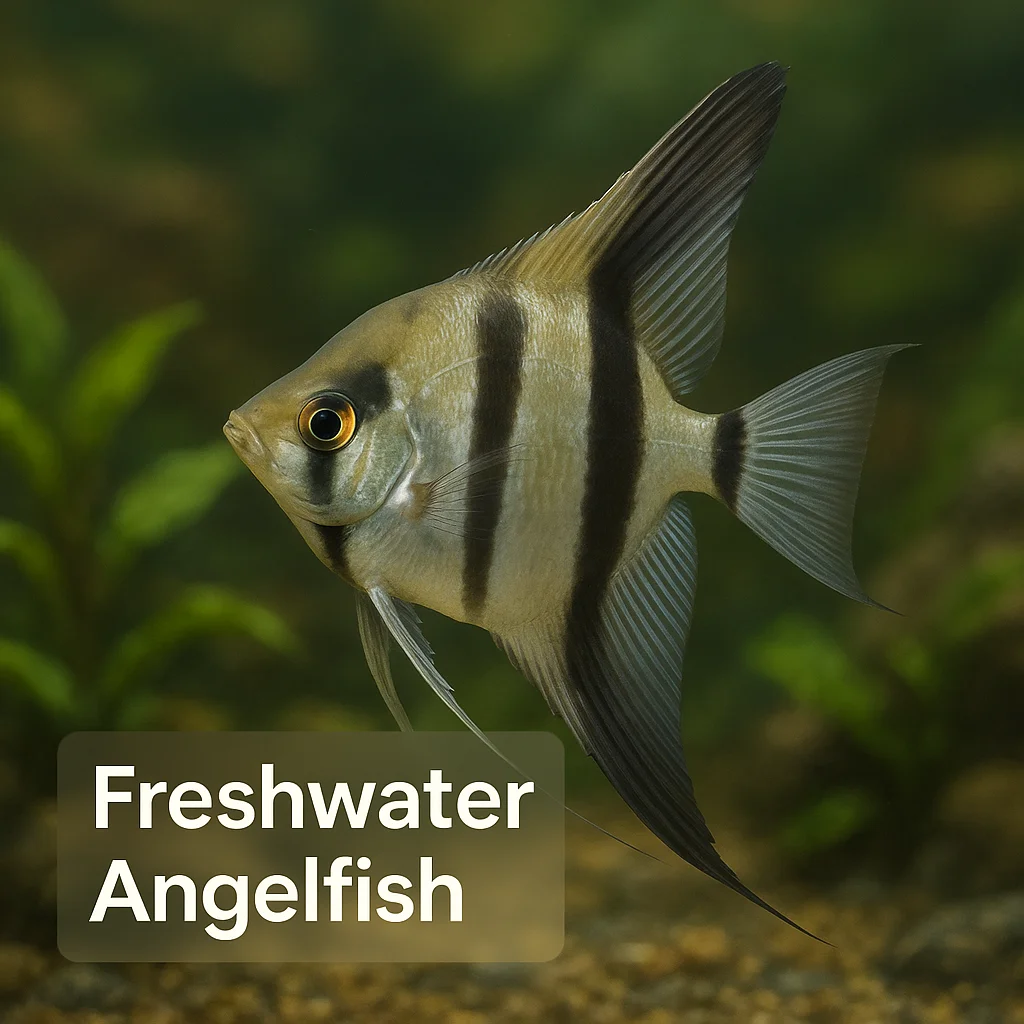
Freshwater angelfish have a distinct triangular shape, accentuated by their long, elegant fins. Their bodies can display a variety of color patterns, including silver with black stripes, as well as marbled patterns and solid colors.
- Body shape and silhouette: Triangular with elongated fins
- Key colors/patterns: Silver with vertical black stripes; other color variants exist
- Distinctive features: Long dorsal and anal fins, narrow body
- Common look-alikes: Discus fish; differentiate by shape and fin length
- Top ID Tips:
- Look for vertical black stripes
- Note the triangular body shape
- Check for characteristic long fins
- Observe the slow, graceful swimming pattern
- Spotting vivid colors in certain variants
- Stripe pattern varies with age
🧱 Body Structure & Physical Adaptations
The freshwater angelfish's body is laterally compressed, aiding in navigating through dense aquatic vegetation. Their fins are adapted for slow, precise movements rather than speed.
- Build and proportions: Slender, laterally compressed
- Fins: Long dorsal and anal fins for precise maneuvering
- Sensory strengths: Good vision but limited low-light capabilities
- Key Adaptations:
- Streamlined body for navigating vegetation
- Elongated fins for stability in water
- Good peripheral vision
- Coloration aids in camouflage
- Misleading stripe pattern can confuse predators
- Can adapt to various water conditions
🌍 Range & Distribution
Native to freshwater environments in the Amazon Basin, angelfish are widespread in tropical waters of South America. They prefer warm, slow-moving rivers and streams with heavy vegetation.
- Native regions: Amazon Basin
- Preferred environments: Tropical, slow-moving freshwater
- Elevation range: Lowland river systems
- Where You Might Find It:
- Amazon River tributaries
- Flooded forest areas during rainy season
- Shallow wetlands
- Plant-dense river margins
- Aquariums globally
🏞️ Habitat & Shelter
Freshwater angelfish thrive in environments with ample cover provided by plants and submerged tree roots. These natural shelters offer protection from predators and are sites for breeding.
- Dense vegetation provides shelter
- Prefers calm, slow-moving water
- Seasons influence breeding and movement
- Habitat knowledge aids in understanding survival strategies
🧭 Behavior & Ecology
Angelfish are known for their deliberate movements and socially intricate behaviors. They often remain in mid-water, monitoring their surroundings and interacting with neighboring fish.
- Daily routine: Active during daylight hours
- Communication: Uses body language and color changes
- Role in ecosystem: Part of the aquatic food chain, prey, and predator
- Behavior Highlights:
- Territorial during breeding
- Engages visually with conspecifics
- Mutualistic relationships with some plants
- Serves as prey for larger aquatic predators
- Display peaceful demeanor
- Maintains partial colonies in suitable areas
👥 Social Life & Group Dynamics
While freshwater angelfish can be kept alone, they exhibit a variety of social behaviors when in pairs or small groups. Pair bonding is common during breeding, and they may exhibit hierarchical behavior in group settings.
- Social tendencies: Both solitary and social interactions
- Group dynamics: Pairs or small, loosely structured groups
- Cooperation: Mainly in breeding contexts
- Social Structure Notes:
- Forms pair bonds during breeding
- Non-breeding individuals often solitary
- Potential for hierarchical displays
- Large territorial display in pairs
- Shared feeding sites among stable groups
🍽️ Diet, Prey & Predators
As opportunistic omnivores, angelfish consume a mix of plant material and small aquatic creatures. Their diet varies with seasonal availability and habitat conditions.
- Main diet components: Insects, juvenile fish, and plant leaves
- Predators: Larger fish, aquatic birds, reptiles
- Feeding Notes:
- Forages throughout daylight hours
- Tolerates a variety of food sources
- Employs slow, deliberate feeding tactics
- Feeds at various depths
- Thrive in healthy, biodiverse waters
🦌 Hunting, Foraging & Movement
Freshwater angelfish have evolved to swim gracefully and efficiently in the water column. Their movement is characterized by subtle navigation through vegetation while foraging primarily during the day.
- Locomotion style: Slow, deliberate swimming
- Movement & Strategy:
- Thrives in plant-dense environments
- Rarely ventures to rapid-flowing waters
- Adapts to habitat obstacles
- Forages by visual cues
- Utilizes slow current areas effectively
🧠 Intelligence & Senses
While not among the most intelligent fish, angelfish display a moderate level of social intelligence and adaptability to changing conditions.
- Sensory abilities: Adequate vision and touch sensitivity
- Notable Abilities:
- Color-based communication important
- Capable of recognizing signals for breeding
- Able to adapt behaviors to partner dynamics
- Memory aids in territory establishment
- Utilizes visual cues for feeding
🪺 Reproduction, Pregnancy & Parenting
Freshwater angelfish are known for forming strong pair bonds during breeding. They are oviparous, laying eggs that are then tended to by both parents.
- Breeding season: Often coincides with the rainy season
- Mating system: Typically monogamous
- Reproduction Snapshot:
- Engages in elaborate courtship displays
- Lays eggs on flat surfaces
- Both parents share egg-guarding duties
- Requires appropriate environmental triggers
- Parental care reduces predation rate
- Spawns in sheltered sites
♀️♂️ Male vs Female Differences
Gender differences in freshwater angelfish are subtle and often involve behavior more than physical traits. However, male angelfish may be slightly larger and exhibit more aggressive territorial displays.
- Physical differentiation: Males can be slightly larger
- Sex Differences at a Glance:
- Males might have more extended fin rays
- Both sexes participate in parenting
- Females lay eggs; males fertilize
- Behavioral differences in territory defense
- Displays more pronounced during breeding
🧬 Subspecies & Variation
Variation among freshwater angelfish primarily includes color and fin shape differences. These variations can often arise from selective breeding in captive environments.
- Known color variants: Silver, gold, marbled
- Variation Notes:
- Subspecies classification debated
- Color variations crucial in captive appeal
- Fin structures vary across populations
- Size and behaviors consistent with native conditions
- Adaptations reflect environmental pressures
⚠️ Threats, Conservation & Human Interaction
The primary threats to freshwater angelfish include habitat destruction and pollution. They are popular in the aquarium trade, which can impact their natural populations if not managed sustainably.
- Threats: Habitat loss, pollution
- Responsible Notes:
- Part of sustainable aquarium trade responsibly conducted
- Habitat restoration critical for wild populations
- Captive breeding reduces wild capture necessity
- Awareness programs for habitat protection beneficial
- Angelfish enhance awareness of aquatic ecosystem health
✨ Fun Facts & Unique Traits
- Angelfish pairs display intricate courting behaviors.
- In aquariums, they are known for their compatibility with diverse species.
- Their shape and graceful movement make them aquarium favorites.
- Angelfish are adaptable to a range of tank conditions.
- Wild populations provide valuable insights into riverine ecosystems.
- Selective breeding techniques have created a wide array of color morphs.
- They can reconceptualize territories after disturbances.
- Angelfish are both predators and prey in their ecosystems.
📌 Summary
- Easy identification by triangular shape and vertical black stripes.
- Native to the Amazon Basin but widely kept in aquariums worldwide.
- Prefers slow-moving freshwater with dense vegetation.
- Omnivorous, eating small animals and plants.
- Predators include larger fish and birds.
- Form pairs during breeding; engages in parental care.
- Capable of slow, deliberate swimming with long fins.
- Social but territorial, especially in breeding scenarios.
- Various color morphs resulting from selective breeding.