🦁 Electric Eel
🧾 Quick Facts
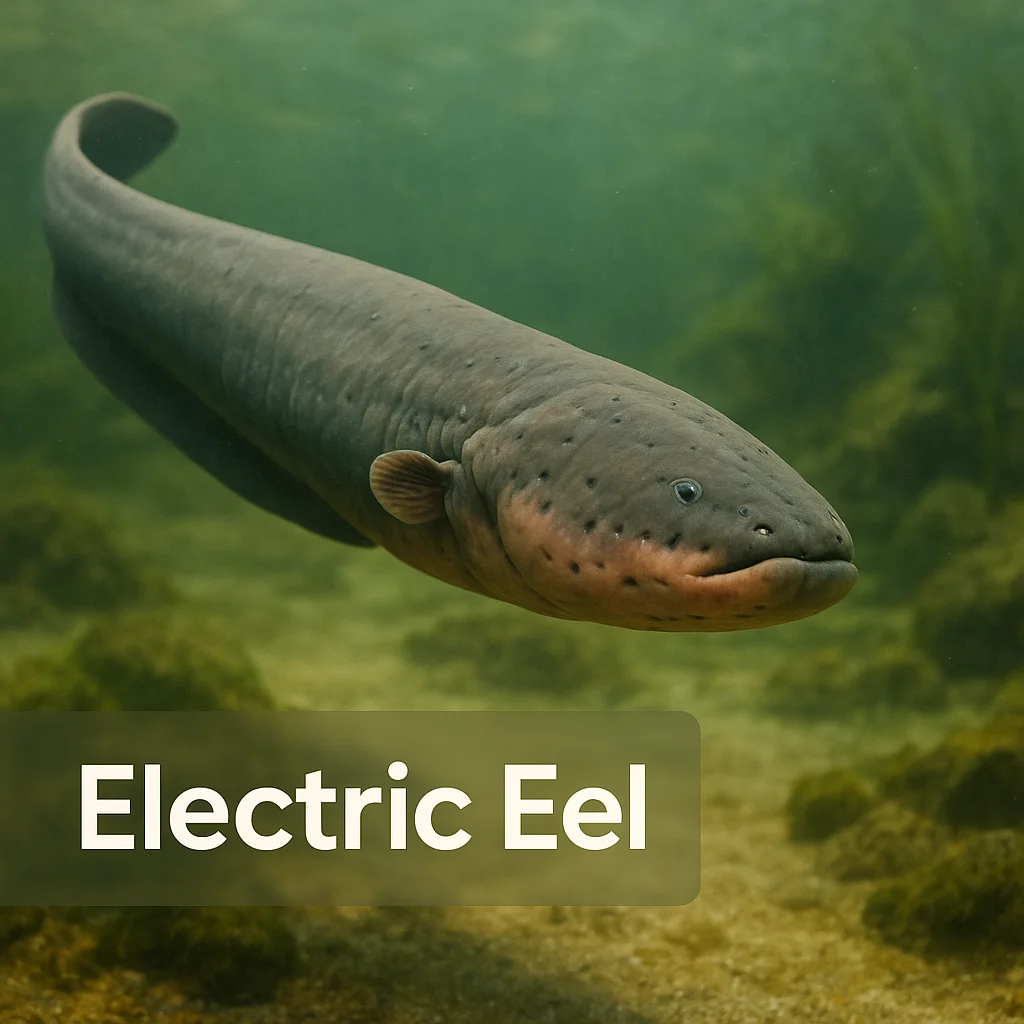
Despite its common name, the electric eel is not a true eel but a member of the knifefish family. Known for its powerful ability to generate electricity, the electric eel is a fascinating species with unique adaptations to its environment.
- Common name(s): Electric Eel
- Scientific name: Electrophorus electricus
- Animal type: Fish
- Typical adult size: 6 to 8 feet (1.8 to 2.5 meters); up to 44 pounds (20 kg)
- Typical lifespan: 15 years in the wild, up to 22 years in captivity
- Diet type: Carnivore; primarily fish and amphibians
- Activity pattern: Nocturnal
- Social structure: Solitary
- Speed / movement highlights: Slow swimmer, uses serpentine motion
- Intelligence/learning: Can learn from experience; capable of complex navigational skills
- Primary habitats: Freshwater systems
- Geographic range: Amazon and Orinoco River basins in South America
- Predators/threats: Large fish, caimans; habitat destruction by humans
- Conservation status: Not evaluated
🔍 Identification & Appearance
The electric eel is identifiable by its elongated, cylindrical body and a distinctively flattened head. It has a dark, brownish-grey color on the back shading to a yellow or orange tint on the underside. Unlike true eels, it lacks dorsal fins, and its long body is supported by a singular fin that extends from the throat to the tip of the tail, aiding in its undulating swimming motion.
- Body: Long and cylindrical with a flattened head
- Color: Dark brown on top, yellow or orange on the belly
- Fins: Lacks dorsal fin, has long anal fin along the underside
- Features: Depressed snout, mouth positioned at the end for catching prey
- Look-alikes: True eels, but distinguished by fin structure and body proportions
- Other signs: Can emit electrical pulses detected with specialized equipment
- Top ID Tips:
- Look for the snake-like body and single, long anal fin
- Note the absence of pectoral fins
- Observe the coloration: dark upper body with lighter underside
- Listen for subtle splashes at the water's surface; indicator of prey capture
- Low dorsal ridge; elongated, smooth appearance
- Presence often reported in deeper water of slow-moving rivers
🧱 Body Structure & Physical Adaptations
The electric eel's body structure is uniquely adapted for its aquatic environment and predatory lifestyle. Its long, flexible body and absence of traditional fin structures facilitate efficient movement in water. The electric eel's primary adaptation is its ability to produce electricity, which it uses for navigation, prey capture, communication, and defense.
- Slender, elongated body allowing stealthy navigation
- Modified muscles that produce electricity, situated along the body
- Electroreceptors scattered around the skin for detecting prey and objects
- Specialized cells known as "electrocytes" generate electrical currents
- Electric charges aid in stunning prey and deterring predators
- Sensitive lateral line system for sensing vibrations in the water
- Key Adaptations:
- Electric organs make up 80% of body length
- Can produce a shock exceeding 600 volts
- Electroreception for detection of prey in murky waters
- Slow metabolism requiring oxygen from the atmosphere
- Utilizes electric pulses to navigate and communicate
- Large mouth adapts for suction feeding
🌍 Range & Distribution
The electric eel is predominantly found in the murky waters of South America's Amazon and Orinoco River basins. It inhabits freshwater environments, such as ponds, creeks, rivers, and tributaries, preferring areas where water current is slow and rich in submerged vegetation.
- Native to the Amazon Basin in Brazil, Venezuela, Suriname, and Guyana
- Prefers lowland river systems with sluggish water current
- Often found in floodplains and swamps
- Resides year-round in freshwater systems
- Adapted to environments with poor water visibility
- Where You Might Find It:
- Amazon River and surrounding regions in South America
- Orinoco River Basin
- Slow-moving, oxygen-deficient streams
- Flooded forests during the rainy season
- Swamps, marshes, and seasonal wetlands
🏞️ Habitat & Shelter
The electric eel thrives in a variety of aquatic environments, from the sprawling reaches of the Amazon River to isolated swamp areas. These habitats provide both shelter and feeding grounds. The dense vegetation found within these environments serves as a hideaway from predators and a fertile hunting ground for unsuspecting prey.
- Prefers calm, slow-moving bodies of freshwater
- Dense, underwater vegetation is important for cover
- Adjusts to seasonal changes in water level and clarity
- Often frequents turbid water where visibility is low
🧭 Behavior & Ecology
The electric eel is a solitary predator with a nocturnal lifestyle, primarily hunting under the cover of darkness. It relies heavily on its electric field both for hunting and navigation. Interactions with other species are generally limited, but it is known to compete for resources with other carnivorous fish in its habitat.
- Highly solitary and territorial
- Courses through slow, murky waters to locate prey
- Crucial ecological role as predator, controlling fish and invertebrate populations
- Broad diet includes fish, amphibians, and occasionally birds or small mammals
- Behavior Highlights:
- Nocturnal hunter, rests during the day
- Uses electrical discharge for prey capture and defense
- Establishes dominance with impressive electrical displays
- Maintains a fixed home range and uses repetitive routes
- Communication via electric signals in social contexts
- Role as a top predator within its ecological niche
👥 Social Life & Group Dynamics
Electric eels are typically solitary creatures. They engage in social interactions predominantly during the breeding season. Their solitary nature ensures minimal competition with others of their kind and controls predation on shared resources.
- Primarily solitary, limited group interactions
- Social interaction is rare, generally during reproduction
- Lacks complex social structures observed in other species
- Competition between males for females during mating season
- Social Structure Notes:
- Individualists with minimal group cohesion
- Breeds in pairs, occurring annually
- Males guard and protect nests
- Care provided by males, which is unusual among fish
- Females become less solitary during breeding
- Parental care is primarily a male responsibility
🍽️ Diet, Prey & Predators
As carnivores, electric eels have a broad diet that includes a variety of aquatic creatures. By utilizing their electric charge, they can both incapacitate prey and assess the presence of other creatures. Their ability to generate electricity also serves as an effective deterrent against potential predators.
- Feeds on fish, amphibians, and invertebrates
- Employs electric discharge for stunning prey
- Predators are few, but include caimans and larger predatory fish
- Defenses include electric shock and evasive swimming
- Feeding Notes:
- Nocturnal feeder; ambush strategy
- Electric discharges disrupt prey's muscle function
- Prefers quick, small prey items for rapid consumption
- Occasionally scavenges if opportunities arise
- Uses low-voltage pulses to locate prey
- High-voltage shocks employed only when needed
🦌 Hunting, Foraging & Movement
Electric eels primarily rely on their extraordinary ability to generate electricity to capture prey and navigate their way through murky waterways. Their foraging methods are unique and highly effective, leveraging their electric charge to sense and immobilize prey.
- Moves with a serpentine motion aided by long anal fin
- Employs both low and high-voltage discharges strategically
- Active hunting occurs under the cover of night
- Ambush predator, striking suddenly at unsuspected prey
- Movement & Strategy:
- Swims in an undulating manner
- Combines navigation with electric pulses
- Relies on stealth and surprise in prey capture
- Electric fields produce spatial awareness in dark waters
- Favored tactic includes encapsulating prey with body
- Limited speed, depends on explosive ambushes
🧠 Intelligence & Senses
Electric eels exhibit a remarkable level of sensory acuity, largely mediated through their ability to generate and detect electric fields. This allows them to efficiently navigate and hunt within their complex aquatic environments.
- Superior electroception abilities
- Can calibrate electrical discharge based on prey size
- Displays problem-solving in locating and capturing prey
- Limited data on learning ability, but exhibit basic conditioning
- Capable of muscle memory associated with routine routes
- Notable Abilities:
- Can emit up to 600 volts of electrical discharge
- Electroreception provides significant environmental awareness
- Utilizes electric "radar" for environmental mapping
- Shows adaptability in response to environmental challenges
- Sensitivity to vibrations and electric fields
- Energy-efficient hunting strategies
🪺 Reproduction, Pregnancy & Parenting
Electric eels have a unique reproductive strategy among fish, with notable male contributions to parental care. Breeding behaviors include the construction of a nest where females deposit eggs and males subsequently take on protective roles. The electric eel's reproductive cycle is closely tied to seasonal changes and environmental conditions.
- Spawns once per year during the dry season
- Breeding involves male-constructed nests
- Females lay clusters of eggs
- Males guard the nest and care for young
- Fertilization is internal, eggs develop in controlled conditions
- Parental care by males ensures high survival rates
- Reproduction Snapshot:
- Nesting occurs in shallows or secluded areas
- Males engage in courtship displays using electric signaling
- Females lay up to 1,700 eggs
- Young hatch fully dependent on stored yolk
- Parental care enhances juvenile success rates
- Nesting territories often defended aggressively
♀️♂️ Male vs Female Differences
The physical differences between male and female electric eels are not particularly pronounced, though subtle variations can be observed in size and reproductive behavior. These distinctions become more emphasized during the breeding season.
- Males generally smaller but vary by individual
- Sexual dimorphism less pronounced than other species
- Behavioral differences appear during mating
- Males take on nest-building and guarding roles
- Sex Differences at a Glance:
- Size varies, males slightly smaller
- Roles during reproduction clearly defined
- Males show increased territoriality during breeding
- Females are more visible when spawning
- Parental care primarily by males
🧬 Subspecies & Variation
While the electric eel is generally considered a single species, variation exists within the population, particularly in relation to geographical distribution and environmental adaptation. The scientific community has yet to agree on formal subspecies classifications.
- Research on subspecies is ongoing
- Genetic diversity across range
- Adaptations to local environmental conditions observed
- Potential morphological differences yet to be standardized
- Variation Notes:
- No formal subspecies recognized
- Geographical variation influences behavior
- Environmental pressures drive adaptation
- Niche specialization within diverse habitats
- Potential cryptic diversity suggests further study
⚠️ Threats, Conservation & Human Interaction
The electric eel faces challenges typical of aquatic habitats, including habitat degradation and competition for resources. While not currently facing an extinction threat, ongoing environmental changes may impact their populations in the future. Responsible management of freshwater ecosystems is crucial for their continued survival.
- Habitat destruction due to deforestation and pollution
- Competition with invasive species
- Potential overfishing in some regions
- Water pollution and sedimentation threaten habitats
- Climate change may alter habitat conditions
- Not typically targeted by fisheries due to electrical defense
- Responsible Notes:
- Promote conservation of freshwater habitats
- Support clean water initiatives
- Protect riverine ecosystems from unsustainable development
- Encourage sustainable land use practices
- Promote education and awareness of aquatic conservation
✨ Fun Facts & Unique Traits
- Electric eels are capable of generating up to 600 volts
- Despite the name, they belong to the knifefish family, not eels
- Electric eels use their electricity for navigation and hunting
- They breathe air and can surface from water up to every 10 minutes
- Capable of stunning large prey with high-voltage discharges
- Electroreception allows them to "see" in murky waters
- Their electric organs are a fusion of three specialized tissues
- Lore inspired by their ability dates back to pre-Columbian cultures
📌 Summary
- Recognizable by long, cylindrical body and single anal fin
- Inhabit slow-moving freshwater in Amazon and Orinoco basins
- Carnivores preying on fish and invertebrates with electric shocks
- Semi-solitary; males play a key role in parenting
- Major predator, maintaining ecological balance in habitats
- Remarkable capacity for generating and detecting electricity
- Breeding involves parental care primarily by males
- Faces threats from habitat destruction and environmental change
- Unique, with sensational electric capabilities
- Requires continued conservation efforts to protect freshwater ecosystems