🦁 Tanager
🧾 Quick Facts
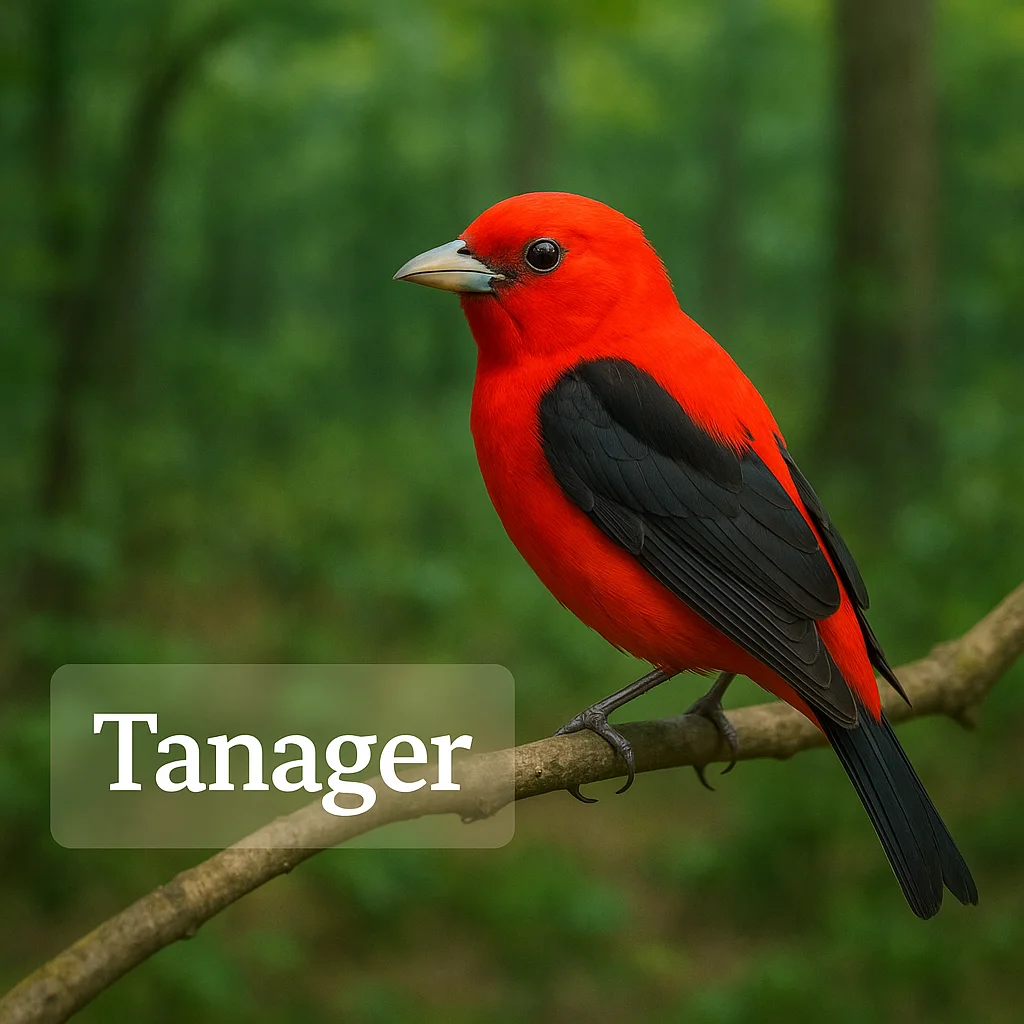
Tanagers are a diverse family of small to medium-sized birds belonging to the Thraupidae family. Known for their vibrant plumage and melodic songs, tanagers are primarily found in the Americas.
- Common name(s): Tanager
- Scientific name: Thraupidae (family)
- Animal type: Bird
- Typical adult size: 12 to 20 cm in length; 15 to 40 grams in weight
- Typical lifespan: 4 to 8 years in the wild
- Diet type: Omnivore; fruits, insects, seeds, and nectar
- Activity pattern: Diurnal
- Social structure: Varies; some species are solitary, while others form pairs or groups
- Speed / movement highlights: Capable flyers, often flit between branches
- Intelligence/learning: Known for problem-solving and learning abilities
- Primary habitats: Forests, gardens, and shrublands
- Geographic range: From southern North America to South America
- Predators/threats: Birds of prey, snakes, and habitat loss due to human expansion
- Conservation status: Varies by region; some species are of least concern, while others face threats
🔍 Identification & Appearance
Recognizing a tanager involves noting their small to medium stature and striking coloration. Their body shape is compact with short wings and a medium-length tail. Tanagers are renowned for vivid plumage, with many species adorned in bright reds, blues, greens, or yellows. While some display monochrome patterns, others exhibit eye-catching multicolored feathers.
- Top ID Tips:
- Compact body with short wings
- Vibrant feather colors; reds, yellows, blues
- Medium-length pointed beak
- Eye-catching and active in tree canopies
- Melodic song, often melodic and complex
- Faintly barred or unstreaked bellies
- Absence of large crest
- Often seen in pairs or small groups
- Unique color patterns for each species
🧱 Body Structure & Physical Adaptations
Tanagers have a streamlined structure with adaptations for a life amongst trees. Their beaks are often slightly curved and pointed, perfect for a diverse and varied diet. They possess strong, grasping claws that allow for efficient perching on branches. Although tanagers primarily rely on vision for navigation and feeding, their hearing aids in recognizing calls and potential threats.
- Key Adaptations:
- Streamlined, aerodynamic body
- Curved beak for accessing fruits and insects
- Strong claws for gripping branches
- Acute vision for spotting food and mates
- Versatile diet accommodated by beak shape
- Adaptable vocal abilities for communication
- Short tails, aiding in swift flight
- Lightweight skeleton enhances mobility
🌍 Range & Distribution
Tanagers have a widespread distribution, chiefly inhabiting the forests of Central and South America. They are predominantly found in tropical and subtropical regions and can also occur in plantations and gardens across these continents. Migratory tanagers, such as the Scarlet Tanager, venture northward to breed, showing remarkable adaptability to different environments.
- Where You Might Find It:
- Amazon Rainforest
- Andes Mountains
- Caribbean islands
- Central America
- Southern United States, seasonally
- Brazilian rainforests
- Cloud forests of Ecuador
- Guatemalan highlands
- Tropical lowland forests
🏞️ Habitat & Shelter
Tanagers thrive in a variety of forested environments, from dense rainforests to montane woodlands. They often build cup-shaped nests tucked in forks of branches for protection against predators. These nests may be found at various tree elevations, depending on the species. Seasonal weather conditions can influence their movement and activity patterns.
🧭 Behavior & Ecology
Tanagers are generally active during the day, with peaks in activity during the early morning and late afternoon. They often engage in grooming behaviors to maintain their plumage. Vocal communication is essential for territory establishment and coordination within pairs or groups. They play a vital ecological role as seed dispersers and pollinators within their habitat.
- Behavior Highlights:
- Active feeding times during dawn and dusk
- Complex and melodious vocalizations
- Territorial singing and displays
- Mutualism with flowering plants for pollination
- Movement in loose flocks outside breeding season
- Use of visual signals during mating displays
- Migratory behavior noted in some species
- Important role in seed dispersal
- Cooperative group behaviors in some taxa
👥 Social Life & Group Dynamics
Tanager social structure varies with species, some preferring solitude or forming monogamous pairs, while others gather in mixed-species flocks outside breeding seasons. During breeding times, cooperative behaviors may include joint territory defense or song duets. Conflict is often resolved through vocalizations and visual displays rather than physical confrontation.
- Social Structure Notes:
- Monogamous pair bonds for many species
- Mixed flocks with other bird species
- Joint parenting roles in some species
- Defense of shared territories during breeding
- Strong pair bonding through vocal exchange
- Sibling cooperation in some youth rearing
- Seasonal gathering in larger groups for migration
- Minimal aggressive interactions
- Flexible group membership outside breeding
🍽️ Diet, Prey & Predators
Tanagers have a diverse diet that shifts with seasonal availability. Fruits are often the staple, supplemented by insects. During certain periods, nectar and seeds may also form part of their diet. While they serve as prey for various avian predators, their bright plumage can be a double-edged sword—helpful when foraging, but potentially revealing to predators.
- Feeding Notes:
- Primarily frugivorous but opportunistic feeders
- Nectar consumed using specially adapted tongues
- Insect consumption spikes during breeding season
- Concealment in foliage while feeding
- Seasonal shifts to predominantly berry diets
- Risk of predation by hawks and falcons
- Feeding often occurs in canopy layers
- Physical adaptations to extract concealed prey
- Frequent singling out fruits over seeds
🦌 Hunting, Foraging & Movement
Tanagers are agile flyers, often seen fluttering between branches in search of food. They utilize a flitting flight pattern, enabling quick maneuvers amidst dense foliage. Their foraging strategy typically involves searching for fruits and insects within the tree canopy, using quick turns and hops to access food that may be out of view.
- Movement & Strategy:
- Efficient in foraging via concise flight jumps
- Flitters in short bursts from branch to branch
- Sustained flight during migratory episodes
- Extensive range within tropical forests
- Uses visual cues to locate food and peers
- Navigational accuracy in woodland habitats
- Effective in dense forest camouflage
- Feeding sites often revisited iteratively
- Flocks maintain structured formation in flight
🧠 Intelligence & Senses
Tanagers possess cognitive abilities suited to their complex environments. Their keen visual sense aids significantly in their foraging and social interactions. Their vocalizations are not only transactional but also sophisticated, allowing them to convey intricate messages. Though research is limited, there is indication of memory and learning involved in avoiding previously cleared areas of food.
- Notable Abilities:
- Precision in visual targeting
- Adaptable communication skills
- Cognitive mapping of foraging sites
- Memory retention for resource locations
- Song variability for distinct messaging
- Advanced observation-based learning capabilities
- Use of environment to orchestrate movement
- Responsive to vocal and visual cues
- Curious behavior towards novel situations
🪺 Reproduction, Pregnancy & Parenting
The breeding behavior of tanagers typically involves forming monogamous bonds. Courtship may include elaborate songs and dances. Nest building is a mutual effort, with both parents often involved in constructing a sturdy cup or dome-shaped nest. Incubation periods can vary, and most hatchlings are altricial, with parents providing food and protection until fledging.
- Reproduction Snapshot:
- Seasonal breeding linked to food availability
- Monogamous pair bonds frequently observed
- Mainly cup-shaped nests in tree forks
- Incubation periods range from 11 to 15 days
- Clutch size of 2 to 4 eggs, generally
- Both sexes often equally involved in care
- Nest defense against predators is practiced
- Altricial young, requiring significant care
- Fledgling development observed over 2-3 weeks
♀️♂️ Male vs Female Differences
In many tanager species, sexual dimorphism is evident. Males often sport more vivid coloration compared to the more subtly colored females. However, size and weight differences between sexes are typically minimal. Behaviorally, both sexes participate in nest building and chick rearing, and males frequently play prominent roles in territory defense.
- Sex Differences at a Glance:
- Males display brighter colorations
- Females often blend with more natural hues
- Minimal size disparities between genders
- Mutual parental investment in offspring
- Shared responsibilities for nest protection
- Males prominent in vocal displays
- Cooperative behaviors in territory defense
- Subtle differences in plumage patterns
- Balanced energy investment in breeding
🧬 Subspecies & Variation
With over 200 species within the Tanager family, variations are numerous and often geographically driven. Local adaptations such as song differences or plumage variations facilitate mating and survival in specific ecosystems. While the Thraupidae classification remains under study, evidence suggests notable adaptability to environmental changes.
- Variation Notes:
- Over 200 unique species
- Plumage variations across geographical ranges
- Adaptive changes in diet preferences
- Different song patterns based on habitat
- Geographic range influences physiological traits
- Notable evolutionary response to climatic shifts
- Debates on subspecies classification continue
- Island-specific adaptations noted in some species
- Colorvariations driven by diet and habitat
⚠️ Threats, Conservation & Human Interaction
The conservation of tanagers varies significantly across regions. While habitat loss is a prevalent threat due to deforestation, climate change also poses a challenge by altering habitats and food availability. Responsible conservation involves protecting critical ecosystems and understanding the species' ecological roles. As some tanager species are occasionally kept in captivity, ethical consideration of their welfare is paramount.
- Responsible Notes:
- Forest preservation is crucial for tanager survival
- Ethical breeding programs to support population
- Monitoring climate change impacts on habitats
- Reducing pesticide use in agriculture for wildlife safety
- Critically reviewing captive breeding practices
- Involving local communities in conservation efforts
- Minimizing forest land conversions for development
- Protecting migratory routes and stopover habitats
- Engaging in bird watching to raise awareness
✨ Fun Facts & Unique Traits
- Tanagers contribute significantly to seed dispersal in tropical forests.
- Many tanager species display brilliant kaleidoscopic plumages.
- The Scarlet Tanager migrates over 2,500 miles between North and South America.
- Some tanagers' diet style shifts according to seasonal changes.
- Tanager songs are complex and play a critical role in mating rituals.
- They exhibit high adaptability due to their varied diet.
- Despite striking colors, some species can camouflage exceptionally well.
- Tanager nest building involves both precision and teamwork.
- Aloof from human settlements, they typically prefer native forested regions.
- They serve as excellent indicators of forest ecosystem health.
📌 Summary
- Tanagers are vivid and diverse members of the avian Thraupidae family.
- Found extensively across South and Central America, in various forests.
- They exhibit brilliant plumage and complex vocalizations.
- Most are omnivores with diets of fruits, insects, and nectar.
- Their role as seed dispersers is crucial in maintaining tropical ecosystems.
- Social structures range from solitary to mixed-species flock behaviors.
- Both parents often take part in nurturing the altricial young.
- Behavioral and physiological differences noted between males and females.
- Conservation status is region-dependent, demanding diverse strategies.
- Known for rapid adaptations to diverse environmental conditions.