🦁 Sunbird
🧾 Quick Facts
The sunbird is a captivating group of small, colorful birds from the family Nectariniidae, found primarily in tropical regions. These birds are often likened to hummingbirds due to their vibrant plumage and feeding habits.
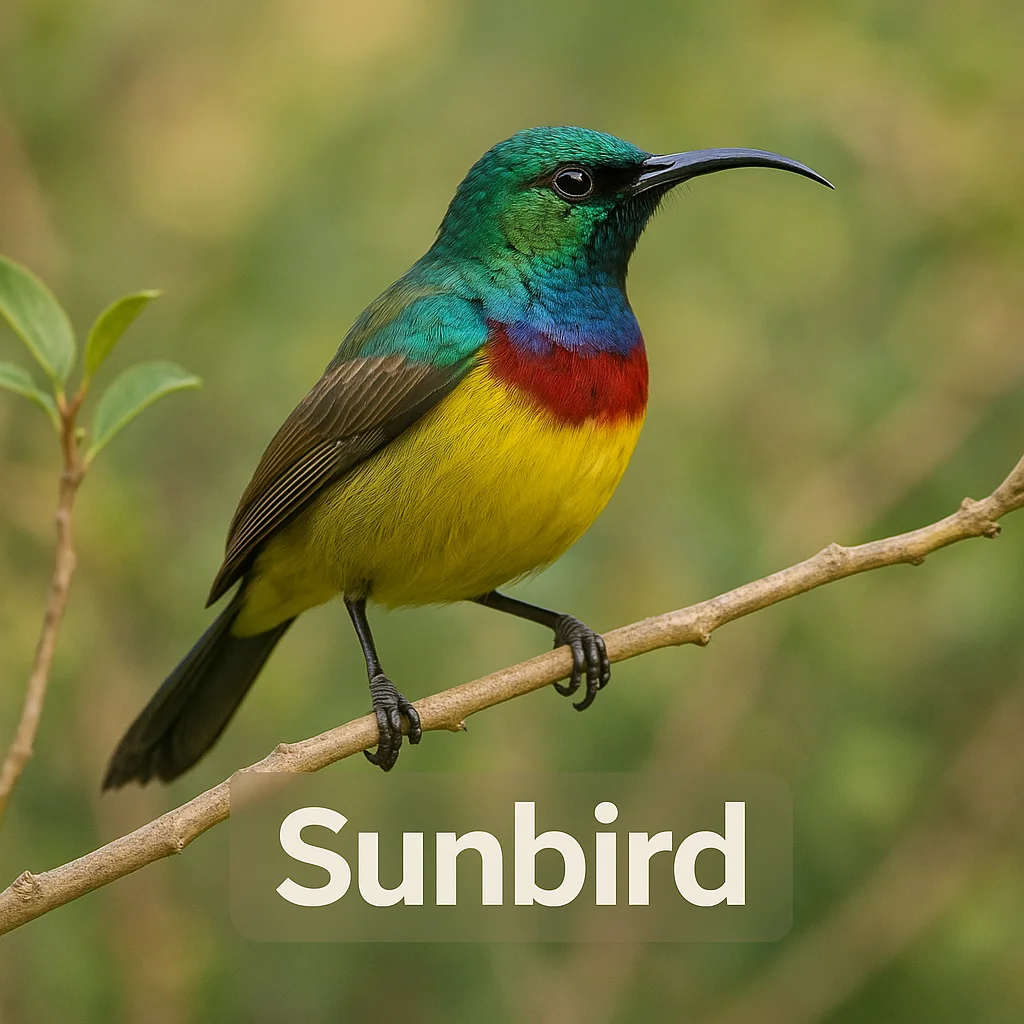
- Common name(s): Sunbird
- Scientific name: Nectariniidae (Family)
- Animal type: Bird
- Typical adult size: 10 to 20 centimeters in length
- Typical lifespan: 5 to 10 years
- Diet type: Omnivore; primarily nectar, also small insects
- Activity pattern: Diurnal
- Social structure: Typically solitary or pairs
- Speed / movement highlights: Capable of rapid flight
- Intelligence/learning: Known for learning feeding behaviors
- Primary habitats: Tropical forests, savannas, gardens
- Geographic range: Africa, Asia, and Australasia
- Predators/threats: Birds of prey, habitat destruction
- Conservation status: Varies by species
🔍 Identification & Appearance
Sunbirds are easily recognized by their small size, slender bodies, and iridescent plumage. Males are often more brightly colored than females, displaying a range of vivid blues, reds, greens, and yellows. Females tend to have more subdued colors. Sunbirds have curved, slender beaks adapted for sipping nectar.
- Slender, delicate body build
- Curved beak for nectar feeding
- Bright, iridescent plumage in males
- Dimorphic coloration; females duller
- Quick, agile flight
- Small, conical feet
🧱 Body Structure & Physical Adaptations
Sunbirds are adapted for nectar feeding with their long, curved beaks and brush-tipped tongues. They are slender, with short wings that allow for rapid and agile movements while flying. Their lightweight structure facilitates prolonged periods of hovering.
- Curved beaks adapted for reaching nectar
- Brush-tipped tongues for nectar extraction
- Short wings for agility in flight
- Slender, lightweight bodies
- Unique plumage for camouflage and display
- Agile flight for evasive maneuvers
🌍 Range & Distribution
Sunbirds inhabit a wide range of tropical regions, predominantly found in sub-Saharan Africa, South and Southeast Asia, and parts of Australia. They thrive in areas with abundant flowering plants, essential for their nectar-based diet.
- Africa (Savannas, forests)
- Southeast Asia (Rainforests, mangroves)
- Southern Asia (Open woodlands, gardens)
- Australia (Coastal forests, shrublands)
- Islands in the Indian Ocean
🏞️ Habitat & Shelter
Sunbirds are highly adapted to tropical environments, and they are found in diverse habitats ranging from dense forests to open savannas. They seek out areas rich in flowering plants that provide nectar, an essential food source. During adverse weather, sunbirds often find shelter in dense foliage.
🧭 Behavior & Ecology
Sunbirds display fascinating behaviors essential for survival. Their daily routines center around feeding on nectar, and they play a crucial role in pollination. They communicate through a series of calls and rely on eye-catching displays for courtship.
- Active during daylight hours
- Crucial pollinators of tropical plants
- Complex courtship displays
- Vocal communication for territory
- Interactions mostly limited to feeding and breeding
👥 Social Life & Group Dynamics
Sunbirds are generally solitary or found in pairs, particularly during the breeding season. They might gather in small groups when food sources are abundant but do not form large flocks. Their social interactions mainly revolve around territorial displays and mating.
- Primarily solitary, forming pairs in mating season
- Minimal cooperation except during breeding
- Territorial with seasonal variations
- Use of vocalizations for territory defense
🍽️ Diet, Prey & Predators
Sunbirds primarily feed on nectar, but they supplement their diet with insects and spiders, especially during breeding season when protein is essential for chicks. They are also known to feed on the juices of fruits.
- Mainly nectivorous, also consuming insects
- Occasional frugivory, especially when fruit is abundant
- Insectivory for protein needs
- Predators include raptors and larger birds
- Anti-predator strategies include fast flight and camouflage
🦌 Hunting, Foraging & Movement
Sunbirds typically forage in areas dense with flowering plants and are adept at hovering to access deep flowers. Their quick flight aids in evading predators and traveling between feeding sites. Sunbirds are active foragers throughout the day but avoid the hottest parts during midday.
- Flight designed for rapid, agile movements
- Forage by hovering in front of flowers
- Mostly diurnal in foraging habits
- Strong territorial behaviors during feeding
- Movement varies seasonally with nectar availability
🧠 Intelligence & Senses
Sunbirds possess keen eyesight for spotting flowers and rivals. They demonstrate problem-solving skills in accessing food sources and have an acute sense of timing for optimal feeding times. Research on their cognitive abilities is ongoing, with findings of developed memory skills for nectar sources.
- Excellent visual acuity for finding flowers
- Learning behaviors related to feeding habits
- Adaptable to different flowering plant species
- Complex problem-solving in urban environments
🪺 Reproduction, Pregnancy & Parenting
Sunbirds usually breed during times of peak nectar availability, often coinciding with the local rainy season. They are predominantly monogamous, though variations exist. Females are primarily responsible for nest-building and egg incubation, though both parents may assist in feeding the chicks.
- Breed during high nectar availability periods
- Monogamous pair bonds typically
- Incubation period: roughly 14 to 17 days
- Clutch size: 1 to 3 eggs
- Both parents may feed the young
- Females play a lead role in nest construction
♀️♂️ Male vs Female Differences
Sunbirds exhibit significant sexual dimorphism. Males are generally more colorful, which is crucial during courtship display. Females have subtler coloration for increased chances of staying hidden while nesting.
- Males more vibrant than females
- Gender differences in territorial behaviors
- Males often involved in defending feeding territories
- Females undertake most nesting duties
🧬 Subspecies & Variation
There are numerous species and subspecies within the sunbird family, each adapted to its specific environment. Variations can include differences in size, plumage coloration, and vocalizations. Some subspecies adapt to specific plants available in their regions.
- Diverse species adapted to local flora
- Plumage variations influenced by environment
- Subspecies exhibit different vocal behaviors
⚠️ Threats, Conservation & Human Interaction
Sunbirds face threats such as habitat destruction due to deforestation and agriculture. Climate change affects their nectar sources, influencing their distribution. Responsible interaction involves conserving natural habitats and promoting biodiversity-friendly practices.
- Habitat loss due to land conversion
- Climate effects on nectar availability
- Importance of native flora in gardens
- Legal protection variances across regions
- Conservation focuses on ecosystem preservation
✨ Fun Facts & Unique Traits
- Sunbirds' iridescence comes from microscopic structure, not pigment.
- They can hover like hummingbirds, though not as steadily.
- Sunbirds contribute significantly to pollination in their habitats.
- They are one of the few birds that can hang upside down to feed.
- Many species have adapted to urban environments.
- Their nests are intricately woven with natural fibers.
- Sunbird males often play a role in territory defense.
- Some species are known to mimic other bird calls.
📌 Summary
- Sunbirds are small, brightly-colored tropical birds.
- They inhabit tropical regions of Africa, Asia, and Australia.
- Primarily nectar feeders, they also consume insects.
- They are crucial pollinators in their ecosystems.
- Sunbirds typically exhibit strong sexual dimorphism.
- Adaptations include curved beaks for nectar feeding.
- They mainly lead solitary or paired lives.
- Nesting involves unique, hanging structures.