🦁 Hummingbird
🧾 Quick Facts
Hummingbirds are fascinating and vibrant birds best known for their incredible flying abilities and unique feeding habits. With over 300 species primarily found in the Americas, these captivating aerial acrobats have a significant role in their ecosystems.
- Common name(s): Hummingbird
- Scientific name: Trochilidae (family; varies by species)
- Animal type: Bird
- Typical adult size: 3–5 inches (7.5–13 cm) in length
- Typical lifespan: 3–5 years in the wild, longer in captivity
- Diet type: Primarily nectarivorous; also feed on insects and spiders
- Activity pattern: Diurnal
- Social structure: Generally solitary; some species exhibit territorial behavior
- Speed / movement highlights: Can hover and fly in any direction; some species can reach speeds of up to 30 mph (48 km/h)
- Intelligence/learning: Good memory for feeding locations
- Primary habitats: Forests, gardens, mountainous areas, and desert regions
- Geographic range: Predominantly the Americas, from Alaska to Tierra del Fuego
- Predators/threats: Predatory birds, snakes, mammals; habitat loss and climate change
- Conservation status: Varies by region and species
🔍 Identification & Appearance
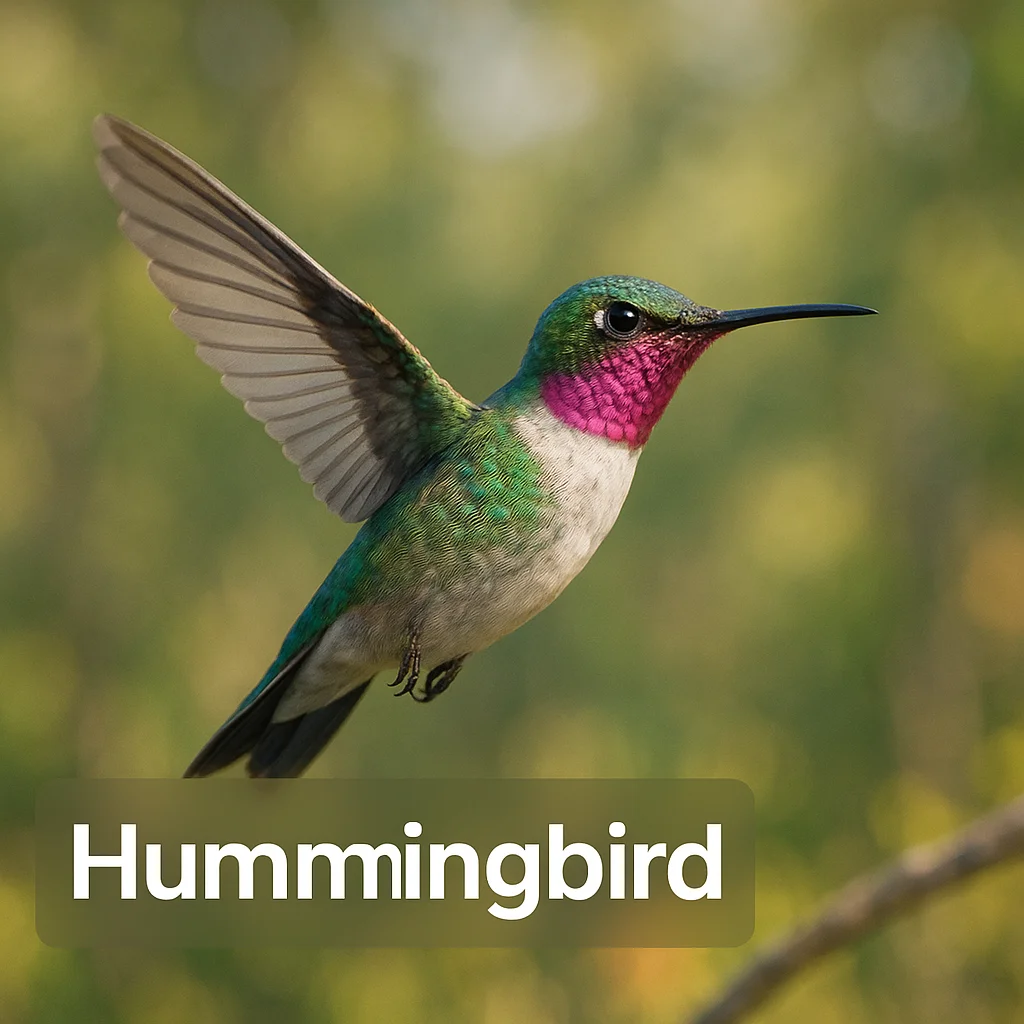
The hummingbird is easily recognized by its small size, rapid wing movement, and iridescent feathers. These birds have slender, tapered bodies with long, needle-like bills adapted for extracting nectar from flowers. Generally, they exhibit bright, metallic hues of green, blue, or red, but this can vary widely.
- Body shape and silhouette: Small, compact with a long bill
- Key colors/patterns: Iridescent greens, blues, and reds
- Distinctive features: Long, narrow bill; incredibly rapid wingbeat; iridescence
- Tracks, scat, or other field signs: Not commonly distinguished in the field
- Common look-alikes: None; unique appearance
- Top ID Tips:
- Smallest flying birds
- Hover with rapid wing beats
- Metallic iridescent plumage
- Long, straight, or slightly curved bill
- Distinctive humming sound from wings
- Adapted for extracting nectar
🧱 Body Structure & Physical Adaptations
The hummingbird’s body is engineered for its unique flying abilities. Its lightweight skeleton supports powerful flight muscles, and its flexible wings allow it to hover with ease. The beak and tongue are specialized for feeding on nectar, featuring grooves adapted for this purpose.
- Build and proportions: Small, streamlined body for agility
- Teeth/beak/jaw adaptations: Long beak for probing flowers
- Claws/hooves/wings/fins: Wings adapted for hovering and reverse flight
- Sensory strengths: Excellent vision, especially in ultraviolet range; limited olfactory senses
- Key Adaptations:
- High wingbeat rate allows hovering
- Unique ball-and-socket joint at shoulder
- Lightweight, porous bones
- Long tongue for nectar feeding
- High metabolism supporting rapid flight
- Excellent color vision
🌍 Range & Distribution
Hummingbirds are exclusive to the Americas, predominantly found in tropical and subtropical regions. They thrive in a variety of environments, from the dense rainforests to high-altitude Andean plateaus.
- North and South America
- Rainforests, mountain regions, desert zones
- Common in the western hemisphere
- Found in the Caribbean islands
- Occasional sightings in extreme northern latitudes during summers
- Where You Might Find It:
- Rainforests
- Garden flowers
- Mountain forest edges
- Skirts of deserts
- High altitude regions
🏞️ Habitat & Shelter
Hummingbirds are highly adaptable and can be found in many habitats, ranging from lush rainforests to sparsely vegetated deserts. They rely heavily on the presence of flowering plants from which they feed. Shelter is often minimal, with many choosing small hollows or the protection offered by thick foliage.
🧭 Behavior & Ecology
Hummingbirds exhibit a variety of behaviors that facilitate feeding efficiency and territoriality. Known for their incredibly rapid wing beats and hovering abilities, they are primarily solitary but can become highly territorial over abundant feeding areas. Their role in pollination is vital, as they feed on flower nectar and inadvertently transfer pollen between blooms.
- Solitary outside of breeding
- Bright plumage for territorial and mating displays
- Territorial over flower-rich areas
- Interspecific competition with bees and bats
- Important pollinators in their habitats
- Behavior Highlights:
- Highly territorial
- Aggressive defense of feeding areas
- Vocalizations include buzzing and chirps
- Complex flight displays
- Assist in plant pollination
👥 Social Life & Group Dynamics
Hummingbirds are predominantly solitary creatures, although they exhibit dynamic interactions during the breeding season and in areas of abundant food. Territories are typically small, and aggression is common when defending feeding sites.
- Territorially solitary
- Pairs form only temporarily for mating
- No social hierarchy beyond mating season
- Occasional loose aggregations in high food areas
- Innate aggression over resources
- Social Structure Notes:
- Generally solitary
- Temporary pair bonds
- Agonistic behaviors observed
- Individuals guard territories
🍽️ Diet, Prey & Predators
The diet of hummingbirds primarily consists of nectar from flowering plants. This diet is supplemented with small insects and spiders to provide essential proteins. Predation threats include larger birds, snakes, and mammals.
- Feed primarily on flower nectar
- Consume small insects and spiders
- Main predators include avian species, snakes, and felines
- Defensive flight patterns and speed are key defenses
- Feeding Notes:
- Specialized for nectar feeding
- Insects provide protein
- Adapted to various flower types
- Renowned for rapid feeding visits
🦌 Hunting, Foraging & Movement
Specialized for rapid movements and efficient foraging. Their speed and ability to hover enable precision feeding from flowers. The hummingbird's acrobatic flight allows it to adopt complex foraging paths.
- Flight speed approximately 30 mph (48 km/h)
- Mainly diurnal foraging
- Hovering precision crucial
- Efficient spatial navigators
- Movement & Strategy:
- Rapid wing beats for hovering
- Swift adjustments in flight
- Lateral and backward movement capability
- Precision navigation to flowers
🧠 Intelligence & Senses
Hummingbirds possess advanced memory, which aids in recognizing flower locations and revisiting profitable ones. They display high spatial reasoning, and their vision is exceptionally tuned to detect bright, colorful blossoms.
- Sharp spatial memory for feeding sites
- Color vision includes ultraviolet range
- Excellent memory for hover-feeding navigation
- Limited tactile senses; primary reliance on vision
- Notable Abilities:
- Understand flower blooming patterns
- Rapid response to visual stimuli
- Adaptive problem-solving for nectar access
🪺 Reproduction, Pregnancy & Parenting
During the breeding season, male hummingbirds perform elaborate aerial displays to court females. Females typically handle all parenting responsibilities, from nest building to incubation and feeding the chicks until they fledge.
- Breeding seasons vary; tend to align with flower blooming
- Females lay 1–3 eggs per clutch
- Nest built by female alone
- Incubation lasts about 14–23 days
- Reproduction Snapshot:
- Males perform aerial displays
- Solitary nesting females
- Rich parental care by females
- Young fledge rapidly post-hatching
♀️♂️ Male vs Female Differences
Males often have more vivid plumes than females, reflective of sexual selection pressure. Males engage in courtship displays, while females are primarily involved in egg and chick care.
- Size differences are minimal
- Males exhibit brighter plumage, used in mating displays
- Females are more camouflaged with duller colors
- Females solely handle nest construction and rearing
- Sex Differences at a Glance:
- Brighter males for courtship
- Females have more substantial parenting roles
- Minimal body size variation
🧬 Subspecies & Variation
The diversity within hummingbird species is wide, with variations in size, coloration, and beak shapes adapting to specific environments and available flora. Some species such as the Anna's hummingbird adapt to colder regions.
- Wide variation in coloration
- Different beak shapes adapted to local flora
- Coloration ranged from vibrant emeralds and blues to more muted tones
- Vocalization differences between subspecies
- Variation Notes:
- Distinct adaptations in bill length
- Desert species capable of enduring arid conditions
- High altitude variations with thermal regulation adaptations
⚠️ Threats, Conservation & Human Interaction
Hummingbirds face several threats, primarily from habitat destruction and climate change. Conservation success relies on habitat protection and nectar-rich gardens in urban areas. Interaction with humans is mostly positive, with backyard feeders providing supplemental food sources.
- Vulnerable to habitat destruction
- Climate change affects migratory patterns
- Some species adapt to urban areas
- Require conservation for preservation of feeding and breeding habitats
- Responsible Notes:
- Protect flowering habitats
- Garden nectar flowers, supplementary feeding
- Avoid habitat encroachment
✨ Fun Facts & Unique Traits
- Only bird capable of sustained hovering
- Can fly backward
- Heart rate exceeds 1,200 beats per minute during flight
- Visit hundreds of flowers daily
- Smallest bird species: Bee Hummingbird
- Some species migrate across the Gulf of Mexico
📌 Summary
- Hummingbirds are small, colorful birds with incredible flight abilities.
- They are specialized nectar feeders and important pollinators.
- Exclusively found in the Americas.
- Range includes various habitats from tropical forests to desert areas.
- Primarily solitary but aggressively territorial around feeding areas.
- Engage in unique courtship displays, predominantly by males.
- Females are responsible for nest building and chick care.
- Human activities such as habitat destruction and climate change pose threats.
- Heart rates are among the highest in the animal kingdom.