🦁 Finch
🧾 Quick Facts
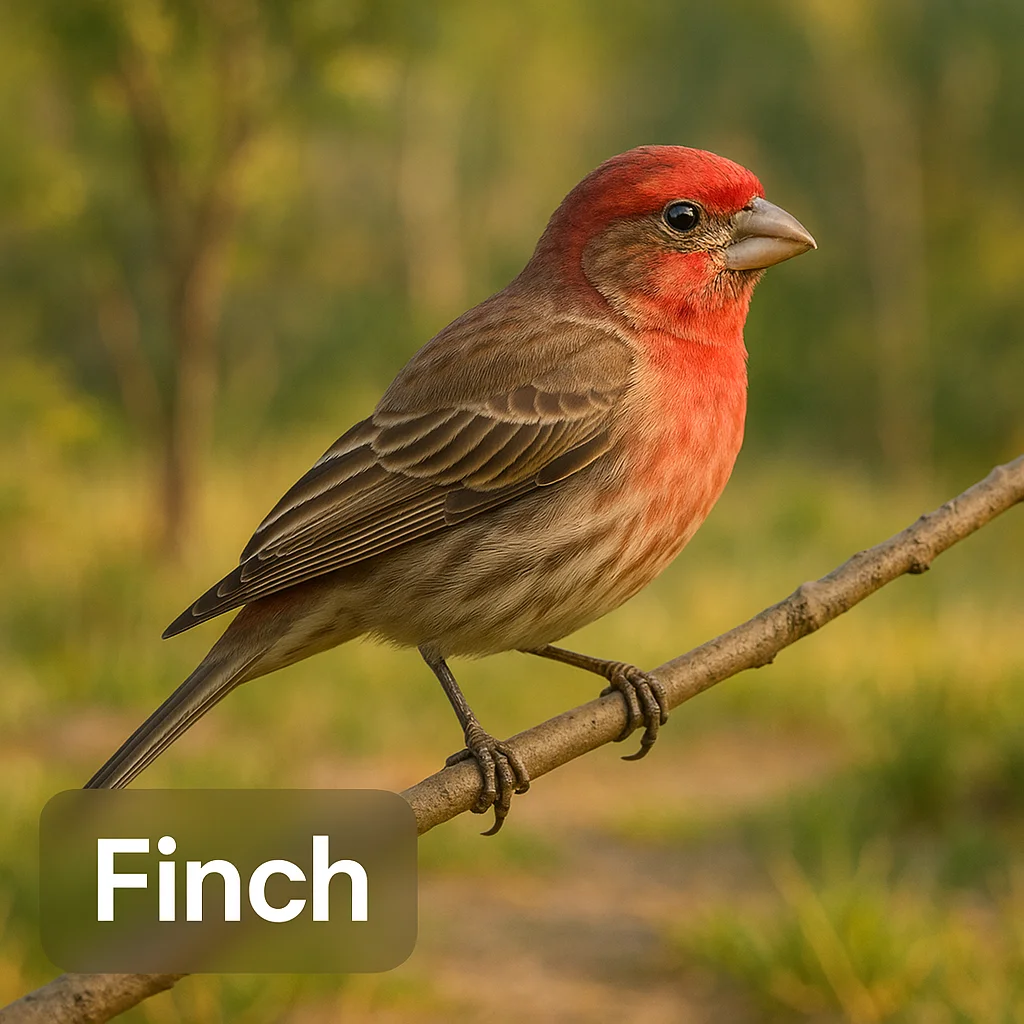
The term "Finch" refers to a diverse group of small to medium-sized passerine birds within the family Fringillidae. These birds are widely recognized for their vibrant plumage and melodious singing. Widely distributed across the globe, finches are often seen in a variety of habitats, from forests to grasslands. While their behavior and physical characteristics vary widely, they share some common traits that make them a fascinating subject for bird enthusiasts.
- Common names: Finch, True finches
- Scientific name: Varies by species (family Fringillidae)
- Animal type: Bird
- Typical adult size: 10 cm to 20 cm in length
- Typical lifespan: 3-10 years in the wild
- Diet type: Primarily granivorous, consuming seeds, with some species eating insects
- Activity pattern: Generally diurnal
- Social structure: Most are social, often found in flocks
- Speed / movement: Swift flyers
- Intelligence/learning: Capable of complex songs and learning from surroundings
- Primary habitats: Forests, grasslands, shrublands, urban areas
- Geographic range: Widespread across North America, Europe, Asia, and Africa
- Predators/threats: Birds of prey, cats, habitat loss
- Conservation status: Varies by species; some species are of concern
🔍 Identification & Appearance
Finches exhibit a range of colors and patterns. They are typically small, with stout bodies and short, conical beaks. Many species display vibrant colors, including reds, yellows, and greens, while others may be more muted. Plumage can vary by age and sex, with males often showing brighter colors. Their songs are distinctive and can be an identifying feature.
- Body shape: Small and round with short necks
- Colors: Often bright; reds, yellows, and greens dominate
- Key features: Short, conical beak suited for seed eating
- Field signs: Known for varied and complex songs
- Look-alikes: Sparrows, but usually distinguished by their beak shape and colors
- Size: Typically smaller than sparrows
- Legs and feet: Adapted for perching
- Tail: Short and cut straight across
- Seasonal changes: Some species may molt and change plumage colors
- Juveniles: Often duller in color compared to adults
🧱 Body Structure & Physical Adaptations
Finches are built for efficient seed handling and feeding. They possess robust beaks that allow them to crack open seeds effortlessly. Their feet are adapted for gripping and perching on branches. They have a well-developed syrinx, which allows them to produce their distinctive songs. With acute vision, they can spot food sources from a distance.
- Build: Compact and round
- Beak: Strong, conical, perfect for seed cracking
- Wings: Designed for agile flight
- Legs: Strong and suited for perching
- Senses: Excellent vision, critical for spotting food
- Sonic capabilities: Capable of intricate vocal patterns
- Feet: Zygodactyl toes for good gripping
- Adaptations: Syrinx for diverse vocalizations
- Muscles: Strong flight muscles for extended flights
🌍 Range & Distribution
Finches are found throughout the world, excluding Australia and Antarctica. They populate a broad range of habitats including forests, grasslands, and even urban areas. Their adaptability allows them to thrive in various climatic conditions from the tropics to temperate zones. While most finch species are year-round residents, some do migrate in response to seasonal changes.
- North America: Variety of species in forests and urban areas
- Europe: Found in wooded areas and gardens
- Asia: Occupy diverse habitats from Siberia to tropical zones
- Africa: Inhabiting savannas and forests
- Non-migratory: Many species remain within a defined range year-round
- Migration: Some finches move to find food in winter
- Islands: Certain species are island-specific
- Altitude: Found from sea level to mountainous regions
🏞️ Habitat & Shelter
Finches thrive in a variety of habitats including woodlands, hedgerows, open fields, and urban gardens. They construct nests in trees and shrubs, creating sheltered environments to raise their young. Seasonal changes can affect their foraging and roosting patterns, with some species moving to more temperate areas or urban settings during colder months. Understanding their habitat preferences is crucial for supporting their population, particularly in areas of rapid development.
🧭 Behavior & Ecology
Finches are known for their gregarious behavior, often seen in flocks not just of their own kind but mixed species gatherings. Their vocalizations range from simple calls to complex songs used in mate attraction and territorial defense. They play an important ecological role as seed dispersers and are a crucial part of their habitat's food web, serving as prey for larger animals and as major consumers of seeds and insects.
- Flocking: Travel and feed in groups
- Singing: Males often sing to attract mates or defend territory
- Social interactions: Complex vocal communications
- Seed dispersal: Contributing to plant propagation
- Prey: Part of the diet for various predators
- Foraging: Energetic with feeding often occurring throughout the day
- Displays: Utilize plumage and song during courtship
- Competitions: Establishing hierarchy within groups
- Regular chirps: Used for contact and alerts
👥 Social Life & Group Dynamics
Finches are generally very social birds, with most species forming flocks outside of the breeding season. They may engage in cooperative behaviors such as group foraging and mutual preening. While some finch species form monogamous pair bonds and exhibit strong territorial defenses, the social structure is often flexible and can change with seasons and environmental conditions.
- Pair bonds: Typically monogamous
- Flock size: Can range from a few to over a hundred individuals
- Group foraging: Increases food acquisition efficiency
- Dominance: Established typically during feeding
- Preening: Mutual preening observed within groups
- Territoriality: Males more territorial during breeding season
- Alert systems: Use alarm calls to warn of predators
- Partnerships: Strong pair bonds in some species
- Seasonal variation: Flock dynamics change with seasons
🍽️ Diet, Prey & Predators
Finches primarily feed on seeds but will also consume small insects and other invertebrates, especially during the breeding season when protein-rich diets are essential for developing chicks. They use their strong beaks to crack hard seeds, which are their main food source. Natural predators include birds of prey and domestic cats. They have developed strategies such as flocking together to reduce predation risks.
- Diet: Predominantly seeds, supplemented with insects
- Seasonal change: More insectivorous during breeding
- Predators: Include hawks and domestic animals
- Feeding strategy: Efficient seed cracking
- Feeding times: Mainly during morning and late afternoon
- Nesting diet: Chicks fed insects for growth
- Defensive behavior: Increase alertness in flocks
- Safety in numbers: Flocking to reduce predation risk
- Scavenging: Occasional opportunistic feeding
- Food caching: Some species store seeds for later use
🦌 Hunting, Foraging & Movement
Finches are agile flyers and foragers, adept at quickly locating and consuming food. They demonstrate precise and coordinated movements when flying, hopping, or climbing. Their foraging tactics are opportunistic, often taking advantage of abundant seed crops. Some species are known for short migration patterns, moving within regions to optimize food availability.
- Locomotion: Primarily hopping and short flights
- Speed: Quick, to evade predators and find food
- Foraging: Opportunistic, often in flocks
- Navigation: Short migrations or local movement
- Seed targeting: Highly efficient seed foragers
- Flight patterns: Undulating flight path
- Adaptations: Strong legs for hopping among branches
- Perching technique: Adapted feet structure
- Feeding pattern: Dawn and dusk peak activity
- Adaptability: Quick to exploit new food sources
🧠 Intelligence & Senses
Finches exhibit intelligence through their complex songs and social interactions. They have the ability to learn and remember songs, critical for social interactions and territoriality. Their vision is particularly acute, aiding in foraging and avoiding predators. While research on their cognitive abilities is limited, the social complexity and adaptability suggest a notable level of intelligence.
- Song learning: Critical for communication and mating
- Vision: Excellent for detecting small food items
- Social intelligence: Complex interactions within flocks
- Adaptation: Quick to learn new feeding techniques
- Memory: Capable of remembering flock members and songs
- Spatial awareness: Keen sense of space for navigation
- Vocal repertoire: Wide variety of sounds
- Problem-solving: Basic abilities for food retrieval
- Observational learning: Learning by watching others
🪺 Reproduction, Pregnancy & Parenting
Reproduction in finches involves intricate courtship displays, often centered around song and plumage coloration. They typically form monogamous pairs, with both males and females participating in nest building and chick rearing. Clutch sizes vary, but many lay between 2–6 eggs per breeding season. The incubation period ranges from 11 to 14 days, and hatchlings are typically altricial, requiring substantial parental care.
- Breeding season: Often linked to food availability
- Monogamous pairs: Common among many species
- Nest building: Both sexes often contribute
- Egg laying: Typically 2–6 eggs
- Incubation: Approximately 11–14 days
- Hatching: Altricial young requiring feeding
- Parental care: Both parents involved
- Nesting sites: Trees, shrubs, and occasionally structures
- Fledging: Occurs after 12–19 days
- Breeding frequency: Often multiple broods per season
♀️♂️ Male vs Female Differences
In many finch species, males and females can be distinguished by coloration, with males often boasting more vibrant plumage. This sexual dimorphism is especially pronounced during the breeding season. Behaviorally, males are typically more vocal and perform more elaborate displays to attract mates and defend territories, while females focus on nesting and rearing young.
- Plumage: Males often more colorful
- Behavior: Males more vocal and territorial
- Role division: Females more involved in nesting
- Size: Generally similar, though varies by species
- Songs: Primarily male responsibility
- Nesting duties: Females more active
- Seasonal changes: Male coloration intensifies in mating season
🧬 Subspecies & Variation
The finch family includes variations and subspecies adapted to different environments. The Galápagos finches, for instance, are a classic example of adaptive radiation, where different island environments have led to significant diversification in beak shapes and sizes. Such local adaptations illustrate the evolutionary pressures exerted by specific environments, resulting in remarkable diversity within the finch family.
- Galápagos finches: Diverse in beak shapes
- Island species: Unique adaptations due to isolation
- Regional variation: Size and coloring can vary
- Arid vs moist ecosystems: Influences dietary nuances
- Subspecies definition: Sometimes debated among scientists
⚠️ Threats, Conservation & Human Interaction
Finches face several challenges, including habitat destruction, climate change, and predation by non-native species like domestic cats. Human-related land changes can both provide new opportunities and pose significant threats, as urban sprawl often removes vital nesting and feeding sites. Conservation efforts focus on habitat preservation and management, ensuring ecological conditions that support healthy populations.
- Habitat loss: Due to agriculture and urban expansion
- Climate impact: Alters food availability and habitat suitability
- Introduced predators: Cats and rats pose significant threats
- Pesticides: Affect food sources and health
- Conservation: Often focus on habitat restoration
- Human habitats: Some species thrive in gardens
- Ethical watching: Importance of observing quietly from a distance
- Conservation status: Ranges from least concern to endangered
✨ Fun Facts & Unique Traits
- Darwin's studies on Galápagos finches significantly contributed to the theory of evolution.
- House finches have been known to acquire color from their diet, with richer diets leading to brighter plumage.
- Some finch species can sing with a complexity rivaling that of human music.
- Finches use their conical beaks to generate powerful forces for cracking seeds.
- Social finch species can recognize flock members individually by their calls.
- Smithsonian researchers use finches to study the evolution of song learning.
- The zebra finch is among the most widely researched birds due to its simple care and prolific breeding in captivity.
- Gouldian finches are noted for their vibrant multi-colored plumage, making them popular in aviculture.
📌 Summary
- Finches belong to the diverse Fringillidae family, displaying vibrant plumage and complex songs.
- Recognizable by their small, stout bodies and rounded, conical beaks.
- They thrive in diverse habitats from forests to urban areas.
- Diet consists largely of seeds, with some additional insects during breeding.
- Face threats from predation and habitat loss, with conservation varying by species.
- Mostly social, forming flocks that adapt their structure with seasons.
- Play a key ecological role as seed dispersers and prey for larger animals.
- Exhibit a variety of reproductive strategies centered around strong pair bonds.
- Prominent beak and sound adaptations aid in their survival and ecological roles.
- Their diversity is highlighted by subspecies and island adaptations.