🦁 European Starling
🧾 Quick Facts
The European Starling, often referred to simply as the "starling," is a small to medium-sized bird found across various regions. Known for its adaptability and social behavior, the species has established itself in multiple habitats. This bird is easily recognizable by its iridescent plumage and dynamic flight patterns.
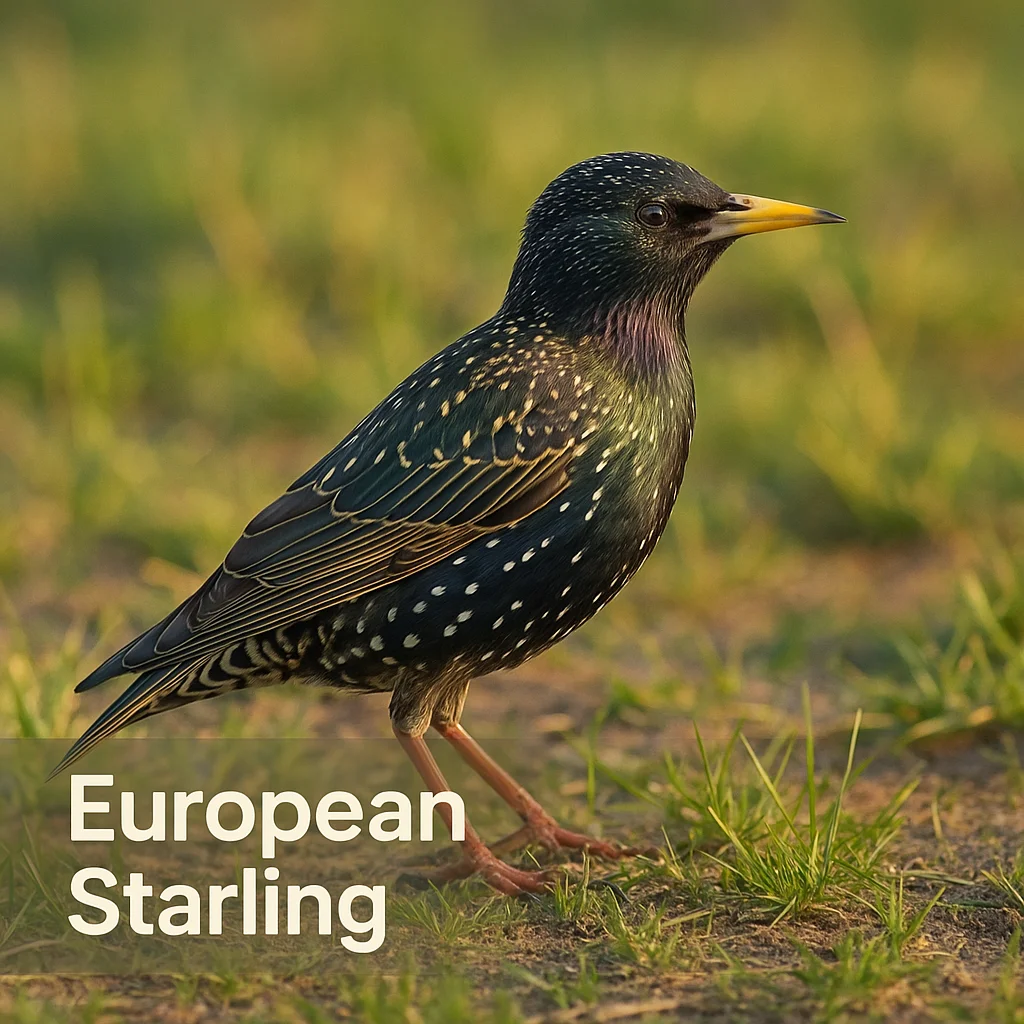
- Common name(s): European Starling, Common Starling
- Scientific name: Sturnus vulgaris
- Animal type: Bird
- Typical adult size: 20-22 cm in length, 75-100 g in weight
- Typical lifespan: 2-4 years in the wild; up to 20 years in captivity
- Diet type: Omnivore; insects, fruits, grains
- Activity pattern: Diurnal
- Social structure: Highly social; forms large flocks
- Speed / movement highlights: Agile flier with swift maneuverability
- Intelligence/learning: Known for mimicking sounds; problem-solving abilities
- Primary habitats: Urban areas, farmlands, woodlands
- Geographic range: Europe, Asia, Africa; introduced to North America, Australia, New Zealand
- Predators/threats: Birds of prey, domestic cats, habitat loss
- Conservation status: Least Concern; population varies by region
🔍 Identification & Appearance
The European Starling is characterized by its robust body, short tail, and strong legs. Its plumage in the breeding season is glossy with iridescent purples and greens, while in winter, its feathers have white spots. It has a sharp, pointed beak and bright yellow in the breeding season, turning darker at other times. Juveniles are a dull brown but quickly take on the adult's metallic sheen.
- Stocky build with a short tail and strong legs
- Iridescent plumage with greens and purples during breeding season
- Winter plumage includes distinctive white spotting
- Yellow bill in breeding adults, darker otherwise
- Juveniles are initially dull brown
- Somewhat triangular wings when in flight
- Vocal mimicry, mimicking other birds and sounds
- Common look-alikes include blackbirds, but starlings are more iridescent
- Form large murmurations, which aid in identification
- Tracks and scat: Small, delicate tracks; rectangular scat near feeding areas
- Top ID Tips
- Glossy, metallic plumage
- Short tail and robust body
- Mimics other bird calls
- Forms murmurations in large flocks
- Pointed yellow beak during breeding
- White-spotted winter plumage
- Triangular wings in flight
- Common in urban and open areas
- Sharp, swift flight patterns
🧱 Body Structure & Physical Adaptations
The European Starling's body is well-suited for its adaptive lifestyle. Its stocky build is complemented by a short tail and triangular wings, providing agility in the air. The beak is pointed, assisting in its varied diet. Compared to many other passerine birds, its strong legs are adapted for walking and running on the ground while foraging.
- Stocky, compact body; aids in aerial agility
- Short tail improves maneuverability
- Beak is sharp and pointed for varied diet
- Strong legs for terrestrial movement
- Wings optimized for swift, agile flight
- Excellent vision for locating food sources
- Feather structure produces iridescent sheen
- Adaptable to a wide range of climates and environments
- Acute hearing aids in communication and mimicry
- Key Adaptations
- Agile flight with strong wings
- Versatile, pointed beak
- Legs suited for ground foraging
- Iridescent plumage for display and camouflage
- Adaptability to urban environments
- Highly social behavior for survival
- Strong visual acuity
- Good auditory mimicry skills
🌍 Range & Distribution
The European Starling is native to Europe, Asia, and North Africa. It has been introduced to several other regions, including North America, Australia, and New Zealand. In these areas, it has become a common presence and an example of a successful invasive species. The bird thrives in a range of habitats, from urban environments to rural landscapes. It occupies elevations from sea level up to higher altitudes, depending on the geographical region.
- Native to Europe, Asia, and North Africa
- Introduced to North America, Australia, New Zealand
- Common in both rural and urban settings
- Populates farmlands and woodlands
- Adaptable to a variety of climate zones
- Can be found from sea level to higher elevations
- Seasonal migrations in some populations
- Thrives in disturbed ecosystems
- Occupies a broad and expanding range
- Where You Might Find It
- Urban parks and gardens
- Agricultural fields and pastures
- Woodlands and deciduous forests
- Coastal areas
- Nesting in buildings and tree hollows
- Fields and grasslands
- Along roadsides and rural areas
- Migratory patterns in some countries
🏞️ Habitat & Shelter
European Starlings are highly adaptable birds, found in a wide range of habitats. They thrive in urban areas, often making use of buildings and artificial structures for nesting. In rural settings, they occupy farmlands, grasslands, and woodlands, using natural cavities like tree holes for shelter. Seasonal changes influence habitat preference, with starlings moving to warmer areas or forming large flocks in winter, known for their mesmerizing aerial displays. Understanding their habitat is crucial for grasping their survival strategies and their role in local ecosystems.
🧭 Behavior & Ecology
European Starlings exhibit a range of behaviors that make them unique. During the day, they are active feeders, competing for food with other bird species. Their vocal communication is diverse, with calls that include a variety of whistles, clicks, and mimicry of other sounds and birds. Social interactions often include fascinating murmurations, where thousands of individuals perform synchronized aerial displays. In ecosystems, they play roles as both seed dispersers and prey. Their adaptability allows them to thrive in a wide range of environments, impacting local flora and fauna.
- Highly social birds, engaging in group activities
- Vocalizations include mimicking other species
- Compete with native species for resources
- Form large flocks for feeding and migration
- Seed dispersers impacting plant diversity
- Serve as prey for larger birds of prey
- Use urban areas for roosting and nesting
- Engage in fascinating murmurations at dusk
- Behavior Highlights
- Murmurations: swirling flock displays
- Mimicking human and other bird sounds
- Daytime feeding and resting patterns
- Inter-species competition
- Integrative role in ecosystems
- Adapts feeding strategies in varied habitats
- Aggressive defenders of nesting sites
👥 Social Life & Group Dynamics
European Starlings are highly social creatures, often found in large, noisy flocks. These groups can range from a few hundred to several thousand individuals, especially during the non-breeding season. They exhibit complex social structures, with flocks organized based on age and experience. Intraspecific cooperation occurs in tasks like predator warning and foraging. While they form tight representations of collective behavior, dominance hierarchies are present, with older and more experienced individuals often taking leading positions. Their social dynamics play a critical role in their survival and foraging success.
- Form large flocks, especially outside breeding season
- Complex group dynamics with scattered leadership
- Engage in collective predator defense
- Shared foraging opportunities
- Cooperative behavior in murmurations
- Known for communal roosting sites
- Age-dependent hierarchies
- Adaptation to human-altered environments
- Social Structure Notes
- Flock sizes can vary seasonally
- Strong group camouflage through murmurations
- Teach younger birds effective foraging
- Significant inter-individual communication
- Vigilance shared among group members
- Territorial behavior during breeding
- Cooperation improves survival rates
🍽️ Diet, Prey & Predators
European Starlings have an omnivorous diet, enabling them to exploit a wide range of food sources. They feed on insects, fruits, and grains, adapting their diet according to seasonal availability. During the warmer months, invertebrates become a critical food source, while seeds and fruits predominate in the colder months. In urban areas, they scavenge readily for human food scraps. Predators of starlings include birds of prey like hawks and falcons. While their flocking behavior offers protection, starlings are also adept at using their surroundings to minimize predation risks. Their role as both predator and prey makes them integral to their ecosystems.
- Omnivorous with seasonal diet shifts
- Eats insects in warmer months
- Seed and fruit consumption in winter
- Opportunistic urban scavenger
- Known to raid human food sources
- Predators include birds of prey
- Utilizes flocking for predator defense
- Influences agricultural pest control
- Feeding Notes
- Highly adaptable diet
- Prefers invertebrates when available
- Adjusts intake according to season
- Exploits human-altered environments
- Forms feeding flocks for efficiency
- Participates in seed dispersal
- Addressed as both pest and biological control
🦌 Hunting, Foraging & Movement
European Starlings are proficient fliers, capable of both long-distance movements and intricate aerial maneuvers. They forage both in trees for insects and on the ground for seeds and fruits. Their large flocks coordinate movements while foraging to increase efficiency and reduce individual predation risks. Speed and agility define their movements, with impressive bursts of flight power enabling rapid escapes from threats. Their migratory behavior is notable in some populations, responding to seasonal changes in food availability and temperature, while others remain predominantly resident.
- Agile flier with rapid aerodynamics
- Forages both arboreally and terrestrially
- Exhibits group foraging strategies
- Mutual help in predator detection
- High-speed flight for predator evasion
- Encompasses migratory and resident individuals
- Aerial displays to harness group movement
- Movement & Strategy
- Swift, agile flight patterns
- Ground and arboreal foraging methods
- Strategies incorporate teamwork
- Seasonal migrations where necessary
- Precision maneuvering during murmurations
- High-speed bursts when evading threats
🧠 Intelligence & Senses
Renowned for their intelligence, European Starlings exhibit impressive problem-solving skills and are known for their ability to mimic a wide array of sounds, including human speech and machinery. Their social learning is significant, with individuals learning from flock mates about food sources and danger signs. They have acute senses, with excellent vision allowing for precision in capturing prey and locating resources. Despite their cognitive capabilities, variations may exist depending on their geographic distribution and environmental challenges.
- Highly capable in problem-solving
- They mimic a range of sounds, verbal and mechanical
- Social learning is pivotal in skill acquisition
- Complex coordinated group behaviors
- Precise vision suitable for detailed tasks
- Relies on vocalizations for intricate communication
- Notable Abilities
- Mimicry of human sounds
- Group learning and problem-solving
- Amazing visual acuity for food capture
- Complex vocal communications
- Social interactions foster skill development
🪺 Reproduction, Pregnancy & Parenting
European Starlings typically have a breeding season during the spring, involving courtship displays where males showcase their plumage and vocal abilities to attract females. They are generally monogamous, with both parents contributing to the construction of nests, which may be within cavities in trees or human structures. The female incubates a clutch of around 4-5 eggs, which hatch after approximately 12 days. Chicks are altricial, necessitating parental feeding and care, involving both male and female participation until fledging.
- Breed in spring; seasonal timing varies
- Monogamous pairs form during breeding season
- Nest in cavities within varied environments
- Egg incubation lasts approximately 12 days
- Typically lay 4-5 eggs per clutch
- Both parents share offspring feeding roles
- Chicks require significant post-hatching care
- Reproduction Snapshot
- Springtime courtship displays
- Monogamous pair bonds
- Nesting in cavities
- Incubation averages 12 days
- Biparental care for chicks
- 4-5 eggs per clutch on average
♀️♂️ Male vs Female Differences
Distinguishing between male and female European Starlings can be challenging due to their similar appearance. However, subtle differences do exist, particularly during the breeding season. Males typically display slightly higher levels of iridescence and more vibrant colors in their plumage, while females have a slightly more muted appearance. Behavioral differences are mainly noted during the breeding season, where males are more involved in song and display for mate attraction.
- Subtle differences in plumage iridescence
- Males often showcase stronger colors
- During breeding, males display heightened vocal activity
- Males play a significant role in courtship
- Females and males share parenting roles
- Differences are most pronounced in breeding season
- Sex Differences at a Glance
- Males can appear more vividly colored
- Males more vocal in breeding displays
- Females contribute equally to parental care
- Minimal size difference between sexes
🧬 Subspecies & Variation
While there are no officially recognized subspecies of the European Starling, regional variations do occur, particularly in plumage coloring and size, influenced by environmental factors like climate and available resources. Differences are subtle and often tied to their diverse geographic range, reflecting their adaptability and ability to thrive in varying conditions. These local adaptations signify a robust species capable of taking advantage of a variety of ecological niches.
- Regional plumage variation; environmental influence
- Subtle size differences based on geography
- Adaptive traits enhance survival in diverse climates
- No distinct subspecies officially recognized
- Geographic adaptation reflects ecological flexibility
- Variation Notes
- Environmental influence on plumage
- Size variance with geographical distribution
- Robust adaptability to diverse conditions
- No currently recognized subspecies
⚠️ Threats, Conservation & Human Interaction
The European Starling's adaptability has ensured its widespread distribution, yet it faces several threats, both natural and anthropogenic. Predation by birds of prey and domesticated animals, along with competition for food, poses natural threats. Human-induced challenges include habitat destruction and pollution, altering its traditional habitats. While considered common, its success as an invasive