🦁 Eurasian Magpie
🧾 Quick Facts
The Eurasian Magpie is a widely recognized member of the crow family, known for its intelligence, striking black-and-white plumage, and vocal nature.
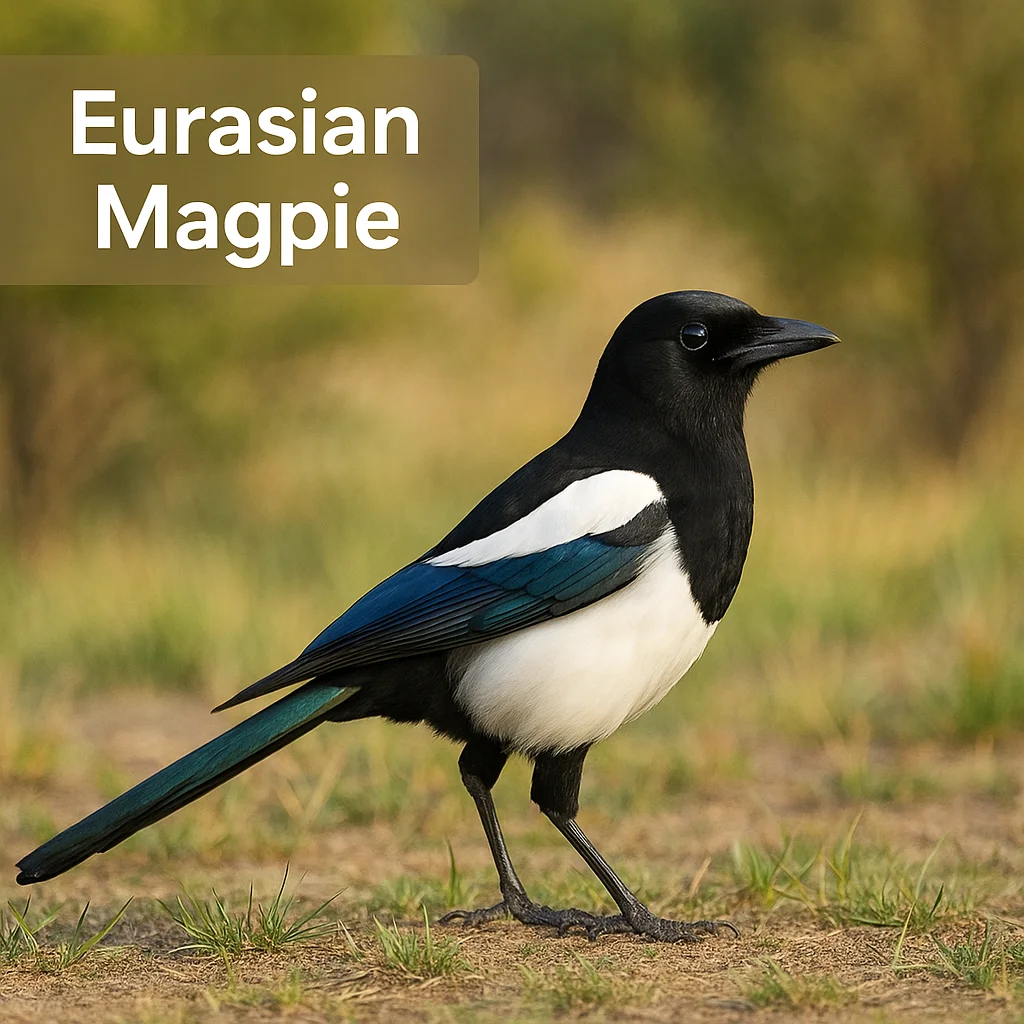
- Common name(s): Eurasian Magpie, Common Magpie
- Scientific name: Pica pica
- Animal type: Bird
- Typical adult size: 37-51 cm in length, wingspan 52-62 cm
- Typical lifespan: 4-8 years in the wild
- Diet type: Omnivore; insects, small mammals, seeds, fruits, carrion
- Activity pattern: Diurnal
- Social structure: Typically found in pairs or small groups
- Speed highlights: Capable fliers with short bursts of swift flight
- Intelligence/learning: High problem-solving abilities and mimicry
- Primary habitats: Woodlands, agricultural areas, urban environments
- Geographic range: Europe, North Africa, parts of Asia
- Predators/threats: Birds of prey, habitat loss
- Conservation status: Least Concern, though varies by region
🔍 Identification & Appearance
The Eurasian Magpie is distinguished by its sleek body with a long tail that often fans out during flight. Its plumage is primarily black and white, with the wings and tail showing iridescent blue and green in sunlight.
- Body shape resembles a robust, medium-sized bird with a comparatively long tail
- Bold black-and-white coloring; the chest and belly are white, contrasting the black head and back
- Irisescent feathers can show blue or green hues
- Sharp, conical black beak suited for a varied diet
- Tracks usually consist of three forward-pointing toes and one backward-pointing toe
- Common look-alikes include the Black-billed Magpie, but it lacks the Eurasian's iridescence
- Look for long tail and rounded wing tips
- Observe the glossy blue-green sheen in sunlight
- Identify the distinctive chattering call
- Note the black hood that extends to the chest
- Spot them in both rural and urban settings
- Look for social behavior in small groups
- Stocky build with strong legs for hopping on the ground
- Beak is strong and suited for probing, catching small animals, and pecking
- Flexible wings for agile flight in both dense and open areas
- Acute eyesight allows for spotting food and predators
- Strong, multifunctional beak
- Long, fan-shaped tail for precise flying
- Feathers are iridescent, providing camouflage
- Rounded wings help in aerobatic flight
- Intelligent problem-solving capabilities
- High learning ability through observation
- Europe including Scandinavia, western Russia
- Across North Africa
- Some regions of the Middle East and across Asia
- Adapt to a range of altitudes up to the treeline
- Adapt well to urban environments
- Domestic gardens and city parks
- Edges of woodlands and forests
- Farmland and open countryside
- Suburban areas
- Riverine locations and meadows
- Engage in vocal communication with a variety of calls
- Use body language for communication
- Aggressive when protecting nests from intruders
- Collaborate for resource sharing like food
- Playful behavior, including chasing and investigating objects
- Ecological role includes scavenging and seed dispersal
- Vocalization with diverse repertoire
- Frequently seen in small groups
- Displays mobbing behavior
- Curious and investigative toward shiny objects
- Territorial during breeding season
- Form pairs for breeding with strong group bond
- Defend established territories, especially during breeding
- Allopreening helps maintain social bonds
- Communal roosting during non-breeding period for warmth and protection
- Engage in family units
- Pairs defend territories
- Occasional loose winter flocks
- Cohesion in groups for mutual defense
- Roles are divided between sexes
- Scavenge carrion when available
- Eats eggs and chicks if encountered
- Forages for seeds and fruits in gardens
- Adept at hunting small rodents and insects
- Diverse seasonal diet
- Takes advantage of human food wastes
- Occasionally preys on nestlings
- Forages in various layers of environment
- Opportunistic feeder adapts to urban landscapes
- Flight characterized by strong, steady wingbeats
- Erratic hopping on the ground to find food
- Excellent endurance in flight across short distances
- Employs patience and curiosity in foraging routines
- Skilled in both land and air maneuvering
- Clever at adapting route during ground foraging
- Observant to changes in habitat conditions
- Effective at avoiding predators through escape routes
- Engages in using tools for food retrieval
- Exhibit sophisticated memory for locations and tasks
- Capable of recognizing individual humans
- Reliable observational learning and mimicry
- Problem-solving acumen
- Social complexity and adaptability
- Excellent communication
- Strong pattern recognition skills
- Clutch size ranges from 5 to 8 eggs
- Incubation by the female lasts around 20-22 days
- Males provide food during incubation
- Young fledge after about 3-4 weeks
- Parents maintain a united front in defending chicks
- Monogamous pairs typically form
- Shared nesting responsibilities
- Long protective care period
- Multiple clutch trials in poor seasons
- Males may have slightly longer tails
- Females often take the leading role in incubation
- Subtle plumage differences only noticeable up-close
- Size difference subtle and varies between pairs
- Shared responsibilities in brood raising
- Male provisioning during incubation
- No distinct coloration differences in general
- Subspecies include Pica pica galliae, Pica pica mauritanica, and others
- Northern subspecies often show darker feathers
- Adaptations like thicker plumage in colder areas
- Geographical variants across Europe and Asia
- Slight adaptability in temperate environments
- Isolated populations show subtle divergences
- Habitat loss through urbanization
- Predation by larger birds of prey
- Perceived as pests in some agricultural settings
- Resilient to minor environmental changes
- Discourage feeding to avoid dependency
- Sensitive to polluted environments
- Adaptative nature aids survival
- Eurasian Magpies can recognize themselves in mirrors, a trait shared with few other animals.
- They have an extensive "vocabulary," using varying sounds to communicate.
- Magpies in urban areas have been known to use traffic signals as signals for food availability.
- Their nests can span over a meter in diameter and are lined with mud for insulation.
- Reputation for collecting shiny objects is somewhat exaggerated, but they do exhibit curiosity.
- They have been a part of European folklore, often depicted as talkative bringers of omens.
- The Eurasian Magpie is a distinctive black-and-white bird with a long tail and iridescent feathers.
- It adapts to a variety of habitats including forests, grasslands, and urban areas.
- Widely distributed across Europe, North Africa, and parts of Asia.
- An omnivore, it consumes insects, mammals, seeds, fruits, and carrion.
- Natural predators include birds of prey; its vigilance and protective behavior provide defense.
- Exhibits both solitary and social behaviors; pairs or small groups.
- Breeding involves shared responsibilities between monogamous pairs.
- Possesses keen intelligence, recognized for problem-solving and tool use.
- Majority of threats involve habitat loss and persecution in certain areas.
- Known for its adaptability and sophisticated social structure.
- Top ID Tips
🧱 Body Structure & Physical Adaptations
The Eurasian Magpie boasts a stout body with a wedge-shaped tail that aids in balance and maneuverability. Its wings are rounded, providing versatility in flight over varied terrain and obstacles.
- Key Adaptations
🌍 Range & Distribution
The Eurasian Magpie is predominantly found across a wide range of the Northern Hemisphere, residing in a variety of temperate habitats. They are generally non-migratory, staying in their regions year-round.
- Where You Might Find It
🏞️ Habitat & Shelter
The Eurasian Magpie is a highly adaptable species, utilizing a wide variety of habitats. Their nests are often built in tall trees or shrubs, composed of twigs and mud for stability and insulation.
They favor habitats that provide ample feeding opportunities and safe nesting areas, regardless of human presence or environmental changes.
🧭 Behavior & Ecology
Magpies are known for their complex social structure and large repertoire of calls. They are alert and cautious, which allows them to thrive in a variety of environments, including those with human activity.
- Behavior Highlights
👥 Social Life & Group Dynamics
The Eurasian Magpie exhibits both solitary and social behaviors. They often pair for life and establish territories that they defend from other magpies and predatory birds.
Outside breeding season, they may form loose flocks to forage or roost together, showing cooperation for communal defense.
- Social Structure Notes
🍽️ Diet, Prey & Predators
An omnivorous feeder, the Eurasian Magpie will consume a wide range of foods — from insects and small animals to seeds, fruits, and carrion. Their diet varies seasonally based on availability and environmental conditions.
They have natural predators such as hawks and owls but can be resourceful in avoiding threats through vigilant behavior and alarm calls.
- Feeding Notes
🦌 Hunting, Foraging & Movement
The Eurasian Magpie employs versatile foraging behavior, often seen meticulously inspecting their surroundings for potential food sources. They are adept at both aerial and terrestrial navigation, capable of nimble flight and agile movement on the ground.
- Movement & Strategy
🧠 Intelligence & Senses
One of the most intelligent bird species, the Eurasian Magpie exhibits remarkable cognitive ability, exemplified by problem-solving, tool use, and social intelligence. They use a diverse range of vocalizations and keen senses to interact with their environment.
- Notable Abilities
🪺 Reproduction, Pregnancy & Parenting
Breeding typically occurs in spring, with nests built collaboratively by both sexes. The pair defends the nest vigorously, and parents share feeding duties post-hatching.
Chicks emerge altricial, developing rapidly under the care of both parents, who ensure warmth, protection, and food provision during early life stages.
- Reproduction Snapshot
♀️♂️ Male vs Female Differences
Sexual dimorphism in Eurasian Magpies is generally subtle, with minor size differences; males may be slightly larger. Behavioral roles are primarily shared, especially in nest defense, but during egg incubation, females are more involved.
- Sex Differences at a Glance
🧬 Subspecies & Variation
The Eurasian Magpie has several recognized subspecies across its range, varying slightly in size and plumage brightness. Geographic differences can influence lifestyle and adaptations within local environments.
- Variation Notes
⚠️ Threats, Conservation & Human Interaction
While currently not endangered, magpies face threats from habitat destruction and predators. Ongoing monitoring is important for conservation. In urban regions, coexistence measures help prevent conflict.
- Responsible Notes