🦁 Common Myna
🧾 Quick Facts
The Common Myna, known for its distinct appearance and vibrant vocalizations, is a familiar bird to many in both urban and rural landscapes. While it is often appreciated for its adaptability, it is also challenged by its invasive status in certain regions.
- Common name(s): Common Myna, Indian Myna
- Scientific name: Acridotheres tristis
- Animal type: Bird
- Typical adult size: 23-26 cm in length, 82-143 g in weight
- Typical lifespan: 4-12 years in the wild
- Diet type: Omnivore; fruits, insects, small invertebrates
- Activity pattern: Diurnal
- Social structure: Pairs or small groups
- Speed / movement highlights: Capable flyer
- Intelligence/learning: Highly intelligent; capable of mimicry
- Primary habitats: Urban areas, gardens, open woodlands
- Geographic range: Native to South Asia; introduced to many parts of the world
- Predators/threats: Birds of prey, habitat competition
- Conservation status: Least Concern, but invasive in some regions
🔍 Identification & Appearance
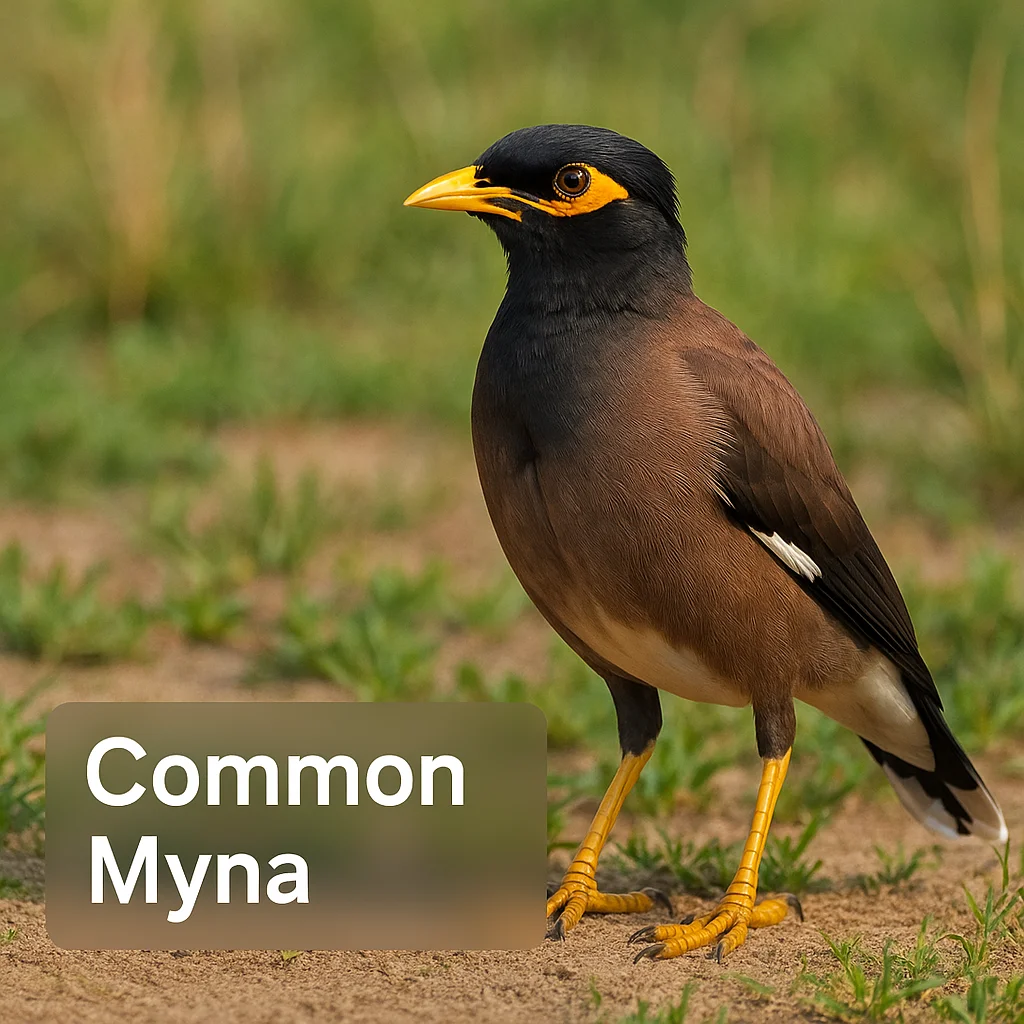
The Common Myna is recognizable by its medium-sized body and sturdy build. Its predominant brown body contrasts with a black head and distinctive yellow eye patch. The bird's legs and beak are also yellow, making it easy to spot.
The Common Myna is agile, often seen hopping or walking confidently on the ground. Its bright white wing patches become visible during flight, further aiding identification.
- Top ID Tips:
- Medium-sized with a stocky build
- Brown body with black head
- Yellow eye patch
- Yellow beak and legs
- White wing patches visible in flight
- Loud and varied vocalizations
- Commonly found in urban settings
- Similar to the Jungle Myna but lacks white eye patches
🧱 Body Structure & Physical Adaptations
The Common Myna possesses a robust and compact physique, allowing it to adapt well to various environments. Its beak is slightly curved, ideal for a varied omnivorous diet.
The bird's claws are well-designed for perching and navigating both trees and human-made structures. Additionally, the myna's excellent vision and hearing facilitate effective foraging and communication.
- Key Adaptations:
- Strong and versatile beak for diverse diet
- Adaptable claws for both perching and ground movement
- Efficient flyer with good maneuverability
- Keen eyesight aids in spotting predators and food
- Acute hearing supports complex communication
- Compact build for urban and natural habitats
🌍 Range & Distribution
The Common Myna is widespread across South Asia, thriving in various environments due to its supreme adaptability. It has expanded its range beyond its native habitat, becoming established in Australia, the Middle East, and island nations such as Mauritius and Fiji.
While typically sedentary, some populations may display minor seasonal movements, especially to take advantage of food resources.
- Where You Might Find It:
- South Asia: India, Pakistan, Bangladesh
- Islands: Mauritius, Fiji
- Australia and the Middle East
- Urban areas and surrounding environments
- Open woodlands, farmlands, and gardens
🏞️ Habitat & Shelter
The Common Myna is highly adaptable, thriving in both natural and anthropogenic habitats. It often favors urban environments, where it nests in roofs, walls, and other structures. In natural settings, it occupies open woodlands and farmlands.
This adaptability allows the myna to exploit various resources, from fruits and insects in gardens to food scraps in urban settings. Understanding its habitat preferences is crucial for managing its invasive potential and ensuring coexistence.
🧭 Behavior & Ecology
The Common Myna is active throughout the day, engaging in foraging, social interaction, and vocal communication. Its mimicry ability is notable, as it adapts diverse sounds from its surroundings. This bird often forms monogamous pairs that cooperate in nest defense and resource acquisition.
Ecologically, the myna plays roles as both a predator and seed disperser. However, its invasive status in some regions has led to competition with native species, impacting local ecosystems.
- Behavior Highlights:
- Adapts vocalizations to mimic sounds
- Forages primarily on the ground
- Forms strong pair bonds
- Nest defender against intruders
- Competes with native species in some areas
- Utilizes urban environments effectively
👥 Social Life & Group Dynamics
The Common Myna typically forms small, close-knit groups or pairs, with monogamous relationships being common. Its social structure enhances cooperation during breeding and foraging.
While generally peaceful within its groups, competition can arise, especially where resources are scarce. Mynas may engage in vocal duels to establish dominance or defend territory.
- Social Structure Notes:
- Forms pairs or small family groups
- Strong pair bonds
- Defends territory from other birds
- Often cooperative within groups
- Engages in vocal battles for dominance
🍽️ Diet, Prey & Predators
The Common Myna is an omnivore, consuming a diverse array of foods like insects, fruits, and small animals. It adapts its diet based on availability, making it highly versatile.
Predators include birds of prey, while human expansion poses indirect risks through habitat alteration. Mynas rely on keen senses and social vigilance to avoid predators.
- Feeding Notes:
- Diverse diet includes insects, fruits, small vertebrates
- Adaptable to urban food sources
- Insect foraging complements plant diet
- Keen senses for predator detection
🦌 Hunting, Foraging & Movement
The Common Myna exhibits efficient movement both on land and in the air, making it a skilled forager. Its sturdy legs enable effective ground movement and hopping, while its wings allow rapid flight when necessary.
Foraging occurs primarily during the day, with birds exploiting a variety of food sources in open spaces and human settlements. While they do not migrate long distances, seasonal resource tracking may influence local movements.
- Movement & Strategy:
- Adaptable flier and ground forager
- Efficient day-long activity
- Exploits diverse urban and rural food sources
- Able to adapt foraging strategies
🧠 Intelligence & Senses
Common Mynas are known for their intelligence, particularly their ability to mimic sounds and adapt to urban environments. Their problem-solving capabilities are aided by sharp vision and hearing, providing them with adaptive advantages.
In groups, these birds exhibit social learning, with younger birds observing and mirroring adult behaviors. However, research into individual intelligence is limited and varies by population.
- Notable Abilities:
- Sound mimicry from environment
- Sharp vision aids hunting and foraging
- Social learning within groups
- Adapts to urban challenges effectively
- Shows behavioral flexibility
🪺 Reproduction, Pregnancy & Parenting
Breeding typically occurs during warmer months, with mynas constructing nests in cavities or building structures. The species is primarily monogamous, with both parents involved in rearing their young.
Eggs are incubated for approximately two weeks, with chicks being fed by both parents until they fledge after another few weeks. This cooperative parenting maximizes offspring survival during vulnerable stages.
- Reproduction Snapshot:
- Breeds in warmer months
- Constructs nests in cavities
- Monogamous pair bonds
- Both parents care for young
- Incubation period of about two weeks
- Chicks fledge in a few weeks
♀️♂️ Male vs Female Differences
Male and female Common Mynas appear nearly identical, with only minor size differences. This similarity extends to their roles in territory defense, parenting, and foraging.
Overall, the subtle differences in size do not affect their social roles. In some cases, observers may find it challenging to distinguish between sexes without close examination.
- Sex Differences at a Glance:
- Overall similar appearance
- Minor size differences
- Engage in similar behavioral roles
- No significant coloration differences
🧬 Subspecies & Variation
Several subspecies of the Common Myna are recognized, though there is some debate around these classifications. Variations are typically seen in size or slight color differences, often influenced by geographic distribution.
- Variation Notes:
- Subspecies mostly similar but vary in size or color
- Debate exists over specific classifications
- Environmental influence on traits
⚠️ Threats, Conservation & Human Interaction
Though listed as Least Concern, the Common Myna faces challenges from habitat loss and competition from other species. Its invasive nature leads to pressure on native fauna.
Humans can foster coexistence by managing urban spaces and controlling the myna's spread, emphasizing ecological balance. Keeping mynas as pets is not advisable due to their complex needs and potential ecological impact.
- Responsible Notes:
- Manage urban environments to reduce spread
- Encourage ecological balance
- Be cautious of invasive impacts
✨ Fun Facts & Unique Traits
- Highly adaptive and thrives in urban environments.
- Known for its ability to mimic human-made sounds.
- Exhibits monogamous pair bonding with cooperative parenting.
- Acts as a seed disperser within native habitats.
- Some populations show impressive vocal learning abilities.
- Occasionally assists in controlling pest populations through insect consumption.
📌 Summary
- Identification: Medium-sized bird with brown body and black head.
- Habitat: Urban areas, gardens, and open woodlands.
- Distribution: Native to South Asia but introduced elsewhere.
- Diet: Omnivore, adaptable; consumes insects and fruits.
- Predators: Birds of prey; human environmental impact.
- Social Life: Forms pairs or small groups, strong bonds.
- Reproduction: Monogamous; cooperative care of chicks.
- Key Adaptations: Sound mimicry and ecological flexibility.
- Distinctive Trait: Notable for adapting to urban environments.