🦁 Barn Swallow
🧾 Quick Facts
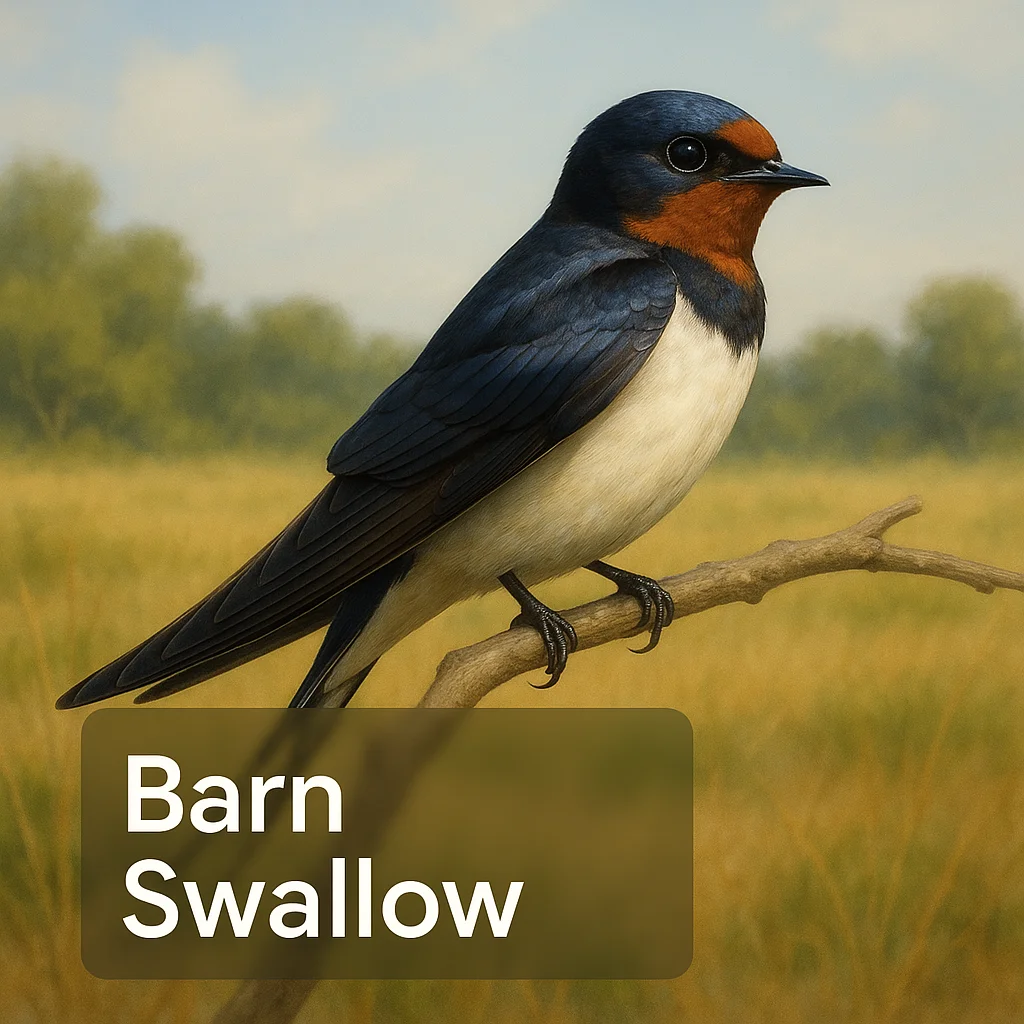
The barn swallow, a well-known avian acrobat, is famous for its striking flight and wide-ranging distribution across the globe. Recognizable by its glossy blue upperparts and distinctive forked tail, this bird is often seen darting through the skies in pursuit of insects.
- Common name(s): Barn Swallow, Common Swallow
- Scientific name: Hirundo rustica
- Animal type: Bird
- Typical adult size: 15–20 cm in length, 15–18 grams in weight
- Typical lifespan: Up to 8 years in the wild
- Diet type: Insectivore; feeds on flying insects
- Activity pattern: Diurnal
- Social structure: Colonial; often found in groups
- Speed / movement highlights: Known for agile and speedy flight
- Intelligence/learning: Known for excellent navigation skills
- Primary habitats: Open fields, wetlands, agricultural areas
- Geographic range: Found across North America, Europe, Asia, and Africa
- Predators/threats: Birds of prey, cats, climate change
- Conservation status: Least Concern
🔍 Identification & Appearance
The Barn Swallow is easily identifiable by its sleek, streamlined body and long, deeply forked tail. Its blue-black upperparts contrast with a pale underside, while a rust-colored throat and forehead add a touch of warmth to its appearance.
- Top ID Tips:
- Small size with streamlined body
- Long, distinctively forked tail
- Glossy blue-black upperparts
- Reddish-brown forehead and throat
- Pale buff to white underparts
- Fast and acrobatic flight pattern
- Tends to perch on wires and fences
- Common look-alikes: Cliff swallow, can be differentiated by tail
- Identifiable by sweet, warbling song
🧱 Body Structure & Physical Adaptations
The Barn Swallow's body is built for agility and speed in the air. Its streamlined shape reduces air resistance, while long wings provide lift and maneuverability. The bird's tail helps with steering and braking mid-flight. Its small, slight build is perfect for its insectivorous diet.
- Key Adaptations:
- Streamlined body for efficient flight
- Long, pointed wings for agility
- Forked tail aids steering
- Sharp beak for catching insects
- Variety of vocalizations for communication
- Acute vision for detecting prey
- Feet adapted for perching
🌍 Range & Distribution
The Barn Swallow is a cosmopolitan species that breeds across the Northern Hemisphere and migrates to the Southern Hemisphere during winter. They are notably adaptable to a range of environments, which allows them to occupy a wide geographical spread.
- Where You Might Find It:
- North America, summer breeding grounds
- Europe, throughout open countryside and towns
- Asia, commonly seen in various landscapes
- Africa, as winter migrants
- Open fields, near water sources
- Nesting in barns, sheds, under bridges
- Lowland farms and rural areas
- Migratory paths across continents
🏞️ Habitat & Shelter
Barn Swallows prefer open environments where they have ample space to hunt for insects. They commonly inhabit fields, meadows, and wetlands. These birds are also noted for their adaptability to human presence, often nesting in barns and sheds, utilizing man-made structures for shelter.
Knowledge of their habitat is crucial as it impacts their survival, particularly in nesting habits and foraging success.
🧭 Behavior & Ecology
Barn Swallows are diurnal and spend much of their day on the wing, engaging in aerial acrobatics to catch insects. Their social nature is evident in their colonial nesting habits and communal roosting. These birds communicate through a series of warbling chirps and calls, serving both mating and territorial purposes.
- Behavior Highlights:
- Advanced aerial maneuvering
- Complex vocal communication
- Nesting in colonies
- Communal roosting by night
- Migratory behaviors
- Prey capture in flight
- Strong pair bonds during breeding
👥 Social Life & Group Dynamics
Barn Swallows are social creatures, often seen in colonies where they build nests side by side. While they exhibit strong pair bonds during the breeding season, these birds typically roost in large groups during migration. Cooperation can be observed in their communal nesting arrangements and alert calls to warn others of predators.
- Social Structure Notes:
- Solitary during foraging, social in nesting
- Colonial nesting sites
- Paired bonding in breeding season
- Group roosting outside breeding season
- Shared alarm call system
- Occasional flocking during migrations
🍽️ Diet, Prey & Predators
Barn Swallows primarily feed on a wide variety of flying insects, including flies, beetles, and moths. Their hunting strategy involves capturing prey on the wing, utilizing their exceptional flying abilities. Common predators include birds of prey and domestic cats, while they employ evasive flight maneuvers to escape threats.
- Feeding Notes:
- Insectivore diet
- Prey includes flies, beetles, and mosquitoes
- Catch insects mid-flight
- Fast and agile hunting style
- Show preference for open feeding grounds
- Pretends to be injured to distract predators away from nests
🦌 Hunting, Foraging & Movement
Barn Swallows are expert fliers, showcasing remarkable agility and speed. They hunt by flying low over open ground or water, capturing insects with their wide-open bills. Migration is a notable aspect of their movement, covering vast distances between breeding and wintering sites.
- Movement & Strategy:
- Proficient aerial hunters
- Migrate thousands of kilometers
- Diagonal or circular flight paths when feeding
- Territorial during breeding season
- Roosting in large flocks during migration
- Utilize landmarks and celestial cues for navigation
🧠 Intelligence & Senses
With their remarkable navigational skills, Barn Swallows demonstrate a high level of intelligence in finding their way over long migration routes. Their keen eyesight is essential for detecting prey and avoiding predators, making these senses critical in their daily survival.
- Notable Abilities:
- Strong navigational skills
- Capable of long-distance migration
- Acute eyesight for detecting insects
- Adaptive behavior in varied environments
- Keen instincts for predator avoidance
🪺 Reproduction, Pregnancy & Parenting
During the breeding season, barn swallows form monogamous pairs. Courtship often involves aerial displays. After mating, females lay a clutch of 3-7 eggs, incubating them for about 14-16 days. Both parents share in feeding the chicks, which fledge about 18-23 days post-hatching.
- Reproduction Snapshot:
- Monogamous with seasonal pair bonds
- Egg incubation: 14-16 days
- Clutch size: 3-7 eggs
- Shared parenting responsibilities
- Fledging period: 18-23 days
- Multiple broods possible in a season
♀️♂️ Male vs Female Differences
Both male and female Barn Swallows exhibit similar coloration but can be distinguished by certain features. Males often display slightly longer and more deeply forked tails. These tails may serve as an indicator in mate selection, where longer tails are often preferred by females.
- Sex Differences at a Glance:
- Both sexes have similar coloration
- Typical male has a longer tail
- Tail length may influence mate choice
- Behavioral differences are subtle
🧬 Subspecies & Variation
The Barn Swallow is found in several subspecies, primarily differentiated by slight variations in size and plumage, which are adaptations to their diverse range of habitats.
- Variation Notes:
- Differences largely in size and tail length
- Coloration varies slightly between populations
- Northern populations may be more robust
- Subspecies have worldwide distribution
⚠️ Threats, Conservation & Human Interaction
While the Barn Swallow is currently listed as least concern, it faces several threats, including habitat loss due to agricultural practices and climate change. Conservation efforts focus on maintaining viable habitats and minimizing human disturbances.
- Responsible Notes:
- Adaptabile to human environments but vulnerable to habitat loss
- Conservation efforts focus on sustainable agriculture
- Avoid disturbing nesting sites
- Support initiatives for wetland preservation
✨ Fun Facts & Unique Traits
- The Barn Swallow's scientific name, "Hirundo rustica," reflects its rustic presence across rural landscapes.
- These birds have one of the widest ranges of any swallow species worldwide.
- A Barn Swallow can consume up to 60 insects per hour.
- Despite their low weight, these birds are capable of flying up to 11,000 kilometers during migration.
- Barn Swallows are among the few bird species to nest inside human structures consistently.
- Known for their distinctive chattering song, Barn Swallows communicate a complex range of messages.
📌 Summary
- Small bird with a streamlined, acrobatic shape and a long, forked tail
- Found across a wide geographic range, inhabiting open fields and wetlands
- Primarily insectivorous, feeding on flying insects
- Predators include birds of prey and domestic cats
- Social and often found in colonies, forming strong pair bonds during breeding
- Navigates proficiently, covering vast distances during migration
- Construsting shared nesting sites, often in human-made structures
- Known for its agile flight and complex vocal communications