🦁 Bananaquit
🧾 Quick Facts
The Bananaquit is a small, energetic bird often seen flitting about in search of its favorite sugary treats. With its vibrant plumage and distinctive foraging style, it is a captivating subject for birdwatchers and wildlife enthusiasts. Below is an overview of the key facts about this fascinating species:
- Common name(s): Bananaquit
- Scientific name: Coereba flaveola
- Animal type: Bird
- Typical adult size: Approximately 4 to 5 inches in length
- Typical lifespan: Around 5 years in the wild
- Diet type: Omnivore; primarily feeds on nectar, fruits, and occasionally insects
- Activity pattern: Diurnal
- Social structure: Typically solitary but may be seen in pairs or small family groups
- Speed / movement highlights: Quick and agile flier
- Intelligence/learning: Known for its adaptability and ability to learn to access new food sources
- Primary habitats: Tropical and subtropical forests, gardens, and plantations
- Geographic range: Caribbean, Central and South America
- Predators/threats: Birds of prey, snakes, and human-related habitat destruction
- Conservation status: Least Concern, though varies by region
🔍 Identification & Appearance
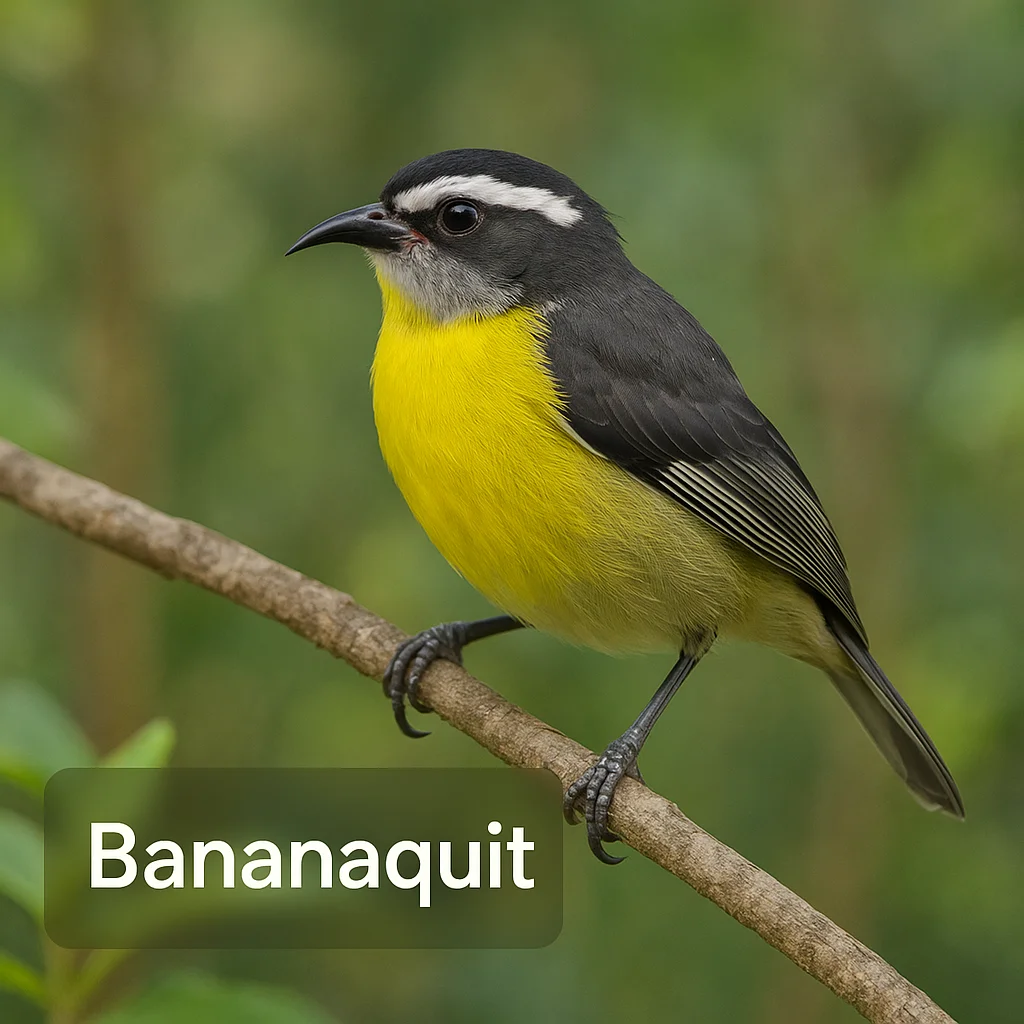
The Bananaquit is a small and lively bird that can be easily recognized by its vibrant colors and unique behaviors. A full-body view reveals its compact, rounded silhouette with a slightly curved beak adapted for nectar feeding. Its plumage typically features a striking mix of colors: a greyish crown and nape, bright yellow underparts, and a contrasting black throat and back.
This bird also has distinctive white wing bars and a white edge on its tail, which help distinguish it from other small songbirds in its habitat. Bananaquits do not show significant color variations between seasons or age groups, maintaining their vibrant appearance year-round.
- Top ID Tips:
- Small size and rounded body
- Curved beak for nectar feeding
- Bright yellow underparts
- Black back and throat
- Distinctive white wing bars
- White edge on the tail
- No significant seasonal color change
- Commonly seen in gardens and on flowering plants
- Active flight behavior, often seen hovering
🧱 Body Structure & Physical Adaptations
The Bananaquit has a small, stocky build that facilitates its active lifestyle. Its limbs are proportionate for perching on branches and flowers, which is essential for its feeding habits. The Bananaquit's beak is narrow and slightly curved, specialized for extracting nectar while also allowing it to feed on small insects and fruits.
Its claws are well-suited for gripping narrow branches and foliage, providing stability while feeding. In terms of sensory adaptations, the Bananaquit has acute vision to locate flowers and ripe fruits. Although not heavily reliant on sound, it does use vocalizations for communication, especially in crowded habitats.
- Key Adaptations:
- Adapted beak for nectar feeding
- Stocky build for agility
- Claws adept for gripping
- Acute eyesight
- Bright coloration for communication
- Ability to hover like a hummingbird
- Efficient energy use for active lifestyle
🌍 Range & Distribution
The Bananaquit is primarily found in the warm climates of the Caribbean, as well as Central and South America. The species thrives in tropical and subtropical regions, frequenting a variety of ecosystems from rainforests to human-modified landscapes like gardens and plantations. The Bananaquit doesn't engage in long migrations but may exhibit local seasonal movements in search of food.
- Where You Might Find It:
- Throughout the Caribbean islands
- Coastal regions of Central America
- Northern parts of South America
- Tropical rainforests
- Subtropical plantations
- Urban gardens
- Woodland edges
- Scrublands
🏞️ Habitat & Shelter
The Bananaquit is versatile in its habitat preferences, able to reside in a wide range of environments including forested areas, scrublands, and even urban areas where flowering plants are abundant. It takes shelter in thick foliage, which provides protection from predators and harsh weather.
During the breeding season, Bananaquits are particularly reliant on dense vegetation for nesting, often building their spherical nests in secure places like tree hollows or dense shrubbery. Knowledge of these habitat preferences is crucial for understanding its survival strategy, as habitat destruction poses a significant threat to its population in some regions.
🧭 Behavior & Ecology
Bananaquits are dynamic foragers with a daily routine that is primarily focused on feeding. They exhibit intriguing behaviors such as hovering mid-air to access flowers, similar to hummingbirds. Though not territorial, these birds may defend rich food sources from others, showcasing a degree of resource-driven aggression.
Vocal communication plays an essential role in their interactions, particularly when warning others of predators. The Bananaquit is a vital part of its ecosystem, acting as both pollinator and seed disperser, helping maintain the biodiversity of its habitat.
- Behavior Highlights:
- Feeding on nectar, fruits, and insects
- Occasionally territorial over food
- Quick, agile flight
- Feeds predominantly during daylight
- Hovering to access food
- Role in pollination
- Vocalizations for communication
👥 Social Life & Group Dynamics
While generally solitary or seen in pairs, Bananaquits may come together in small family groups during breeding seasons. Cooperation centers around food discovery and opportunistic feeding rather than complex social interactions.
These birds exhibit a degree of social flexibility, adapting to the group dynamics benefitting their survival, but they do not display complex social structures or hierarchies typical of pack animals.
- Social Structure Notes:
- Primarily solitary
- Pairs common in breeding season
- Small group gatherings at food sources
- No complex hierarchy observed
- Adaptive social behaviors
🍽️ Diet, Prey & Predators
The Bananaquit's diet is generalized, with nectar forming the core component. It supplements this with fruits and occasionally small insects, offering a balanced nutritional intake. This adaptability in diet allows it to exploit various food sources depending on availability, aiding its survival across different habitats and seasons.
Its main predators include birds of prey and snakes, against which it employs quick escape and alarm calls as defense strategies. Human activities such as habitat destruction pose an additional threat.
- Feeding Notes:
- Nectar as primary food
- Feeds on various fruits
- Occasional insect consumption
- Adaptive feeding habits
- Quick evasion from predators
- Vocal alarm calls as a defense
🦌 Hunting, Foraging & Movement
Bananaquits are known for their agile flying capabilities and adeptness at foraging. As fliers, they display short bursts of speed and the capability to hover, which enables efficient access to nectar from flowers. Their foraging usually occurs during daylight, using quick, darting movements to exploit a variety of food resources.
- Movement & Strategy:
- Agile flight patterns
- Ability to hover
- Quick bursts of speed
- Daytime foraging
- Darting movements for feeding
- Efficient navigation in dense foliage
🧠 Intelligence & Senses
The Bananaquit demonstrates a notable level of intelligence, particularly in problem-solving when accessing difficult food sources. It can learn to extract nectar from flowers and feeders in unconventional ways, showing a degree of creativity and flexibility.
Its senses, particularly sight and sound, are well-developed to detect food and communicate with conspecifics. Due to these abilities, the Bananaquit easily adapts to changes in its environment.
- Notable Abilities:
- Problem-solving in feeding
- Adapting to new food sources
- Good visual acuity
- Effective use of vocalizations
- Flexible learning capabilities
🪺 Reproduction, Pregnancy & Parenting
The Bananaquit engages in seasonal breeding patterns, often tied to favorable food conditions. Its mating system is generally considered monogamous, with pairs coming together to build nests. The incubation period is about two weeks, with both parents involved in rearing the young.
Parenting includes feeding and protecting the chicks until they are ready to fledge, highlighting a cooperative dynamic between male and female Bananaquits during the breeding season.
- Reproduction Snapshot:
- Seasonal breeding patterns
- Monogamous pair bonds
- Two-week incubation period
- Both parents involved in chick rearing
♀️♂️ Male vs Female Differences
In Bananaquits, sexual dimorphism is subtle, with males and females sharing similar coloration and size. There may, however, be slight variations in behavioral roles during breeding, particularly in nest building and incubation duties.
- Sex Differences at a Glance:
- Similar coloration
- Similar size
- Shared nesting duties
- Cooperative chick rearing
🧬 Subspecies & Variation
There is some variation across the Bananaquit's range, with several recognized subspecies showing slight differences in plumage and regional adaptations. While these variations are minor, they provide insights into how the Bananaquit has adapted to diverse environments.
- Variation Notes:
- Multiple recognized subspecies
- Minor plumage differences
- Adaptations to local ecosystems
⚠️ Threats, Conservation & Human Interaction
The Bananaquit faces threats primarily related to habitat loss due to deforestation and urban expansion. Conservation efforts focus on preserving its diverse habitats. Fortunately, due to its adaptability, the Bananaquit can often coexist peacefully with humans in anthropogenic landscapes.
- Responsible Notes:
- Habitat preservation is crucial
- Thrives in urban gardens
- Beneficial for biodiversity
- Adaptable to human-modified areas
- Conservation status varies by region
✨ Fun Facts & Unique Traits
- The Bananaquit is nicknamed the “sugar bird” for its affinity for sweet foods.
- They are known to pierce the bases of flowers to access nectar.
- Some populations have learned to build nests in man-made structures.
- They are one of the few bird species adaptable to both wilderness and urban settings.
- Their hovering capability is reminiscent of hummingbirds.
- Bananaquits have been observed to use spider webs to reinforce their nests.
📌 Summary
- Small, energetic birds with vibrant yellow underparts and black upperparts.
- Found across the Caribbean, Central, and South America.
- Primarily feeds on nectar, with a diverse diet capable of adapting across seasons.
- Quick and agile flier, often seen hovering to feed.
- Important pollinators, playing a critical role in their ecosystem.
- Generally solitary or forms small groups during breeding seasons.
- Both male and female parents care for the young.
- Adaptable and capable of living in various habitats, including urban areas.
- Faces threats from habitat loss but remains adaptable.