🦁 Wolverine
The wolverine, often recognized for its ferocity and tendency to roam vast terrains, is an enchanting yet astonishing creature of the northern woods. Under its scientific title Gulo gulo, the wolverine stands as the largest member of the weasel family, despite its elusive nature in the wild. Its adaptability to harsh climates and solitary lifestyle contribute to its intrigue and mystique.
🧾 Quick Facts
Below is a compilation of rapid insights about the wolverine, encapsulating its characteristic traits and natural environment.
- Common name(s): Wolverine, Skunk Bear
- Scientific name: Gulo gulo
- Animal type: Mammal
- Typical adult size: 26 to 42 inches in length; 24 to 40 pounds in weight
- Typical lifespan: 5 to 13 years in the wild
- Diet type: Carnivore; feeds on small to medium-sized mammals and carrion
- Activity pattern: Primarily crepuscular
- Social structure: Solitary
- Speed / movement highlights: Can travel long distances up to 15 miles a day
- Intelligence/learning: Known for problem-solving skills, particularly in hunting
- Primary habitats: Boreal forests, taiga, tundra
- Geographic range: Northern regions of North America, Europe, and Asia
- Predators/threats: Wolves, bear species, human-induced habitat fragmentation
- Conservation status: Depends on region; generally elusive but declining in some areas
🔍 Identification & Appearance
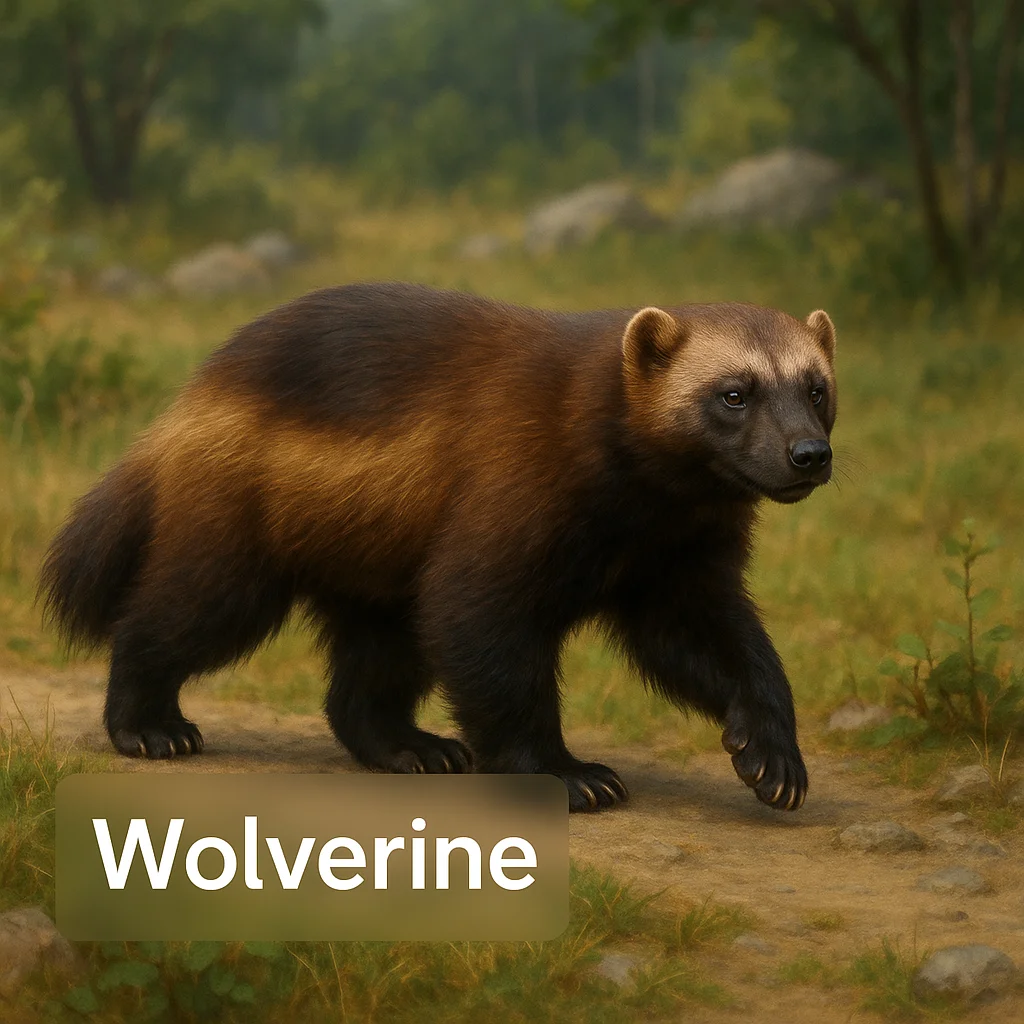
The wolverine features a muscular build and is easily identifiable by its robust appearance and dark, bushy fur with lighter face masks and lateral patterns. Their short legs and broad paws make walking in snow feasible, while the elongated, sharp claws are adapted for digging and climbing.
The wolverine is often mistaken for small bears or badgers due to its large, round body and thick fur that ranges from brown to black, occasionally sports white or golden highlights.
- Top ID Tips:
- Stocky, bear-like body proportions
- Dark fur with white or tan stripes running from shoulders to tail
- Broad head with small ears and a blunt snout
- Large paws relative to body size; ideal for snow trekking
- Visible long claws for gripping, climbing, and digging
- Bulky fur coat that varies seasonally
- Distinctive musky scent
- Unique tracks: five-toed paw with claw marks
- Dense, even fur helps in harsh, cold climates
🧱 Body Structure & Physical Adaptations
The wolverine displays a sturdy form, with a broad chest and powerful shoulders. This provides the strength required for pulling and tearing through snow and ice in search of food or shelter. Their robust teeth and strong jaws are well-optimized for cracking bones and consuming frozen carcasses.
Wolverines equipped with keen olfactory senses and auditory capabilities rather than visual acuity, allowing them to efficiently hunt by sound and smell. Their dense, oily fur insulates against the cold and sheds snow, which is vital for survival in their chilly habitats.
- Key Adaptations:
- Powerful bite force for bone cracking and scavenging
- Strong, retractable claws for climbing trees and terracing through snow
- Exceptional sense of smell for locating food beneath snow layers
- Dense, water-repellent fur providing insulation against subzero temperatures
- Broad paws acting as natural snowshoes for efficient traversing
- Muscular build aids in long-distance travel and foraging
- Versatile tail assisting in balance during climbing and maneuvering
- Acute hearing for detecting potential prey or predators
🌍 Range & Distribution
Wolverines inhabit the circumpolar north with primary strongholds in Canada, Alaska, and the Russian and Scandinavian north. They favor cold, remote environments where competition for food is low, and human interference is minimal.
Their range in North America traditionally spans mountain ranges and forested areas along the Arctic Circle, while in Eurasia, they dwell in similar boreal and tundra regions.
- Where You Might Find It:
- Northern Canadian Rockies
- Alaskan wilderness
- Siberian taiga
- Scandinavian tundra
- Subarctic European forests
- Montane regions and alpine tundra
🏞️ Habitat & Shelter
Wolverines thrive in expansive, sparsely populated areas with rigorous climates. Forests, alpine zones, and tundra are their staples, offering adequate cover and food resources. The varied topography, from steep terrains to dense woods, accommodates their constant searching of vast territories.
Seasonal adaptation includes using sheltered dens and brush cover for resting and concealing themselves from predators, while steep climbs or broken forest provide hiding spots.
🧭 Behavior & Ecology
The wolverine is well-known for its fierce territoriality, routinely marking boundaries with scent glands. They spend considerable time on solitary foraging expeditions, showcasing cunning hunting tactics and resilience in the face of competition.
As opportunistic scavengers, wolverines play a crucial role in ecosystems by cleaning carrion and assisting in nutrient cycling. They engage minimally with competitors and mainly rely on winter food caches throughout lean months.
- Behavior Highlights:
- Intense territorial marking using scent
- Adaptable to varied food sources, including carrion
- Roaming behavior to cover vast territories in search of resources
- Efficient diggers, using burrows for shelter against elements
- Communal feeding pairs during rare social encounters
- Engages in fierce encounters over food and territory
👥 Social Life & Group Dynamics
Wolverines are primarily solitary creatures, unless mating. Social interactions are rare, typically revolving around disputes over food or mating rights. Males tend to expand over larger territories that overlap those of multiple females.
Co-parental involvement exists, with males occasionally assisting in feeding the young. Yet, these interactions remain the exception in their otherwise solitary routines.
- Social Structure Notes:
- Predominantly solitary, limiting social structures
- Overlapping territories imply passive avoidance, rather than active conflict
- Temporary pair bonding may occur during mating seasons
- Mild, cooperative foraging ventures between mates
- Seasonal variations influencing territorial behaviors
🍽️ Diet, Prey & Predators
Wolverines consume an extensive diet, eating anything from small mammals like rodents and rabbits to larger animals such as deer fawns. They rely heavily on scavenged carcasses in the winter, using strong jaws and teeth to access marrow and flesh, even from deep within frozen carcasses.
These tenacious foragers also face threats from wolves and bears, although human habitat encroachment is the primary concern over predator competition.
- Feeding Notes:
- Opportunistic diet spanning from mice to ungulates
- Efficacious scavengers, breaking into bone for marrow
- Seasonal and geographic variations in prey availability
- Resilient hunters equipped for tackling large ungulate prey
- Strong scavenger tendencies, reinforced by wilderness adaptations
🦌 Hunting, Foraging & Movement
Wolverines are adept at traveling over varied landscapes, utilizing energy-efficient lope movements to cover vast areas in search of food. They alternate between active hunting and scavenging modes, based on availability and season.
Wolverines showcase strategic determination in acquiring food, combing through dense snow in search of tracks to follow or scents to lead toward sustenance.
- Movement & Strategy:
- Continuous, tireless traversers across territories
- Versatile hunters who adapt strategies, dependent on prey size
- Exploiting alpine regions for shelter and obscure feeding zones
- Efficient scavengers using olfactory cues to locate carrion
- Navigate notoriously harsh conditions with preparedness
🧠 Intelligence & Senses
The wolverine exhibits marked resourcefulness in accessing nourishment in isolated, snowbound habitats. Known for advanced cognitive behavior and problem-solving, they demonstrate strategic intelligence when tracking potential prey or evading predators.
Olfactory and auditory senses prevail over visual sharpness due to nocturnal and semi-nocturnal behaviors, enabling them to detect food under thick snow or identify territorial intrusions.
- Notable Abilities:
- Problem-solving skills aid in hunting and food storage
- Distinct olfactory abilities for scent-based navigation
- Extensive memory capacity for territory mapping and resource tracking
- Displays adaptability in challenging circumstances
- Utilizes keen auditory sense for prey detection
🪺 Reproduction, Pregnancy & Parenting
Breeding generally occurs within late winter months, with a polygamous mating system observed. Post-construction of nutritive-sufficient food stores, females retreat to isolated dens to birth litters into the early spring.
The 30 to 50-day gestation results in a litter size averaging 2 to 3 kits, who require parental dependency for up to seven months. Female wolverines protectively rear kits within dens, while males occasionally supply food aid.
- Reproduction Snapshot:
- Breeding spans from February to March
- Polygynous mating practices
- Gestation averages 30-50 days, with possible delay
- Typically, litters yield two to three wolverine kits
- Altricial kits that depend on den-based protection
- Seasonal availability affects breeding productivity
♀️♂️ Male vs Female Differences
Wolverines display moderate sexual dimorphism, with males often outweighing females and exhibiting slightly larger territories. These dominant size traits enable males to cover multiple female territories and prevail in competitive mate encounters.
- Sex Differences at a Glance:
- Males generally larger and more aggressive
- Females maintain localized ranges compared to males
- Seasonal coloration differences typically subtle
- Territorial range size diverges; larger for males
- Males possess metropolitan-sized home ranges compared to females
🧬 Subspecies & Variation
Potential subspecies within Gulo gulo are under constant debate, with regional specificity involving size, coat pattern, and range distinctions. Variation in wolverines primarily stems from broad geographic dispersal, with traits influenced by local climatology.
Population assessments reveal genetic variation, yet quantifying their concrete subspecies classification remains elusive due to their scarcity and range overlap.
- Variation Notes:
- Genetic differentiation within boreal and montane populations
- Debates continue on subspecies validity
- Latitude causes possible diverging fur patterns
- Island isolation leads to potential size variations
- Components such as climate drive morphological differences
⚠️ Threats, Conservation & Human Interaction
Human pressures notably impact wolverine survival, with habitat encroachment and climate changes exerting influence on population stability. Conservation efforts aim to ensure continued wilderness protection while studying field perceptions raise conservation awareness globally.
Balanced and proactive approaches towards habitat preservation are crucial, offering refuge and sustainable roving environments to these elusive mammals.
- Responsible Notes:
- Habitual fragmentation disrupts natural range
- Vital to preserve remote areas safe from human tensions
- Afforestation and planning policy improvements help
- Climate fluctuations focus on critical survival challenges
- Awareness campaigns can bolster coexistence mindsets
✨ Fun Facts & Unique Traits
- Known for character traits mimicking fictional counterparts due to ferocity
- Name "Gulo" derives from Latin for "glutton," reflecting large appetite
- Wolverines symbolically link with wild spirits in Indigenous American legends
- Their powerful jaws can bite into bones, accessing energy-rich marrow
- Distinctive musky smell deters rivals from entering their territory
- Efficient solitary travelers, covering up to 15 miles in a day
- Despite size, they can take down prey much larger than themselves
📌 Summary
- Wolverines are robustly built with unique coloration and strong adaptivity
- Primarily inhabit northern taiga, tundra, and boreal forests globally
- Primarily meat-based diet includes rodents, small deer, and scavenged remains
- Wolves and bears form the nucleus of predator competition
- Solitary, yet occasionally cooperative reproductive structures
- Breeding occurs in late winter, with polygynous pairing
- Key adaptations include strength, dense fur, and versatile dentition
- Distinct traits like muskiness deter competitive interactions