🦁 Spotted Hyena
🧾 Quick Facts
The spotted hyena is a fascinating and often misunderstood mammal known for its social structure and formidable hunting skills. This species boasts unique characteristics in both appearance and behavior, thriving in various African landscapes.
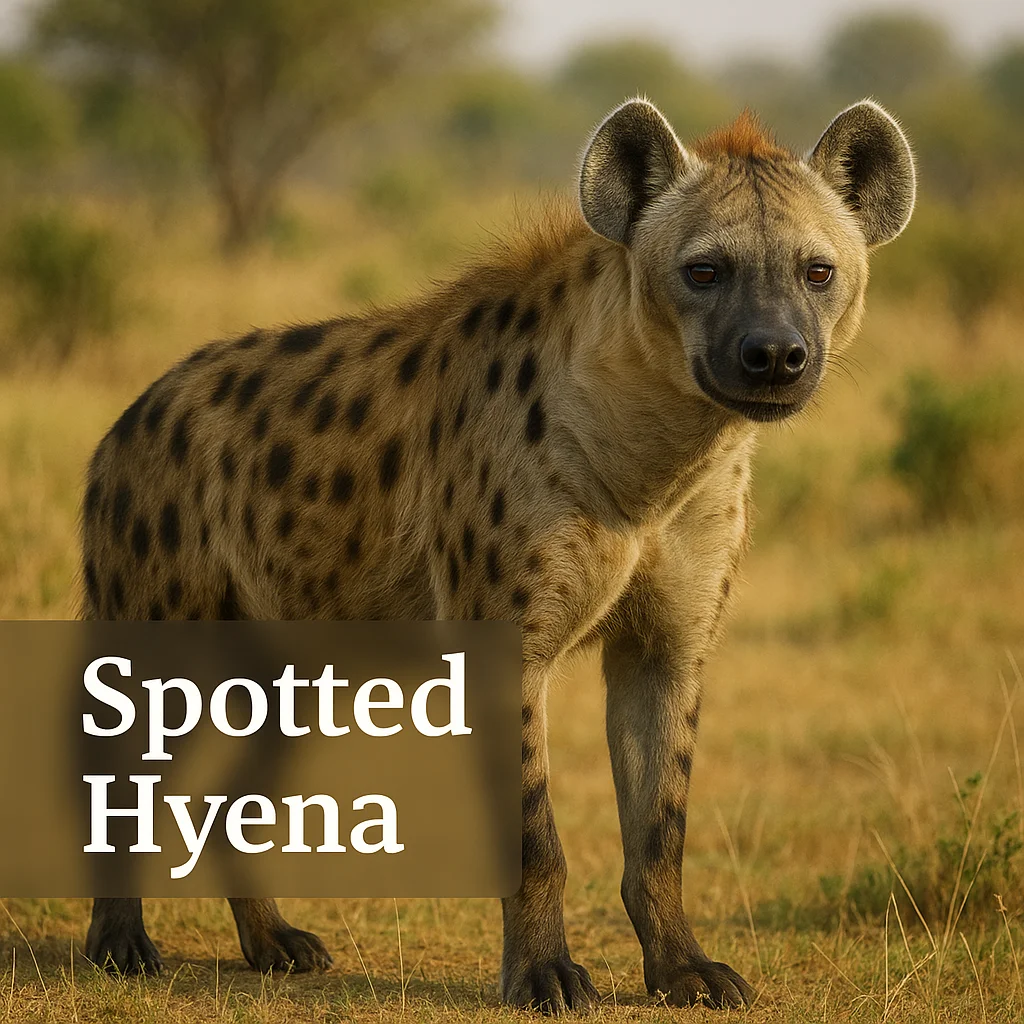
- Common name(s): Spotted Hyena, Laughing Hyena
- Scientific name: Crocuta crocuta
- Animal type: Mammal
- Typical adult size: 1.2 to 1.85 meters in length; 40 to 86 kg in weight
- Typical lifespan: Up to 25 years in the wild; around 40 years in captivity
- Diet type: Carnivore; consumes antelope, wildebeest, birds, reptiles, and carrion
- Activity pattern: Nocturnal
- Social structure: Group living (clans) with complex hierarchies
- Speed / movement highlights: Can run up to 60 km/h
- Intelligence/learning: Highly intelligent with problem-solving abilities
- Primary habitats: Savannas, grasslands, woodlands, forest edges, sub-deserts
- Geographic range: Sub-Saharan Africa
- Predators/threats: Lions, leopards, humans
- Conservation status: Least Concern, but varies by region
🔍 Identification & Appearance
The spotted hyena has a robust, bear-like build with a large head and powerful jaws. The coat is coarse with a sandy color backdrop adorned with dark black or brown spots that vary in size and pattern, becoming fainter with age. Its front legs are longer than the hind legs, resulting in a sloped back. Distinctive features include rounded ears and a short tail with a bushy tip.
- Top ID Tips:
- Robust build with a sloping back
- Sandy coat with distinctive dark spots
- Large, powerful jaws and teeth
- Rounded ears
- Spots fade as the animal ages
- Short, bushy tail
🧱 Body Structure & Physical Adaptations
Spotted hyenas have a strong and muscular build, especially in the forelimbs and neck region, which aids in tackling prey and defending territory. Their powerful jaws and strong teeth are adapted for crushing bones, a skill vital for scavenging. They have non-retractable claws that help provide traction and facilitate digging.
- Key Adaptations:
- Strong, muscular forelimbs
- Massive skull and jaws for bone crushing
- Non-retractable claws for traction
- Sharp senses of smell and hearing
- Large stomach capacity for consuming substantial food at once
- Immune to many diseases and pathogens carried by prey
🌍 Range & Distribution
The spotted hyena inhabits most of sub-Saharan Africa, appearing in several habitats ranging from savannas and grasslands to forest edges and sub-deserts. These adaptable creatures can be found at various elevations, usually opting for areas with abundant prey availability. They are mostly resident but may venture closer to human settlements when searching for food.
- Where You Might Find It:
- Sub-Saharan Africa
- Savannas and grasslands
- Forest edges
- Sub-desert regions
- Near water sources, especially during dry seasons
- Areas with abundant prey populations
- Occasionally near human settlements
🏞️ Habitat & Shelter
Spotted hyenas favor open habitats such as savannas, grasslands, and woodlands but can also thrive in forested areas and sub-deserts. They use dens, which may be burrows or caves, for shelter—especially during breeding. These dens provide protection for cubs and offer refuge from the midday heat. Habitat knowledge is crucial because these environments shape their social structures, hunting strategies, and overall survival.
🧭 Behavior & Ecology
Primarily nocturnal, spotted hyenas engage in activities such as hunting and socializing after sunset. Territorial and social, they communicate through vocalizations like laughter—an iconic sound of the African night. They scavenge but are effective pack hunters. As scavengers and predators, they shape ecosystems by controlling prey populations and recycling nutrients found in carrion.
- Behavior Highlights:
- Nocturnal activities
- Complex social hierarchy
- Use of vocalization for communication
- Scavenging behavior with pack hunting
- Defend large territories
- Role as an ecosystem balancer
👥 Social Life & Group Dynamics
Spotted hyenas are highly social, living in matriarchal clans typically consisting of 10 to 80 individuals. Female dominance hierarchy is a defining aspect of their social structure. Cooperative hunting, clan defense, and communal childcare are prevalent behaviors that strengthen clan bonds. They resolve conflicts primarily through vocalizations and intimidation rather than physical confrontation.
- Social Structure Notes:
- Matriarchal clan structure
- Clan size ranges from 10 to 80 members
- Cooperative hunting strategies
- Shared childcare duties
- Female-based dominance hierarchy
- Conflict resolution through communication
🍽️ Diet, Prey & Predators
Spotted hyenas are skilled hunters and scavengers, known to tackle large prey such as wildebeest and antelope. They also consume small mammals, birds, and carrion. Hyenas have few natural predators, but lions and leopards pose threats. They use their formidable build and social cooperation as defenses, often facing more danger from humans due to habitat encroachment and poaching.
- Feeding Notes:
- Carnivorous diet
- Prey includes wildebeest, antelope, and zebras
- Scavenging plays a significant role in their diet
- Opportunistic feeder, will consume insects and small mammals
- Utilize powerful jaws to process bones
- Human encroachment impacts food availability
🦌 Hunting, Foraging & Movement
Capable runners, spotted hyenas can reach up to 60 km/h when pursuing prey. They often hunt in groups, displaying strategic coordination and endurance. Nighttime is the peak foraging period. Their territories can be extensive, requiring keen navigation skills. Though mostly terrestrial, they can swim and cross water bodies when necessary.
- Movement & Strategy:
- Efficient running speed and stamina
- Group hunting tactics
- Active primarily at night
- Territorial navigation skills
- Adaptable to varying terrains
- Occasional swimming capabilities
🧠 Intelligence & Senses
Spotted hyenas exhibit notable intelligence, demonstrated through problem-solving and social cunning. They have advanced communication systems, including an array of vocalizations. Their sense of smell and hearing are acute, assisting both in locating food and avoiding threats. However, there can be regional variation in intelligence studies necessitating further research.
- Notable Abilities:
- Complex problem-solving skills
- Strong social intelligence and communication
- Advanced memory capabilities
- Acute sense of smell
- Excellent hearing
- Potential object manipulation skills
🪺 Reproduction, Pregnancy & Parenting
Breeding in spotted hyenas is non-seasonal, occurring year-round. They exhibit a polygynous mating system. Females give birth after a gestation period ranging from 90 to 110 days, typically producing 1 to 4 cubs that are altricial at birth. Female hyenas are the primary caregivers, although alloparenting may occur within the clan. Cubs stay in the den for several weeks before integrating into the clan.
- Reproduction Snapshot:
- Non-seasonal breeding
- Polygynous mating system
- Gestation period of 90 to 110 days
- Litter size ranges from 1 to 4 cubs
- Altricial development of newborns
- Primary maternal care with occasional alloparenting
♀️♂️ Male vs Female Differences
Female spotted hyenas are typically larger and more dominant than males, with a pronounced pseudo-penis that complicates gender identification. There are minimal coloration differences. Females hold the top rank in the social hierarchy, playing crucial roles in clan leadership, while males often occupy lower ranks and may leave their birth clan to join others.
- Sex Differences at a Glance:
- Females larger than males
- Dominant social role of females
- Similar coloration and markings
- Pseudo-penis in females
- Males typically disperse to new clans
- Gender roles in hunting may vary
🧬 Subspecies & Variation
Currently, the spotted hyena is not formally divided into subspecies, although there can be noticeable regional differences in size and appearance. These differences may arise from adaptation to local environments, such as coat thickness in different climates. Ongoing genetic studies may redefine our understanding of subspecies and variation in spotted hyenas.
- Variation Notes:
- No formally recognized subspecies
- Size may vary regionally
- Potential coat thickness variation
- Subject to adaptation based on local ecosystems
- Genetic diversity reflects geographic distribution
⚠️ Threats, Conservation & Human Interaction
Spotted hyenas face threats from habitat loss, poaching, and human-wildlife conflicts. As they compete with larger predators like lions, human expansion further complicates their survival. Conservation efforts include habitat protection and reducing conflict with humans. They are occasionally kept in captivity, which raises ethical considerations, especially regarding natural behavior and ecology.
- Responsible Notes:
- Impact of habitat loss and fragmentation
- Occasional poaching and hunting pressures
- Competition with apex predators like lions
- Human-wildlife conflict management
- Importance of educational conservation programs
- Ethical considerations for captive care
✨ Fun Facts & Unique Traits
- The sounds of a hyena's "laugh" can be heard over long distances.
- Hyenas are often more successful hunters than lions in certain regions.
- Their digestive systems are equipped to process large bones.
- Spotted hyenas have a political social structure with female-led clans.
- They use chemical signals to communicate their territory boundaries.
- Fossil evidence suggests that early hyena species were even more widespread.
- Their laughter contains information about age, rank, and identity.
📌 Summary
- Spotted hyenas are robust, bear-like carnivores with spotted coats.
- They occupy various habitats across sub-Saharan Africa.
- Known for their distinctive "laugh," they possess advanced communication skills.
- Matriarchal social structures with cooperative hunting strategies define their social life.
- They exhibit complex intelligence and problem-solving abilities.
- Hyenas are adaptable foragers, skilled in both hunting and scavenging.
- Female hyenas dominate in size and social status within clans.
- They play a vital role in the ecosystem as both predators and scavengers.
- Conservation requires addressing habitat loss and human-wildlife relations.
- Unique traits include powerful jaws and a complex social hierarchy.