🦁 Snow Leopard
🧾 Quick Facts
The snow leopard (Panthera uncia) is a solitary big cat known for its striking appearance and elusive nature. Native to the mountain ranges of Central and South Asia, it is specially adapted to survive in harsh, cold environments.
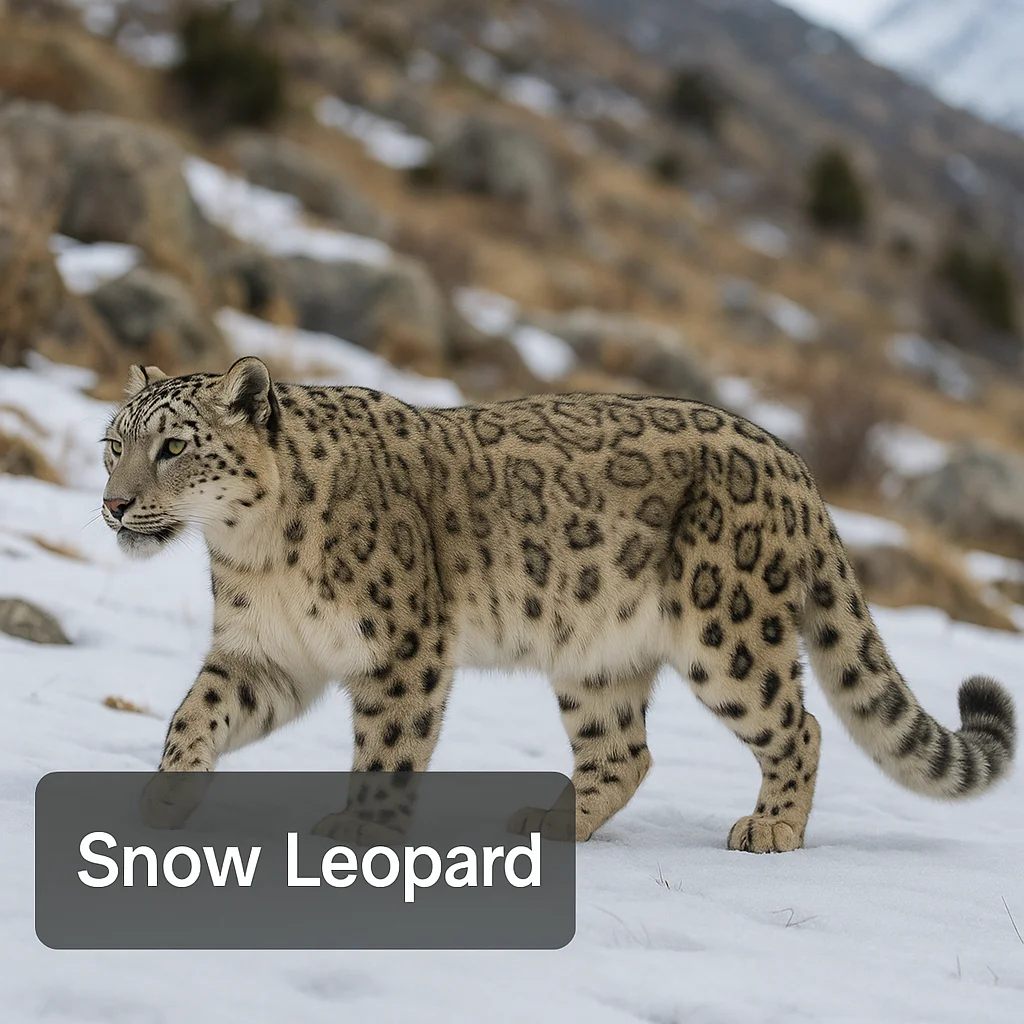
- Common name: Snow Leopard
- Scientific name: Panthera uncia
- Animal type: Mammal
- Typical adult size: 86-125 cm (34-49 inches) body length; 22-55 kg (49-121 pounds) in weight
- Typical lifespan: 10-12 years in the wild; can live up to 22 years in captivity
- Diet type: Carnivore; preys mostly on ibex, bharal (blue sheep), and smaller mammals
- Activity pattern: Crepuscular, most active at dawn and dusk
- Social structure: Solitary, except during mating season or when females are raising cubs
- Speed: Can reach speeds of up to 64 km/h (40 mph)
- Intelligence/learning: Known for intelligent hunting strategies and navigational skills
- Primary habitats: Mountainous regions, particularly in alpine and subalpine zones
- Geographic range: Central and South Asia, including the Himalayas, Altai Mountains, and Tien Shan
- Predators/threats: Humans (poaching), habitat loss, and retaliatory killings
- Conservation status: Vulnerable, with populations declining because of human impacts
🔍 Identification & Appearance
Snow leopards are characterized by their long, thick fur and grayish-white coat with unique black spots and rosettes. This distinctive coat provides excellent camouflage against the rocky mountainous terrain they inhabit.
- Body shape and silhouette: Compact, powerful build with a thick tail and short legs
- Key colors and patterns: Creamy white to yellowish-gray coat, covered with black open or solid rosettes and spots
- Distinctive features: Thickly-furred long tail, used for balance and warmth; small rounded ears
- Tracks and signs: Large, round paw prints with no claw marks due to retractable claws
- Common look-alikes: Often confused with common leopards (Panthera pardus), which have more prominent rosettes and live at lower altitudes
- Long, bushy tail aids in balance and warmth
- Wide paws act like snowshoes to distribute weight on snow
- Thick and dense fur provides insulation from cold
- Ear length helps minimize heat loss
- Unique rosette patterns aid in identifying individuals
🧱 Body Structure & Physical Adaptations
The snow leopard’s body is adapted for life in a chilly, mountainous environment. Its stocky build, deep chest, and powerful shoulders help it navigate steep and rugged terrain efficiently.
- Build and proportions: Compact and muscular with a low center of gravity for stability
- Teeth/jaw adaptations: Strong canines and jaw muscles for gripping and holding prey
- Claws: Retractable, sharp claws aid in gripping and climbing
- Sensory strengths: Excellent vision, capable of seeing in low light; keen sense of hearing
- Long, agile tail for balance
- Thick, insulated coat for cold environments
- Short ears reduce heat loss
- Large nasal cavity warms the air before it reaches the lungs
- Powerful legs for climbing
🌍 Range & Distribution
The snow leopard’s distribution stretches across 12 countries in Central and South Asia. While it predominantly inhabits mountain regions, it can also be found in steep and rocky cliffs and ravines.
- Regions: Located in the Himalayas, Altai Mountains, and the Tien Shan range
- Countries: Afghanistan, Bhutan, China, India, Kazakhstan, Kyrgyzstan, Mongolia, Nepal, Pakistan, Russia, Tajikistan, and Uzbekistan
- Elevation range: Typically found between 3,000 and 4,500 meters (9,800 – 14,800 feet) but can go as low as 1,000 meters (3,280 feet)
- Climate range: Cold mountain climates with dry winters and mainly alpine or subalpine zones
- Himalayas and high-altitude ranges
- Remote rocky outcrops and cliffs
- Alpine meadows of Central Asia
- Low human habitation areas
- National parks and protected areas in their range
🏞️ Habitat & Shelter
Snow leopards are primarily found in rugged, mountainous terrains where there is much snow cover. They use rocky outcrops and cliffs to hide and stalk prey, relying on their stealth and patience.
- Preferred habitats: Alpine and subalpine zones, mountain slopes, rocky outcrops, and gorges
- Microhabitats and shelter: Use rocky caves and crevices for shelter and to rear their young
- Seasonal behavior: Remain active year-round, adapting to seasonal prey availability
- Weather-related behavior: Stay close to abundant prey during severe winters
🧭 Behavior & Ecology
Elusive and solitary, snow leopards are most active at dawn and dusk. They are known for their solitary nature, only coming together for mating or when a mother is raising her cubs.
- Daily routine: Primarily crepuscular, they favor cooler times of the day
- Communication: Use scent marking, vocalizations like growls or yowls, and scratching behaviors
- Role in the ecosystem: Apex predator, maintains the balance of the populations of prey species
- Patrolling and scent marking their territory
- Resting by day in secluded spots
- Opportunistic predator, relies on stealth
- Minimal interaction with other species
- Vital part of mountain ecosystem management
👥 Social Life & Group Dynamics
As primarily solitary animals, snow leopards tend to establish large territories that they defend using scent marks. They only socialize during the mating season.
- Solitary except during mating or raising young
- Territorial with little overlap in ranges between individuals
- Limited social interactions save for mating pairs
- Females with cubs tend to maintain slightly overlapping ranges
- Strongly territorial, maintain established range
- Minimal social interaction
- Mother-offspring bonding during early stages
- Territory size varies with prey density
🍽️ Diet, Prey & Predators
Snow leopards have a primary diet of large ungulates (hoofed animals) like ibex and blue sheep, although they will also hunt smaller mammals.
- Primary prey: ibex, bharal (blue sheep), argali sheep, small mammals
- Seasonal changes in diet: more reliant on smaller animals when ungulate populations are low
- Rarely scavenges, prefers fresh prey
- Significant predator, regulates prey species population
- Mostly hunts large ungulates
- Uses steep terrain to stalk and ambush
- Opportunistic feeding in lean seasons
- Top predator with few natural threats other than humans
🦌 Hunting, Foraging & Movement
Specially adapted to their terrain, snow leopards are able to cover significant distances in search of food. They employ surprise and stealth to capture prey.
- Locomotion style: Ambush predator, challenge terrain with powerful leaps
- Hunting strategy: Stalks prey closely before a short chase or ambush
- Navigation: Exceptional balance on rocky and rugged terrain
- Agile climber for rough environments
- Cautious, deliberate hunting mode
- Extensive territory patrols for food and mating
- Relies on camouflage and stealth movements
🧠 Intelligence & Senses
Snow leopards are intelligent and adaptable cats with acute senses that allow them to hunt effectively, even in the challenging terrains of their high-altitude habitats.
- Problem-solving abilities evident in hunting techniques
- Capable of learning environmental navigation routes
- Acute vision facilitates low-light hunting compatibility
- Keen hearing for detecting prey movements
- Astute navigation of mountainous regions
- Expert stealth and patience for hunting
- Adaptive to environmental changes
- Effective solitary hunting strategies
🪺 Reproduction, Pregnancy & Parenting
Snow leopard mating occurs between January and March. Females give birth in well-protected caves or crevices to shield the young from the harsh elements.
- Breeding season: Late winter into early spring
- Mating system: Mainly monogamous, pairs form during mating season
- Gestation period: Approximately 90-103 days
- Litter size: On average, 2-3 cubs
- Newborn development: Cubs are initially blind and helpless, remain with the mother before dispersing
- Mating occurs mainly in early spring
- Parental care primarily by mothers
- Cubs remain dependent for up to two years
- Shelter cubs in caves or rocky dens
- Seasonal timing to align birth with prey abundance
♀️♂️ Male vs Female Differences
While external sexual dimorphism is not pronounced in snow leopards, males tend to be slightly larger than females.
- No significant coloration or markings differences between genders
- Behavior: males cover more territory, while females typically accompany cubs
- Slight size disparity with males larger on average
- Males more territorial in behavior
- Females involved in cub rearing
- Limited dimorphic traits observed visually
🧬 Subspecies & Variation
There are currently no officially recognized subspecies of the snow leopard, but regional adaptations exist based on habitat variations.
- Habitat-driven size variation, high-altitude dwellers may have heavier coats
- Current classification as a single species, with research ongoing
- Possible regional coat pattern distinctions
- No formally identified subspecies currently
- Genetic studies ongoing for further insights
- Minor geographical-based adaptations recorded
⚠️ Threats, Conservation & Human Interaction
Snow leopards face numerous pressures from human activities, including habitat fragmentation, poaching, and climate change. Conservation efforts focus on habitat preservation and mitigating human-wildlife conflict.
- Human-wildlife conflict due to livestock predation
- Illegal poaching for fur and bones as a significant threat
- Habitat fragmentation reduces available territory
- Conservation designations to protect habitats crucial
- Protected status to limit human encroachment
- Mitigation of retaliatory killings through education
- Focus on coexistence strategies with local communities
- Conservation outreach and research for ecology insights
✨ Fun Facts & Unique Traits
- Panthera uncia is the only big cat unable to roar properly
- Known as "ghosts of the mountain" for their elusive nature
- Their tails can be as long as their body, assisting balance
- Cubs often breed in maternal eyesight for subsequent generations
- Still full of mystery, many aspects of their life aren't thoroughly understood
📌 Summary
- Snow leopards are expertly adapted to cold, mountainous habitats
- Often found across 12 countries in Central and South Asia
- Carnivorous, with a diet primarily of wild ungulates
- Grounded major threats from human activities
- Solitary with brief social interactions typically for reproduction
- Cubs remain with the mother for about a year
- Thick fur and long tail aid in navigating harsh climates
- Wonderfully camouflaged, they are symbols of wildlife conservation efforts