🦁 Polar Bear
🧾 Quick Facts
The polar bear, renowned for its striking appearance and impressive adaptations, is one of the most iconic species of the Arctic. These majestic bears are not only pivotal to the Arctic ecosystem as apex predators, but they also highlight the effects of climate change on wildlife.
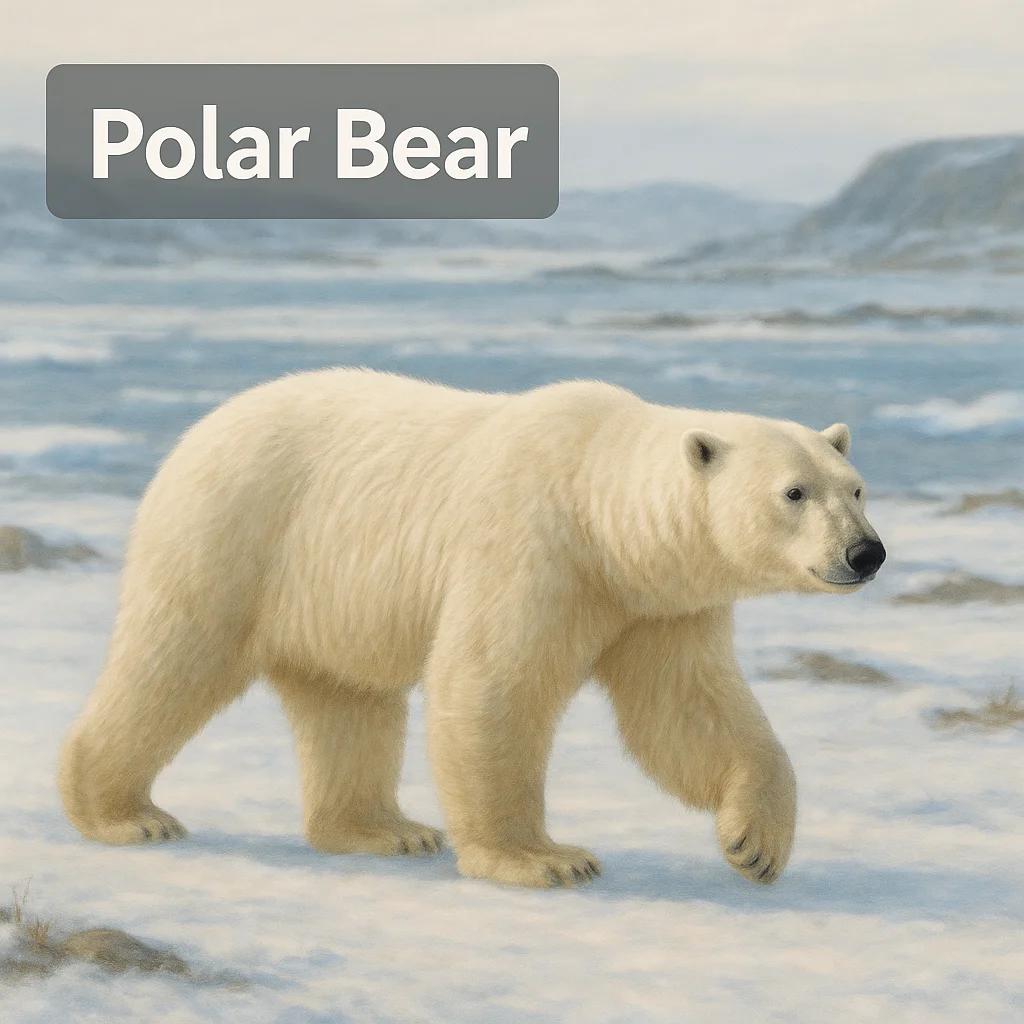
- Common name: Polar Bear
- Scientific name: Ursus maritimus
- Animal type: Mammal
- Typical adult size: 7-10 feet (2.1-3 meters) in length, 900-1,600 pounds (400-720 kg)
- Typical lifespan: 15-20 years in the wild; up to 30 years in captivity
- Diet type: Carnivore; primarily seals
- Activity pattern: Predominantly diurnal
- Social structure: Mostly solitary
- Speed / movement highlights: Strong swimmers, reaching 6 mph (10 km/h) in water; land speed up to 25 mph (40 km/h)
- Intelligence/learning: Highly intelligent with problem-solving abilities
- Primary habitats: Sea ice, coastal regions
- Geographic range: Circumpolar Arctic region
- Predators/threats: Humans (climate change impacts, habitat loss)
- Conservation status: Vulnerable
🔍 Identification & Appearance
Polar bears can be recognized by their distinctive silhouette and predominantly white appearance, which provides camouflage against the snow and ice. Despite their white fur, their skin is actually black, which absorbs heat from the sun. Their large paws aid in swimming and distribute weight while walking on ice. Polar bears also have small ears and a short tail, reducing heat loss.
- Top ID Tips:
- Massive body with a long neck and narrow head
- Predominantly creamy white coat
- Black nose and eyes
- Thick, water-repellent fur
- Large feet adapted for swimming
- Seasonal yellowish tinge due to oxidation
- Ears and tail are relatively small
- Scat is dark and often contains seal remains
- Large, identifiable footprints left in snow
🧱 Body Structure & Physical Adaptations
The polar bear's body is uniquely adapted to its Arctic environment. Its stocky build and insulating layers of fat provide buoyancy and warmth in cold waters. Besides their thick fur, they possess a powerful set of jaws and sharp canines designed to catch and consume tough prey like seals. Their sharp, non-retractable claws facilitate gripping onto slippery ice.
- Key Adaptations:
- Well-developed blubber layer for insulation
- Large paws for swimming and walking on ice
- Sharp claws for catching prey
- Acute sense of smell for detecting prey under the ice
- Whiskers that function as tactile sensors
- Solid, muscular build for powerful swimming
- Specialized teeth for ripping and chewing flesh
- Small ears reducing heat loss
- Water-repellent fur
🌍 Range & Distribution
Polar bears inhabit the circumpolar Arctic region, spanning several countries. They rely on sea ice as their primary habitat, using it as a platform for hunting seals. While their range spans multiple continents, climate and seasonal changes can cause variation in their distribution. Some may travel vast distances to follow the movement of sea ice.
- Where You Might Find It:
- Arctic coasts and sea ice
- Regions around Norway (Svalbard), Russia, the United States (Alaska)
- Canada, particularly the Hudson Bay area
- Greenland
- Island regions within the Arctic Circle
- Sea ice in the Barents and Beaufort Seas
- Coastal areas of the Chukchi Sea
- Near the Arctic Archipelago
- Across the polar ice cap
🏞️ Habitat & Shelter
Polar bears dwell on sea ice and along coastal regions where they hunt and rest. In areas with significant seasonal variation, they may utilize ice floes or den sites as seasonal shelters. During the warmer months, some polar bears may rest on land while waiting for the sea ice to return. Understanding their habitat needs is crucial for conservation efforts, as sea ice conditions significantly affect their hunting efficiency and survival rates.
🧭 Behavior & Ecology
Polar bears exhibit a range of behavioral adaptations that enhance their survival in harsh Arctic environments. Solitary by nature, they roam vast territories in search of food, primarily dependent on their sense of smell to locate prey. They are known for their skillful, patient hunting techniques, such as waiting by seal breathing holes. While polar bears can communicate with various vocalizations during interactions, they primarily rely on their physical and olfactory senses for navigation and territoriality.
- Behavior Highlights:
- Solitary hunters
- Active mostly during early morning and late afternoon
- Conserve energy by resting frequently
- Patience and stealth in hunting tactics
- Communicate through sounds like growls and roars
- Mark territories with scent to establish presence
- Non-aggressive interactions outside mating season
- Depend on sea ice for hunting grounds
👥 Social Life & Group Dynamics
Polar bears are predominantly solitary but do congregate during breeding seasons or when food is abundant. Generally, individuals avoid each other unless food resources necessitate temporary tolerance. Hierarchies are usually established through displays rather than physical confrontations. While females demonstrate strong nurturing behaviors, males have minimal roles in cub rearing.
- Social Structure Notes:
- Mostly solitary except for mothers with cubs
- Transient social interactions when feeding on large carcasses
- Females exhibit maternal instincts
- Territorial disputes involve displays over direct aggression
- Temporary gatherings occur during migration seasons
- Largely solitary except during the mating season
🍽️ Diet, Prey & Predators
Polar bears have a carnivorous diet focused on hunting seals, particularly ringed and bearded seals. They are specialized predators that rely heavily on the abundance of these marine mammals. Occasionally, they may scavenge on carcasses or consume other available food sources. Due to their position as top predators, adult polar bears face little predation except from human threats.
- Feeding Notes:
- Primarily prey on seals
- Use stealth and patience to capture prey
- Scavenge on whale or walrus carcasses when available
- May consume small mammals, bird eggs, and vegetation if necessary
- Infrequent risk of predation except from humans
🦌 Hunting, Foraging & Movement
Polar bears are powerful swimmers and often foray long distances across sea ice and open water in pursuit of prey. They employ stalking strategies on sea ice, waiting near known seal breathing holes. Their movement is largely influenced by the distribution of sea ice and the availability of seals. They are known to cover extensive distances as seasonal ice patterns shift.
- Movement & Strategy:
- Excellent swimmers over long distances
- Cover wide areas to find prey
- Pursue seals at their breathing holes
- Seasonally move with polar ice shifts
- Rest frequently to conserve energy
- Primarily ambush predators
🧠 Intelligence & Senses
Polar bears exhibit remarkable problem-solving skills and adaptability, having evolved sensory capabilities finely tuned to their icy habitat. Their keen sense of smell can detect seals nearly a mile away. Though they generally have poor vision in low-light conditions, their hearing and touch senses compensate for any deficits.
- Notable Abilities:
- Strong problem-solving skills
- Excellent sense of smell
- Good auditory perception
- Adaptable hunting strategies
🪺 Reproduction, Pregnancy & Parenting
Polar bear mating occurs in late spring, with a gestation period that includes delayed implantation lasting about eight months. Mothers typically give birth to one or two cubs in secluded dens, where they nurture their young until they are ready to face the outside world's challenges. During this time, females fast and survive on fat reserves.
- Reproduction Snapshot:
- Births usually occur from November to February
- Litters consist of one to two cubs
- Cubs remain in den for several months after birth
- Females fast while nursing cubs
- Mothers provide extended care and protection
♀️♂️ Male vs Female Differences
Significant size differences exist between male and female polar bears, with males often being twice as large as females. While the overall appearance is similar, males do not participate in cub rearing, which is primarily a female undertaking. There are no significant coloration or pattern differences, but behaviorally, females are more nurturing.
- Sex Differences at a Glance:
- Males are significantly larger than females
- Females raise cubs alone
- Similar coloration in both sexes
🧬 Subspecies & Variation
Polar bears are generally considered a single species with no recognized subspecies. However, variation exists between populations due to geographic distribution and environmental pressures. These differences include slight variances in size and behavior patterns influenced by the availability of prey and sea ice conditions.
- Variation Notes:
- Single species with variations across regions
- Geographic variation in size and behavior
- No formally recognized subspecies
⚠️ Threats, Conservation & Human Interaction
The primary threats to polar bears include climate change, habitat loss due to melting sea ice, pollution, and human conflict. As apex predators, they play an essential role in the Arctic ecosystem. Coexistence with humans requires careful management of resources and habitat protection. Polar bears are often subject to conservation efforts to mitigate the impact of environmental changes.
- Responsible Notes:
- Threatened by climate change and habitat reduction
- Signs of recovery efforts through conservation
- Research on migrating patterns important for protection
- Public education on minimal human impact
✨ Fun Facts & Unique Traits
- Polar bears' skin is black, which helps absorb sunlight and keep them warm.
- They can swim continuously for long distances while searching for habitat or prey.
- Polar bears have been known to eat over 100 pounds of food in one sitting.
- They use sea ice as a platform for hunting and rest between swims.
- Polar bears rarely travel over snow-covered hills to conserve energy during hunting excursions.
- Mother polar bears care for their cubs for more than two years, teaching them to hunt and survive.
📌 Summary
- The polar bear is a top predator in the Arctic, known for its white fur and massive size.
- Habitat: Sea ice and coastal areas within the Arctic Circle
- Distributed across the Arctic, including parts of Canada, Norway, Russia, and Greenland
- Diet primarily consists of seals, which they hunt using stealth tactics.
- Human threats and climate change endanger their survival.
- Solitary by nature, except during breeding season or abundant feeding opportunities.
- Reproduction involves females raising one to two cubs alone.
- Advanced adaptations for living in cold environments, such as blubber and specialized claws.
- Recognized for their excellent swimming capabilities and intelligent hunting strategies.
- Conservation efforts focus on habitat protection and addressing climate change impacts.