🦁 Leopard
🧾 Quick Facts
Leopards are one of the most versatile and widespread big cats, known for their adaptability and varied habitats. They are part of the Panthera genus, which includes lions, tigers, and jaguars. Highly resourceful, leopards have mastered survival in diverse environments.
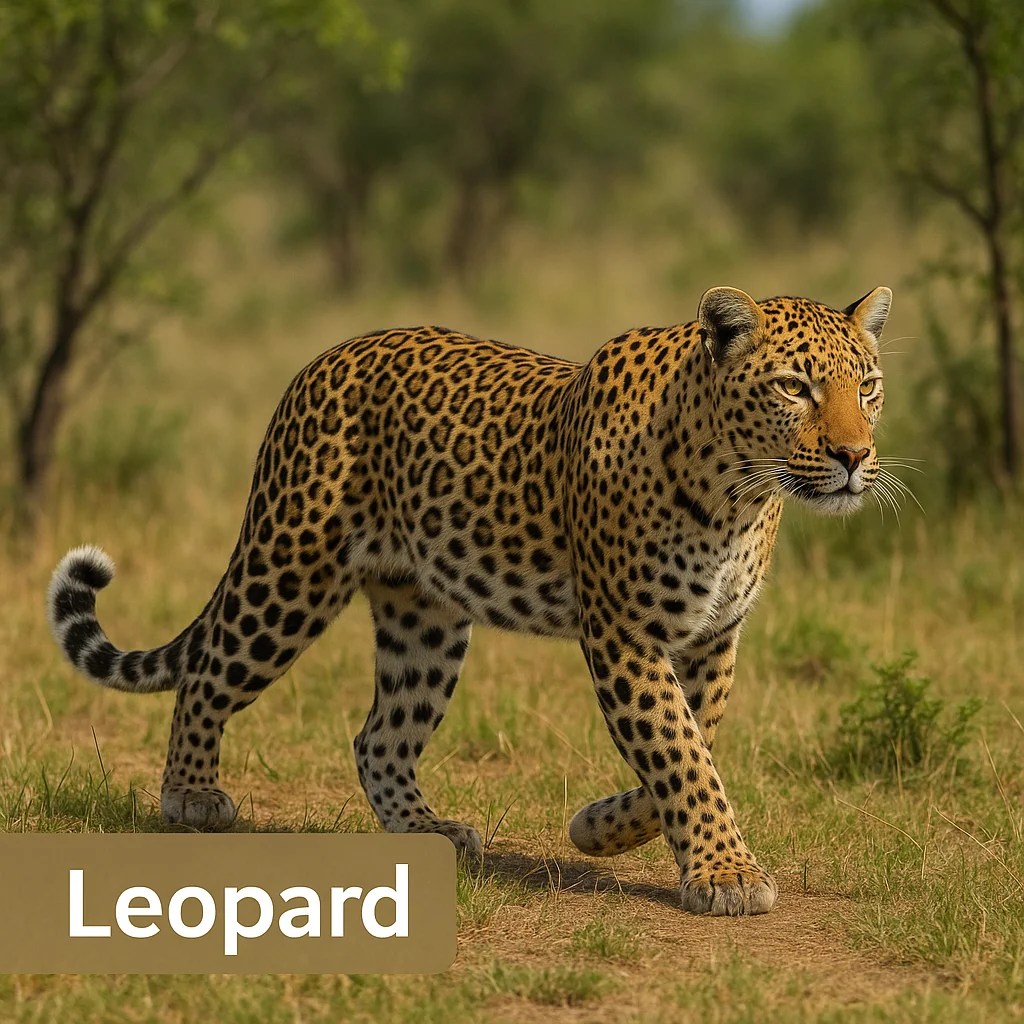
- Common name(s): Leopard, Panther
- Scientific name: Panthera pardus
- Animal type: Mammal
- Typical adult size: 90–160 cm in body length, 50–90 kg in weight
- Typical lifespan: 12–17 years in the wild; up to 23 years in captivity
- Diet type: Carnivore; feeds on ungulates, rodents, birds, and reptiles
- Activity pattern: Primarily nocturnal, but can be crepuscular
- Social structure: Generally solitary
- Speed / movement highlights: Can run up to 58 km/h
- Intelligence/learning: High problem-solving ability; adaptable hunter
- Primary habitats: Forests, grasslands, savannas, mountains
- Geographic range: Sub-Saharan Africa, parts of Asia
- Predators/threats: Humans, lions, tigers
- Conservation status: Varies by region; many populations are threatened
🔍 Identification & Appearance
Leopards are recognized by their powerful, muscular build and distinct spotted coat. Their rosettes—the ring-like spots on their fur—are unique to each individual, making them a key identifying feature. Generally, leopards have a large head, strong jaw, and long, muscular limbs.
- Body shape and silhouette: Sleek, muscular, with a long tail for balance
- Key colors/patterns: Golden-yellow coat with black rosettes
- Distinctive features: Short muzzle, broad paws
- Tracks, scat, or other field signs: Pugmarks with no claw marks (retractable claws)
- Common look-alikes: Jaguars; smaller rosettes and no central spot
- Top ID Tips
- Look for rosettes that distinguish leopards from jaguars
- Muscular body with a long tail
- Golden-yellow coat
- Retractable claws
- Solitary nature
- Cuffs are not present in pugmarks
🧱 Body Structure & Physical Adaptations
Leopards are designed for strength and stealth, with a well-balanced body equipped for diverse hunting strategies. Their physical adaptations make them powerful predators capable of taking down large prey and climbing trees.
- Build and proportions: Well-muscled, with a proportional head and strong limbs
- Teeth/beak/jaw adaptations: Strong jaws and sharp canines for gripping prey
- Claws/hooves/wings/fins: Retractable claws for climbing and gripping
- Sensory strengths: Superior vision (especially in low light), excellent hearing
- Key Adaptations
- Strong, muscular limbs for swift movement
- Retractable claws help in climbing and hunting
- Sharp, robust teeth for dispatching prey efficiently
- Excellent night vision aids in nocturnal hunting
- Adaptability to various habitats and terrains
🌍 Range & Distribution
Leopards occupy an extensive range across sub-Saharan Africa, as well as parts of Asia including the Middle East, India, and China. They inhabit diverse environments, from rainforests to savannas, illustrating their adaptability.
- Continents/regions: Africa and Asia
- Typical countries/biomes: Kenya, South Africa, India, China
- Elevation range/latitude/climate range: Sea level to 5,200 m; variable climates
- Seasonal movements/migration: Generally sedentary but may disperse for food
- Where You Might Find It
- Forest patches in sub-Saharan Africa
- Mountainous regions of India
- Grasslands of central Africa
- Remote areas of China
- Savannas of East Africa
🏞️ Habitat & Shelter
Leopards are remarkably flexible in their habitat preferences, able to thrive in diverse ecosystems. They often choose areas with plenty of cover and good hunting prospects. Their ability to adapt to different shelters, from tree canopies to rocky caves, is a survival advantage.
- Preferred habitats: Forests, grasslands, savannas, mountainous regions
- Microhabitats and shelter: Trees, rock crevices, small caves
- How weather/season changes behavior: Leopards may travel further in dry seasons for food
- Why habitat knowledge matters: Understanding habitat assists in predicting leopard behavior and movement
🧭 Behavior & Ecology
Leopards exhibit a solitary and territorial lifestyle, often marking and defending their domains using scent and auditory signals. These adaptable hunters play a crucial role in the ecosystem as apex predators.
- Daily routine: Mostly nocturnal; active during cooler parts of the day
- Communication: Scent marking, roaring, and rasping sounds
- Typical interactions: Limited interaction; some overlap in home ranges
- Role in the ecosystem: Predator preventing overpopulation of prey species
- Behavior Highlights
- Utilizes both stealth and speed in hunting
- Stores prey in trees
- Uses a variety of vocalizations for communication
- Terrestrial and arboreal in habitat use
- Solitary hunters
👥 Social Life & Group Dynamics
Leopards are primarily solitary animals, interacting with others primarily for mating or territory disputes. Their solitary nature minimizes conflict but requires well-developed personal skills for survival and adaptation.
- Solitary vs social tendencies: Mostly solitary, except females with cubs
- Group types: Temporary pairings for mating
- Cooperation: Rare, primarily in mother-cub units
- Dominance hierarchies: Territory and rank are self-maintained
- Social Structure Notes
- Females are solitary with cubs
- Minimal social grooming
- Territory overlap occasionally occurs
- Indirect communication through scent marking
- Brief bonding during mating seasons
🍽️ Diet, Prey & Predators
Leopards have a broad diet based on available prey, commonly hunting in the night. As apex predators, their diet includes various mammals, birds, and reptiles. Their adaptable hunting strategy allows them to exploit different food sources efficiently.
- What it eats: Mammals, birds, and reptiles, including antelope and gazelles
- Hunting targets and strategies: Ambushes from trees; stalking and pouncing
- Main natural predators: Lions, tigers, crocodiles
- Scavenging behavior: Opportunistic, consuming leftover kills
- Feeding Notes
- Prefers medium-sized prey
- Stores and eats from kills over several days
- Diet highly varies by region
- Can fast for extended periods
- Uses height advantages
🦌 Hunting, Foraging & Movement
Leopards are incredibly versatile hunters, able to adjust their tactics to suit terrestrial or arboreal prey. Known for their strength and agility, they utilize trees for scouting prey and storing food.
- Locomotion style: Ambush predator, adept climber
- Speed and endurance: Up to 58 km/h for short bursts
- Typical hunting/foraging times: Primarily at night
- Navigation and spatial behavior: Maintains well-defined territories with landmarks
- Movement & Strategy
- Efficient ambusher
- Utilizes trees for escape mechanisms
- Capitalizes on surprise in hunts
- Primarily nocturnal activities
- Balances agility with strength
🧠 Intelligence & Senses
Leopards are known for their cunning and problem-solving skills, crucial for a solitary predator. Their keen senses facilitate their primary roles as hunters and territorial animals in commanding their environment.
- Problem-solving and learning: Highly adaptive; capable of adjusting hunting tactics
- Senses: Exceptional hearing and night vision
- State uncertainties: Research on cognitive abilities is limited but suggests high intelligence
- Notable Abilities
- Interprets environmental signals effectively
- Utilizes strategic memory
- Advanced night vision
- Strong adaptiveness to habitat
- Exhibits skilled climbing capabilities
🪺 Reproduction, Pregnancy & Parenting
Leopard mating and parental roles are defined by the species' solitary nature. While males and females only pair for breeding, females invest significantly in rearing young in secure environments.
- Breeding seasonality and courtship: Year-round, increased activity during wet seasons
- Mating system: Polygynous
- Gestation period: Approximately 90–105 days
- Litter size: Typically 2–3 cubs
- Parenting roles: Females primarily responsible for teaching and care
- Reproduction Snapshot
- Year-round mating
- Cubs born blind and helpless
- Weaning occurs around three months
- Cubs stay with the mother up to two years
- Female-led cub care
♀️♂️ Male vs Female Differences
While leopards share many traits, subtle differences exist between males and females, mostly concerning size and behavior, influencing their interactions and roles within their habitats.
- Size/weight differences: Males are larger and heavier
- Behavioral role differences: Males often dominate territories aggressively
- Differences in physical maturity: Males develop more robust physiques than females
- Subtle differences: Females are more clandestine in nature
- Sex Differences at a Glance
- Males display greater territoriality
- Size difference typically up to 30%
- Mature males have thicker necks
- Females more secretive hunters
- Males more solitary than females with cubs
🧬 Subspecies & Variation
Leopards display a range of variations and recognized subspecies, adapting unique traits for their environments. Subspecies distinctions are based on genetic, morphological, and geographical factors.
- Known subspecies: African, Indian, Sri Lankan, and others
- Regional differences: Coats vary with ranges (thicker in cold climates)
- Variations in habitat: Mountain leopards show adaptations to harsh conditions
- Adaptive significance: Region-specific coat patterns
- Variation Notes
- African leopards differ in muscle mass
- Coloration varies with biome
- Mountain variants have longer coats
- Island dwarfism in smaller populations
- Subspecies interbreeding is uncommon
⚠️ Threats, Conservation & Human Interaction
Leopards face numerous threats due to habitat encroachment and human activities but are creatures of cultural fascination and ecological importance. Conservation priorities emphasize habitat protection and coexistence strategies.
- Natural challenges: Competition with larger predators
- Human-related pressures: Habitat loss, poaching, human-wildlife conflict
- Coexistence tips: Following local guidelines on notifications
- Conservation efforts: Poaching deterrence, habitat restoration
- Captivity and ethical considerations: While leopards are generally not pets, ethical management is crucial in captivity
- Responsible Notes
- Minimize conflict by securing livestock
- Support conservation organizations
- Protect natural habitats
- Understand species-specific needs
- Report illegal wildlife activities
✨ Fun Facts & Unique Traits
- Leopards are the only big cats that can drag prey up a tree
- They can hear high-pitched sounds up to 5 km away in open terrains
- Leopards are excellent swimmers and fishermen
- They use their raspy tongues to strip meat from bones
- Leopard rosettes offer camouflage that mimics tree dappled light
- Cubs are often hidden in dense vegetation to avoid predators
- Melanistic leopard, known as black panther, is a color variant
📌 Summary
- Leopards are highly adaptable big cats recognizable by their spotted coats
- They inhabit diverse terrains across Africa and Asia
- Leopards are stealthy, powerful predators that feed on various prey
- Socially, they are primarily solitary, with short-term maternal bonds
- Males tend to be larger, with notable territorial behaviors
- Successful hunters, utilizing trees for storing food and vantage points
- Subspecies exist with regional variations in size and coat pattern
- Conservation efforts focus on habitat protection and poaching deterrence
- Known for their remarkable strength, they can carry prey twice their body weight
- Leopard's elusive nature makes them a fascinating subject of study