🦁 Jaguar
🧾 Quick Facts
The jaguar, with its majestic and fearsome presence, is a powerful predator found primarily in the Americas. Known for its strength and striking appearance, this big cat plays a crucial role in its ecosystem as an apex predator.
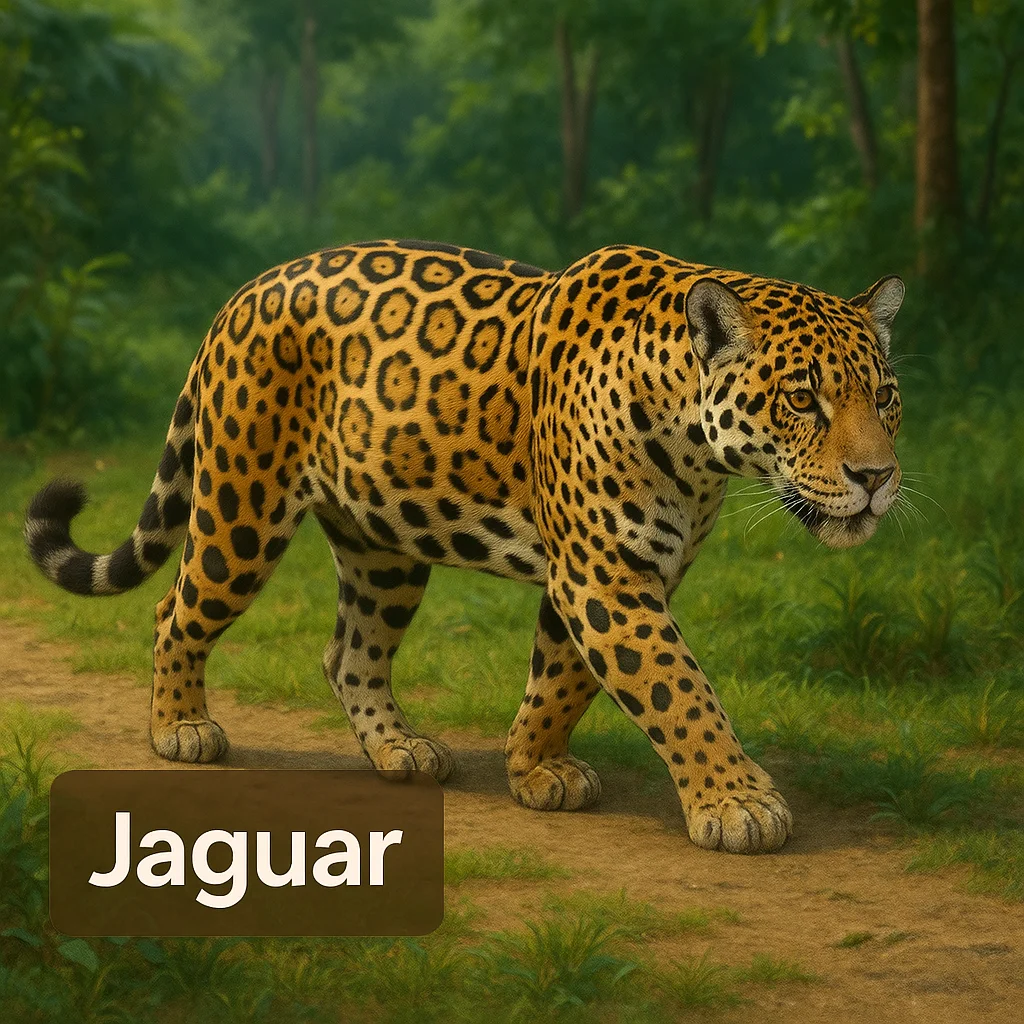
- Common name(s): Jaguar
- Scientific name: Panthera onca
- Animal type: Mammal
- Typical adult size: 4 to 7 feet in length; 100 to 250 pounds
- Typical lifespan: 12 to 15 years in the wild; up to 20 years in captivity
- Diet type: Carnivore; hunts deer, peccaries, capybaras, and occasionally fish
- Activity pattern: Mostly nocturnal and crepuscular
- Social structure: Solitary, except for mothers with cubs
- Speed / movement highlights: Capable of burst speeds up to 50 mph
- Intelligence/learning: Known for problem-solving skills and adaptability
- Primary habitats: Rainforests, swamps, grasslands, and woodlands
- Geographic range: Mainly Central and South America, with some populations in North America
- Predators/threats: Primarily humans, habitat destruction, and conflict with livestock farmers
- Conservation status: Near Threatened, varies by region
🔍 Identification & Appearance
Jaguars are medium to large-sized felines known for their robust build and powerful jaw muscles. They are often confused with leopards, but jaguars have distinct physical traits that differentiate them.
- Top ID Tips:
- Strong, stocky body with a large head
- Coat color ranges from yellow to tan with distinctive black rosettes and central spots
- Short, powerful limbs adapted for climbing, crawling, and swimming
- Tail is shorter relative to other big cats, aiding balance when climbing
- Tracks are large with a round shape, devoid of claw marks
- Exhibits larger and more complex rosettes compared to leopards
- Rounded ears and a comparatively more massive skull
🧱 Body Structure & Physical Adaptations
Jaguars possess a formidable physical build designed for adaptability across diverse environments. From dense forests to open savannahs, their physical adaptations ensure success as apex predators.
- Key Adaptations:
- Compact and muscular body enables stealth and power
- Strong jaw with specialized teeth for crushing bones of prey
- Sharp retractable claws for climbing and catching prey
- Highly developed sense of smell and acute night vision
- Short, sturdy tail aids in maneuverability during ambushes
- Waterproof coat aids in swimming and hunting in aquatic environments
- Robust limbs facilitate powerful bursts of speed and leaping abilities
🌍 Range & Distribution
The jaguar is native to the Americas, occupying a range of habitats across the continent. While their historic range spanned from North to South America, their current distribution is more limited, primarily due to habitat loss and human encroachment.
- Where You Might Find It:
- Primarily in the Amazon Basin, offering dense cover
- Also found in Pantanal wetlands of Brazil
- Ranges extend from southern United States to northern Argentina
- Occupied areas include forested and open terrains
- Favor locations with abundant water sources like rivers and swamps
- Vulnerable to habitat fragmentation impacting range continuity
- Mostly resident within established territories, with minor seasonal movements
🏞️ Habitat & Shelter
Jaguars thrive in a wide array of habitats, each offering unique advantages and challenges. They require large territories to find sufficient prey and maintain their solitary lifestyle.
- Prefer dense tropical and subtropical forests for cover and ambush hunting
- Use caves, dense vegetation, and hollow logs for shelter and resting spots
- Depend on proximity to water bodies for hunting and hydration
- Seasonal behaviors include shifts to higher ground during floods
- Habitat destruction from agricultural expansion poses significant survival threats
- Maintain vast territories, overlapping with other jaguar territories occasionally
🧭 Behavior & Ecology
As solitary animals, jaguars exhibit unique behaviors that underscore their adaptability and dominance within their environments. They play a critical role in maintaining ecological balance by controlling prey populations.
- Behavior Highlights:
- Mostly nocturnal, but active during dusk and dawn
- Mark territories with scent markings and vocalizations
- Highly territorial, using urine and scrapes to mark boundaries
- Their growls and roars serve as communication tools for mating and territory defense
- Act as key predators, regulating prey species and supporting biodiversity balance
- Demonstrate a preference for ambush hunting techniques
- Occasionally exhibit scavenging behavior when a suitable opportunity arises
👥 Social Life & Group Dynamics
Jaguars are notably solitary, with social interactions primarily occurring during mating seasons or between mothers and cubs. This solitary nature simplifies resource competition and limits conflict.
- Social Structure Notes:
- Predominantly solitary except for mating pairs or offspring interaction
- Mothers accompany their cubs for up to two years
- Occasional encounters in shared hunting grounds
- Avoid direct conflicts with other jaguars by scent marking boundaries
- Lack of social hierarchies or structured group dynamics
- Experience seasonal increases in interactions during mating periods
🍽️ Diet, Prey & Predators
Jaguars are carnivorous predators utilizing their strength and stealth to capture a diverse array of prey. Their diet reflects their adaptability, showcasing a broad acceptance of various prey items depending on habitat availability.
- Feeding Notes:
- Primary prey includes deer, peccaries, and capybaras
- Occasionally hunt aquatic prey like fish and caimans
- Demonstrate a unique skull-crushing bite that aids in efficient kills
- Diet shifts to available prey in their immediate area
- No significant natural predators due to apex status, but young are vulnerable
- Scavenging is rare but occurs during food scarcity
🦌 Hunting, Foraging & Movement
The jaguar's movement is characterized by stealth and power, honed through evolutionary adaptations that support its role as a top predator. Their mythical ability to move and hunt silently is essential for their hunting success.
- Movement & Strategy:
- Primarily an ambush predator, using cover and surprise
- Capable of running at speeds up to 50 mph over short bursts
- Skilled swimmer, adept at hunting in water-rich environments
- Exhibits notable capacity for climbing trees to ambush prey
- Utilizes strong dental structure for efficient prey dispatch
- Tightly defined home ranges monitored closely for intruders
🧠 Intelligence & Senses
Jaguars showcase advanced cognitive abilities, including problem-solving and adaptability, allowing them to thrive in diverse environments. They have highly tuned senses appropriate to their nocturnal and predatory lifestyle.
- Notable Abilities:
- Effective problem-solving skills enhance hunting strategies
- Highly developed night vision accommodates nocturnal behavior
- Superior auditory senses to pinpoint prey movements
- Acute olfactory senses in detecting territory and prey
- Limited evidence of tool use, but intelligent problem-solving observed
- Research on memory and learning is ongoing but shows promise
🪺 Reproduction, Pregnancy & Parenting
Breeding behavior in jaguars highlights complex dynamics involving courtship, territorial overlap, and maternal care following offspring birth. Their reproductive cycle ensures survival in varied conditions.
- Reproduction Snapshot:
- Typically breeds year-round with peaks in specific seasons
- Females signal readiness with vocalizations and increased scent marking
- Gestation lasts about 93 to 105 days
- Typical litter size ranges from one to four cubs
- Cubs remain with mothers for up to two years, learning survival skills
- Males do not play an active role post-mating
- Courtship involves temporary pairing without long-term bonding
♀️♂️ Male vs Female Differences
Sexual dimorphism in jaguars is subtle but noticeable, primarily in size differences and occasionally in territorial behaviors between the sexes.
- Sex Differences at a Glance:
- Males are generally larger and more robust than females
- Females more reliant on stealth, males on raw power
- Both sexes possess similar coat patterns and coloration
- Males typically have larger territorial ranges than females
- No significant differences observed in reproductive roles except care-giving
🧬 Subspecies & Variation
While jaguars exhibit consistent physical traits, some regional variation occurs due to ecological adaptation. Traditionally recognized subspecies distinctions are debated among researchers.
- Variation Notes:
- Minor differences observed in size and coat patterns across regions
- Notable regional adaptation to specific habitats (forest vs savannah)
- Evidence of genetic drift due to population isolation
- Disputed subspecies classifications based on phylogenetic analysis
⚠️ Threats, Conservation & Human Interaction
Efforts to conserve jaguar populations are complicated by habitat loss and human-animal conflict. Sustainable coexistence measures are vital to maintaining healthy populations and ecosystems.
- Responsible Notes:
- Habitat fragmentation significantly threatens jaguar survival
- Conservation efforts focus on corridor establishment between habitats
- Education programs aim to reduce human-wildlife conflict
- Strict anti-poaching regulations vital for population stability
- Protected areas serve as refuges from human encroachment
- Fostering community engagement in conservation enhances success
✨ Fun Facts & Unique Traits
- Jaguars are one of the few cats that enjoy swimming
- Their name is derived from the Native American word "yaguar," meaning "he who kills with one leap"
- Smile uniquely among big cats due to their powerful jaws and deep voice
- Only big cat in the Americas with a capability to roar
- Uniquely adapted for durability, capable of breaking turtle shells
- Serves as a cultural symbol in various indigenous cultures
📌 Summary
- Jaguars are easily identifiable by their broad build and distinctive coat patterns.
- They prefer dense forests and wetlands, often found near water sources.
- Occupy regions across Central and South America with specific population occurrences.
- Main diet consists of various terrestrial and aquatic prey, exhibiting versatility in hunting.
- Humans and habitat loss are the primary threats, although they have few natural predators.
- Maintain solitary lives, except during mating and mother-cub interactions.
- Reproductive complexities involve specific gestation timelines and strong maternal care.
- Physical adaptations, including powerful jaws and retractable claws, enable their apex status.
- Unique traits include their swimming ability and significance in cultural symbolism.