🦁 Eurasian Lynx
🧾 Quick Facts
The Eurasian Lynx is a majestic feline inhabiting the forests of Europe and Asia. Known for its elusive nature and striking appearance, this lynx plays a vital role in its ecosystem as both a predator and a vital component of biodiversity.
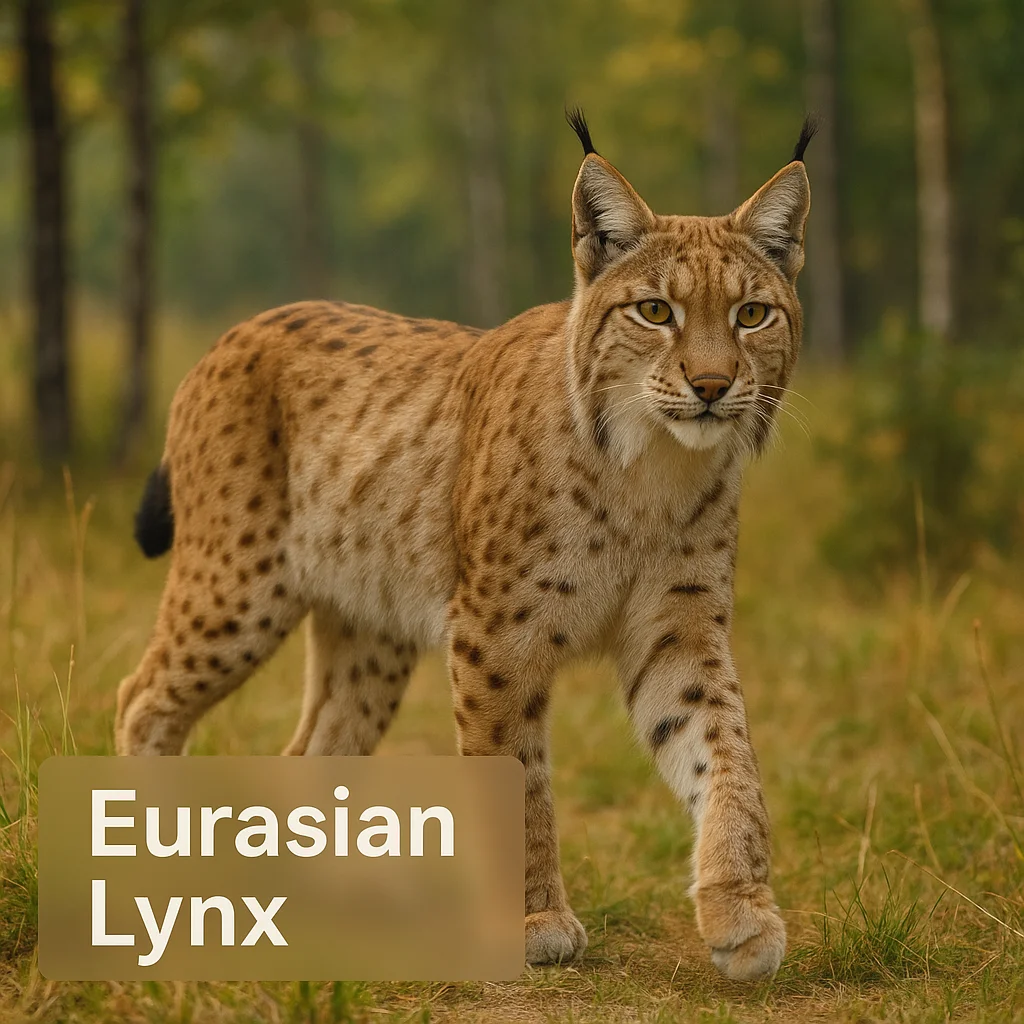
- Common name(s): Eurasian Lynx, Northern Lynx
- Scientific name: Lynx lynx
- Animal type: Mammal
- Typical adult size: 80-130 cm in length; shoulder height up to 70 cm; 18-36 kg in weight
- Typical lifespan: 10-15 years in the wild; up to 20 years in captivity
- Diet type: Carnivore; preys on roe deer, hares, small mammals, and birds
- Activity pattern: Primarily crepuscular and nocturnal
- Social structure: Solitary
- Speed / movement highlights: Capable of short sprints up to 60 km/h
- Intelligence/learning: Highly adept hunter with sharp sensory and stalking skills
- Primary habitats: Temperate forests, taiga, and mountainous regions
- Geographic range: Europe, northern and central Asia
- Predators/threats: Humans, habitat fragmentation, competition from other predators
- Conservation status: Least Concern, but varies by region due to local threats
🔍 Identification & Appearance
The Eurasian Lynx can be identified by its medium to large body, short tail, and long legs. Its coat is dense with a background color that varies from yellowish to bright brown, speckled with dark spots. The ears have black tufts, and the face is marked by distinctive white markings around the eyes and chin. Winter coats tend to be thicker and paler.
- Body shape and silhouette: Large, robust body with proportionally long legs
- Key colors/patterns: Coat varies with a range of spotting; prominent ear tufts
- Distinctive features: Ear tufts, ruff of fur beneath the chin
- Tracks, scat, or other field signs: Tracks show large, round paws without claw marks
- Common look-alikes: Can be confused with other lynx species; distinguishable by size and habit
- Top ID Tips:
- Look for a large feline with a short tail and ear tufts
- Spot the spotted coat pattern for quick ID
- Note the thick winter fur and paler coat in cold months
- Observe their stealthy, deliberate movements
- Large tracks without visible claw marks indicate a lynx
🧱 Body Structure & Physical Adaptations
The Eurasian Lynx is built for power and stealth. It has a robust, muscular body with long legs adapted for pouncing on prey. The jaw structure is strong, with adapted teeth for holding and slicing meat. Lynx have retractable claws, helping them maintain sharpness for gripping prey. Their sensory capabilities are finely tuned, with excellent night vision and acute hearing ideal for hunting nocturnally.
- Build and proportions: Stocky with powerful limbs; short, strong neck
- Teeth/jaw adaptations: Carnassial teeth for shearing flesh
- Claws: Retractable, aiding in stealth and capture of prey
- Sensory strengths: Exceptional night vision, keen hearing
- Key Adaptations:
- Long legs for leaping
- Retractable claws for stealth
- Thick fur for insulation in cold environments
- Sharp vision for low-light hunting
- Keen hearing to detect prey
🌍 Range & Distribution
The Eurasian Lynx is found across a wide area, ranging from Western Europe to Russia and parts of Central Asia. It prefers habitats within dense forests and mountainous regions and is able to adapt to various elevations.
- Present in countries like Norway, Sweden, Finland, and Russia
- Found in temperate forests and rocky terrains
- Adapted to climates from temperate to subarctic
- Mostly resident with minor seasonal movements for prey availability
- Where You Might Find It:
- Dense forests of Siberia
- Mountain ranges in Scandinavia
- Alpine regions of central Europe
- Forested regions of the Balkans
- High-altitude plateaus of Asia
🏞️ Habitat & Shelter
The Eurasian Lynx thrives in varied habitats but has a preference for dense forest landscapes that provide ample cover for hunting and resting. Shelter is often found in natural formations such as rock crevices or hollow trees, and its activities may shift with seasonal changes in prey distribution.
Understanding its habitat requirements is crucial for conservation efforts, as habitat destruction poses significant threats to its survival.
🧭 Behavior & Ecology
The Eurasian Lynx is predominantly nocturnal, spending its night hours actively hunting. It is territorial and uses scent marking and vocalizations to communicate presence. As an apex predator, it helps control the population of its prey, maintaining ecological balance.
- Typically rests during the day in concealed spots
- Highly territorial with overlapping boundaries in prey-rich areas
- Uses vocalizations such as growls and mews, especially during the mating season
- Plays a critical role as a keystone predator in its ecosystems
- Behavior Highlights:
- Nocturnal and crepuscular hunting habits
- Selective hunting promotes ecological balance
- Displays curious and cautious nature
- Solitary except during mating or rearing young
- Adapts hunting tactics to conditions and prey behavior
👥 Social Life & Group Dynamics
The Eurasian Lynx is primarily solitary, with adult lynxes coming together only for mating. Females rear young alone and territorial disputes among individuals are uncommon but can occur.
- Strongly solitary; lone parents in child-rearing phase
- Occasional contact occurs through territory overlap without conflict
- Social Structure Notes:
- Solitary hunters
- Strong individual territories
- Interactions mainly through scent and marking
- Young dependent solely on maternal care
- Defensive behaviors used to protect territories
🍽️ Diet, Prey & Predators
The carnivorous Eurasian Lynx primarily preys on medium-sized ungulates such as roe deer, supplemented by smaller animals and birds. Its hunting strategy involves stalking and quick pouncing. Natural predators are minimal; however, humans remain the primary threat through habitat encroachment.
- Preys mainly on deer, hares, and similar-sized mammals
- Uses cover and ambush strategies
- Minimal scavenging; prefers fresh kills
- Feeding Notes:
- Seasonal diet shifts based on prey availability
- Primarily ambush predator
- Energetically efficient hunting
- Occasional opportunistic small bird predation
- Responds to prey population dynamics
🦌 Hunting, Foraging & Movement
The Eurasian Lynx moves with a graceful, silent glide, minimizing noise to sneak up on prey. They rely on the element of surprise to pounce on unsuspecting animals. Though not built for long chases, they possess the speed required for quick takedowns.
- Expert ambushers, prefer dense cover for stalking
- High bursts of speed for short chases
- Territory patrollers, maintaining ranges for prey accessibility
- Movement & Strategy:
- Blend into the forest foliage
- Adapts to prey behavior changes
- Silent, deliberate approach to prey
- Utilizes varied techniques from wait ambushes
- Seasonal territory adjustments for food
🧠 Intelligence & Senses
The Eurasian Lynx is known for its acute sensory capabilities, particularly its hearing and vision, which are crucial for its nocturnal hunting. Their methodical approach to stalking and hunting displays cognitive skills tailored to maximize hunting success.
- Highly tuned to sounds from potential prey
- Uses acute hearing for judicial territory maintenance
- Notable Abilities:
- Utilizes low-light vision for night hunts
- Adaptive hunting tactics showcase learning
- Responsive to environmental stimuli
- Excellent navigator within territories
- Aware and responsive to territorial intruders
🪺 Reproduction, Pregnancy & Parenting
The reproductive cycle of the Eurasian Lynx is marked by courtship in late winter followed by a gestation period of around 67-74 days. Females give birth to litters of 2-3 kittens, which are altricial and heavily dependent on maternal care from birth until independence.
- Breeds once annually
- Mating season peaks in late winter
- Gestation lasts approximately 70 days
- Reproduction Snapshot:
- Strong parental investment by females
- Cubs weaned at approximately 4-5 months
- Young independent after about one year
- Females establish separate territories before breeding
- Small litters optimize parental care investment
♀️♂️ Male vs Female Differences
While both sexes of the Eurasian Lynx are similar in appearance, males generally tend to be larger, a trait observed in many solitary predators. There is little sexual dimorphism in terms of color or markings.
- Males typically larger and heavier
- Male ranges may encompass several female territories
- No significant difference in coat or coloration
- Sex Differences at a Glance:
- Size and weight distinctly greater in males
- Territory boundaries overlap with multiple females
- Subtle behavioral variances during mating season
- Males more frequently vocalize during courtship
- No distinct coloring differences noted
🧬 Subspecies & Variation
Within the Eurasian Lynx species, there are several recognized subspecies which vary geographically and adapt to specific environmental conditions. Differences include size, coloration, and prey preference, often dictated by regional habitat characteristics.
- Subspecies variations exist with geographic distribution
- Notable differences in size and prey based on habitats
- Some subspecies adapts to higher altitudes with thick fur
- Variation Notes:
- Certain subspecies exhibit darker coats
- Isolated populations show variation in body size
- Disputed classifications exist among subspecies
- Distinct ecological roles in different environments
- Regional food resource variations influence morphology
⚠️ Threats, Conservation & Human Interaction
Human expansion poses the most significant threat to the Eurasian Lynx through habitat destruction and fragmentation. Legal protection and conservation programs vary by region, aiming to maintain viable populations in wild habitats. Promoting awareness and habitat preservation can aid in long-term species survival.
- Encounters with humans primarily via habitat encroachment
- Conservation efforts focus on habitat protection and corridors
- Responsible Notes:
- Key conservation focuses on preserving forest habitats
- Public education on lynx and ecosystem importance needed
- In some regions, hopeful population recoveries noted
- Participatory frameworks enhance conservation efforts
- Poaching and illegal trade require active monitoring
✨ Fun Facts & Unique Traits
- Eurasian Lynx can spot prey at distances of up to 75 meters.
- Thick, padded paws allow them to walk silently, an adaptation to snowy environs.
- Their ear tufts improve their ability to detect distant sounds.
- Biggest member of the Lynx family in terms of body size.
- The density of their fur is second only to the snow leopard among big cats.
- Some populations inhabit regions with temperatures plunging to -20°C or lower.
- They play a major role in the regulation of prey populations, like foxes.
- Despite territoriality, lynxes may cross paths without conflict.
📌 Summary
- The Eurasian Lynx is a solitary hunter, primarily preying on ungulates.
- Identified by its spotted coat, tufted ears, and strong body.
- Habitat varies from dense forests to mountainous regions across Europe and Asia.
- Evolved as an apex predator in its ecosystem, controlling prey populations critically.
- Adapted for life in cold climates, with fur and behavior suited for lower temperatures.
- Critical conservation efforts focus on habitat protection amid habitat fragmentation.
- Displays interesting solitary behavior and limited social interactions outside mating.
- Eurasian Lynx remains an iconic species for biodiversity and ecological health.