🦁 Dhole
🧾 Quick Facts
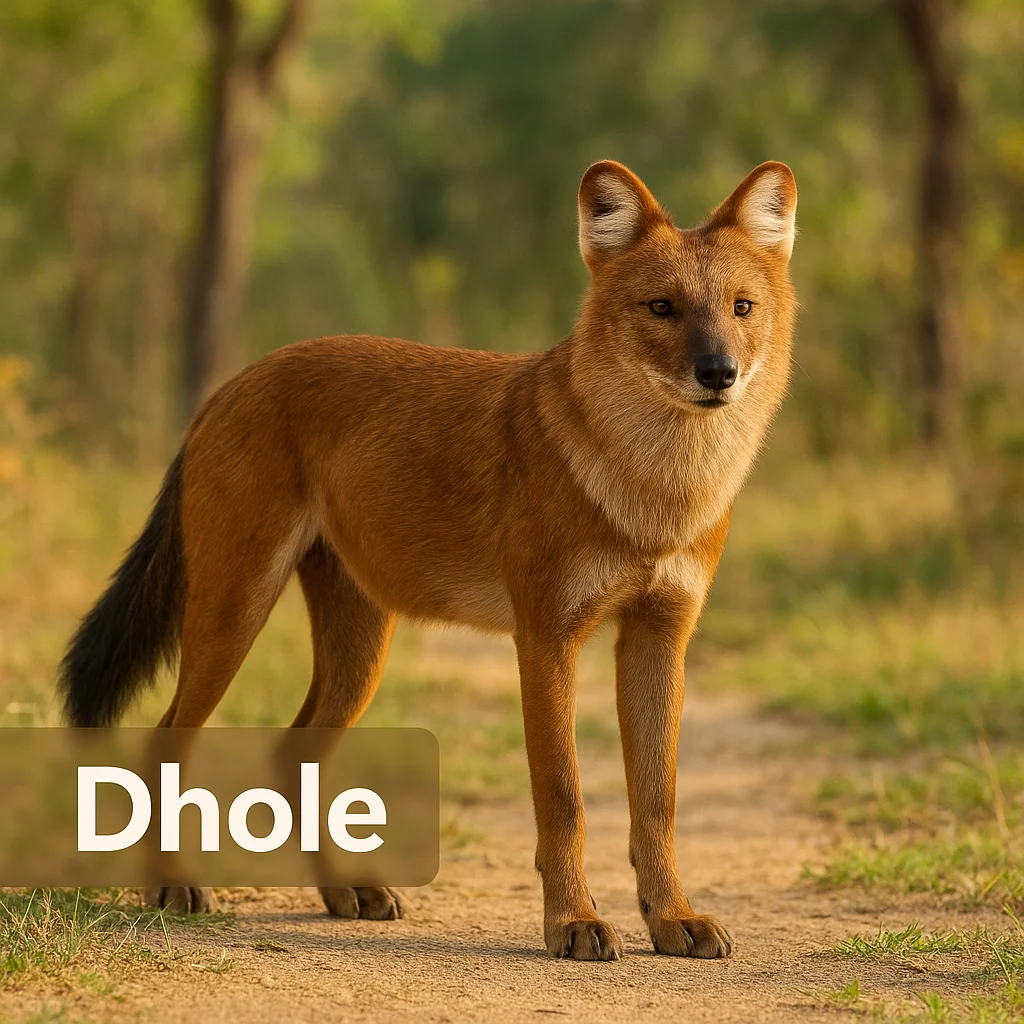
The Dhole, scientifically known as Cuon alpinus, is a wild canid native to various parts of Asia. It is also referred to as the Asiatic wild dog. Dholes are known for their social behavior and distinct vocalizations, setting them apart from other canid species.
- Common name(s): Dhole, Asiatic Wild Dog
- Scientific name: Cuon alpinus
- Animal type: Mammal
- Typical adult size: Length 90 - 110 cm; Tail 40 - 45 cm; Weight 12 - 20 kg
- Typical lifespan: 10 - 12 years in the wild
- Diet type: Carnivore; primarily hunts medium and large-sized ungulates
- Activity pattern: Diurnal
- Social structure: Pack animals, living in groups of around 5 - 12 members
- Speed / movement highlights: Capable runners, maintain speed over long distances
- Intelligence/learning: Highly intelligent with complex problem-solving skills
- Primary habitats: Forest, grassland, mountain areas
- Geographic range: Now primarily found in India, Southeast Asia, and China
- Predators/threats: Tigers and leopards; human encroachment and habitat destruction
- Conservation status: Endangered; varies by region
🔍 Identification & Appearance
Dholes have a distinctive appearance, with their slender and muscular build making them adept hunters. Their coat is typically a rich red coloration with lighter underparts, which may vary to a darker brown in some individuals. These wild canids have bushy tails and large upright ears, contributing to their keen sense of hearing.
- Body shape and silhouette: Slender yet muscular, with a pronounced, bushy tail
- Key colors/patterns: Red to brown coat, lighter throat and belly; variations seen between individuals
- Distinctive features: Bushy tail, large ears, and sharp facial features
- Tracks: Paw prints similar to those of domestic dogs, but slightly elongated
- Common look-alikes: Can be confused with the African wild dog, but dholes have a more uniform coat coloration
- Bushy, black-tipped tail
- Large ears that stand erect
- Reddish-brown coat with uniform color
- Sharp, angular facial structure
- Found in pack-oriented environments
- Top ID Tips
🧱 Body Structure & Physical Adaptations
The Dhole exhibits physical adaptations that support its role as a social hunter. Its body is designed for endurance and speed, crucial attributes for chasing prey over long distances. Dholes have powerful jaws and sharp teeth, well-suited for meat consumption.
- Build and proportions: Slender, with strong limbs and a bushy tail for balance
- Teeth/jaw adaptations: Sharp carnassials for shearing meat, powerful jaw muscles
- Claws: Non-retractable, aiding in grip during high-speed pursuits
- Sensory strengths: Exceptional hearing and smell, moderate vision
- Endurance runners capable of sustained chases
- Strong pack coordination during hunts
- Acute auditory and olfactory senses
- Adapted for diverse terrains from forests to mountains
- Highly efficient digestive system for meat consumption
- Key Adaptations
🌍 Range & Distribution
Dholes are primarily found in Asia, with significant populations in India, Southeast Asia, and parts of China. These carnivores inhabit a variety of environments, ranging from dense forests to open grasslands. Elevation ranges typically include lowland to moderate altitudes, avoiding extremely arid or icy regions.
- Continents/regions: Asia, prominently in India, Southeast Asia, and China
- Biomes: Forests, grasslands, and mountainous areas
- Elevation range: Generally below 3000 meters
- India's Western Ghats and forested regions
- Dense jungles in Thailand
- Nepal's Himalayan foothills
- Forest edges in Malaysia
- Mid-altitude zones in southern China
- Where You Might Find It
🏞️ Habitat & Shelter
Dholes prefer varied habitats ranging from dense forest environments to open grasslands. These areas provide both cover and hunting grounds. Dholes create dens in sheltered locations, such as abandoned burrows or rock crevices, for raising their pups. Seasonal changes influence their activity, with drier months requiring more extensive foraging trips.
- Preferred habitats: Tropical forests, open grasslands, and mountainous regions
- Microhabitats: Utilize dens or rock crevices for shelter and breeding
- Behavioral adaptations to weather/season: Extensive foraging in dry seasons
- Importance of habitat: Provides cover for stalking prey and safe rearing areas for young
🧭 Behavior & Ecology
Social by nature, dholes live and hunt in packs, which allows them to take down larger prey. They are highly vocal and utilize a range of sounds for communication, crucial for coordinated hunting and maintaining pack cohesion. As apex predators, they play a significant role in controlling prey populations in their ecosystems.
- Daily routine: Active during daylight, engages in hunts and social activities
- Communication: Complex vocal calls, including whistles and chattering
- Interactions with other species: Compete with other large predators like tigers
- Role in ecosystem: Apex predators regulating prey species
- Coordinated pack hunts targeting large prey
- Extensive use of vocalization for pack coordination
- Scent-marking territories to ward off competitors
- Take part in communal grooming within packs
- Display playful behavior, strengthening social bonds
- Behavior Highlights
👥 Social Life & Group Dynamics
Dholes are among the most social of wild canids, often living in packs that can include up to 20 individuals, although smaller groups are more common. Packs are typically family groups, with deferred breeding among younger members until opportunities for dispersal arise. Cooperation in hunting and raising young is pervasive, showing intricate social structures.
- Solitary vs social tendencies: Highly social, rarely found alone
- Group types and sizes: Packs ranging from 5 to 12 members, occasionally larger
- Cooperation: Cooperative hunting and pup-rearing
- Dominance hierarchies: Subtle, with limited aggressive displays compared to other canids
- Hierarchies more relaxed compared to wolves
- Young delay breeding in home pack for survival
- Communal care for offspring within packs
- Subordinate members assist in feeding leaders' pups
- Pack size may fluctuate with resource availability
- Social Structure Notes
🍽️ Diet, Prey & Predators
Dholes are obligate carnivores with a diet focusing on medium to large mammals like deer and wild boar. They use group tactics to hunt efficiently, and their diet may shift seasonally based on prey availability. While they have few natural predators, they face competition and threats from larger carnivores, such as tigers and leopards, and human activities.
- Diet: Primarily ungulates; vary prey selection seasonally
- Hunting targets and strategies: Hunt cooperatively; pursue and corner prey using pack coordination
- Main natural predators: Tigers and leopards
- Anti-predator defenses: Rely on pack numbers and agility for safety
- Prefer deer species; opportunistic with diet
- Utilize speed and endurance to exhaust prey
- Less scavenging compared to other predators
- Hunting efficiency increases with pack size
- Young are fed regurgitated meat by adults
- Feeding Notes
🦌 Hunting, Foraging & Movement
With an emphasis on pack hunting, dholes are strategic predators that combine speed and endurance. They engage in cooperative tactics that allow them to overcome prey larger than themselves. Their movement patterns within a territory often involve traversing large distances in search of food.
- Locomotion style: Endurance runners, adept at pack coordination
- Speed and endurance: Capable of sustained runs exceeding 45 km/h
- Typical hunting times: Primarily diurnal, focusing on early mornings and late afternoons
- Navigation and spatial behavior: Territorial with overlapping ranges during scarce periods
- Long-range chases; wear down prey
- Switch between land covering strategies based on prey movement
- Spot prey via scent detection before visible approach
- Navigate using communal trails and scent markers
- Adjust movement patterns seasonally
- Movement & Strategy
🧠 Intelligence & Senses
Dholes display impressive intelligence, clearly observable in their social structures and complex hunting strategies. They rely extensively on their heightened senses to detect prey and communicate effectively within packs. Although detailed research is limited, their observed behavior highlights problem-solving abilities.
- Problem-solving and learning: Efficient hunters through learned cooperation
- Senses: Acute smell and hearing help detect prey and avoid danger
- State of research: Limited studies, but known for elaborate social intelligence
- Flexible hunting strategies adapted to pack size
- Sophisticated methods of vocal communication
- Dense memory for recognizing pack members
- Efficient problem-solving in complex environments
- Adaptable diet reflecting ecological changes
- Notable Abilities
🪺 Reproduction, Pregnancy & Parenting
The Dhole's breeding primarily occurs once a year, with a mating system that shows temporary pair bonds. Gestation lasts around 60-63 days, resulting in litters of 4-6 pups on average. Parenting is collaborative, with pack members sharing responsibilities to ensure the young's survival and development.
- Breeding seasonality and courtship: Seasonal breeders with courtship involving mutual grooming
- Mating system: Monogamous seasonally; potential for multi-male aspects
- Gestation period: 60-63 days
- Litter size and development: Average of 4-6 pups; born altricial
- Parenting roles: Cooperative raising by entire pack for maximum survival
- Births occur in dens, well-protected from threats
- Pups nursed for about two months before emerging
- Delayed sexual maturity encourages stay-at-home strategy
- Alloparental care boosts young's survival chances
- Cooperative feeding ensures nutritional adequacy for growing pups
- Reproduction Snapshot
♀️♂️ Male vs Female Differences
In dholes, sexual dimorphism is subtly exhibited, with males being slightly larger than females. While both sexes participate in hunting and care for the young, the exact roles may differ slightly, with females primarily governing near-birth nurturing activities.
- Size/weight differences: Males slightly larger than females
- Coloration and features: Largely similar, with minor differences in robustness
- Behavioral roles: Females central in raising young; both genders partake in hunting
- Males more involved in defense of territory
- Females more dominant during pup-rearing
- Subtle morphological differences exist, focusing primarily on size
- No pronounced differences in coat coloration
- Behavioral roles flexible based on pack needs
- Sex Differences at a Glance
🧬 Subspecies & Variation
There is some debate and uncertainty within subspecies classification of dholes, with variation mostly linked to environmental adaptations. Regional adaptations include slight changes in size, coat thickness, and color, reflecting localized climate and terrain conditions.
- Known subspecies differences: Debatable classifications with geographical adaptations noted
- Local adaptations: Size and coat thickness/quality may vary regionally
- Classification uncertainties: Challenge in defining subspecies strictly helps maintain comprehensive conservation strategies
- Subtle size differences across major latitude zones
- Variability in coat density aligned with climatic shifts
- Insular populations display slight dwarfism
- Adaptive response to local prey availability noted
- Preserving genetic variability critical for species conservation
- Variation Notes
⚠️ Threats, Conservation & Human Interaction
Dholes face substantial threats, primarily from habitat destruction and fragmentation due to human expansion and land use changes. They are also affected by diminished prey availability, disease transmission from domestic dogs, and direct persecution in some areas. Conservation efforts are directed towards habitat protection, reducing human-wildlife conflict, and maintaining prey populations.
- Natural challenges: Predation pressure from large cats
- Human-related pressures: Habitat loss, reduced prey, and retaliatory killings
- Coexistence tips: Encouraging ecotourism and protective legislations to sustain healthy ecosystems
- Common captive status: Found in some zoos for philanthropy and breeding programs; discourage capturing/removal from wild
- Engage in habitat restoration to support wild dhole populations
- Educate local communities on dholes' ecological role
- Ensure policies consider non-lethal management of livestock predation
- Advocate for preservation of natural prey species
- Support regulated ecotourism to raise conservation awareness
- Responsible Notes
✨ Fun Facts & Unique Traits
- Dholes have an impressive vocal vocabulary, crucial for their complex social interactions.
- They can leap across wide crevices and streams - an ability quite unique among canids.
- Dholes play a significant cultural role and are central figures in some regional folklore.
- Unlike wolves and other dogs, dholes do not bark. Instead, they produce whistling noises for communication.
- Despite being endangered, dholes remain one of the least studied wild carnivores in the world.
- These canids support ecosystem balance by acting as major control agents of prey populations.
- Dholes form dens for raising pups, maintaining a concealed shelter to ensure survival.
- Packs can be observed practicing synchronized hunting, indicative of high social coordination.
📌 Summary
- Dholes, known scientifically as Cuon alpinus, are social and vocal canids native to Asia.
- They thrive in diverse habitats, including forests and grasslands, across regions like India and Southeast Asia.
- As pack animals, they are primarily carnivorous, hunting mid to large-sized prey like deer.
- Endurance runners, dholes rely on cooperative hunting strategies within their packs.
- Despite facing threats from habitat loss and competition with big cats, dholes play a critical role as apex predators.
- Intricate social structures facilitate coordinated hunting and collective care for offspring.
- The dholes' unique vocal communication sets them apart from other canids.
- Endangered, yet remarkably adaptable, dholes underscore the urgency for comprehensive conservation measures.
- Understanding their role in ecosystems highlights ecological diversity and community cohesion.