🦁 Coyote
🧾 Quick Facts
The coyote, known for its adaptability and keen survival instincts, is a versatile mammal found widely across North America. It thrives in a range of environments from deserts to urban areas.
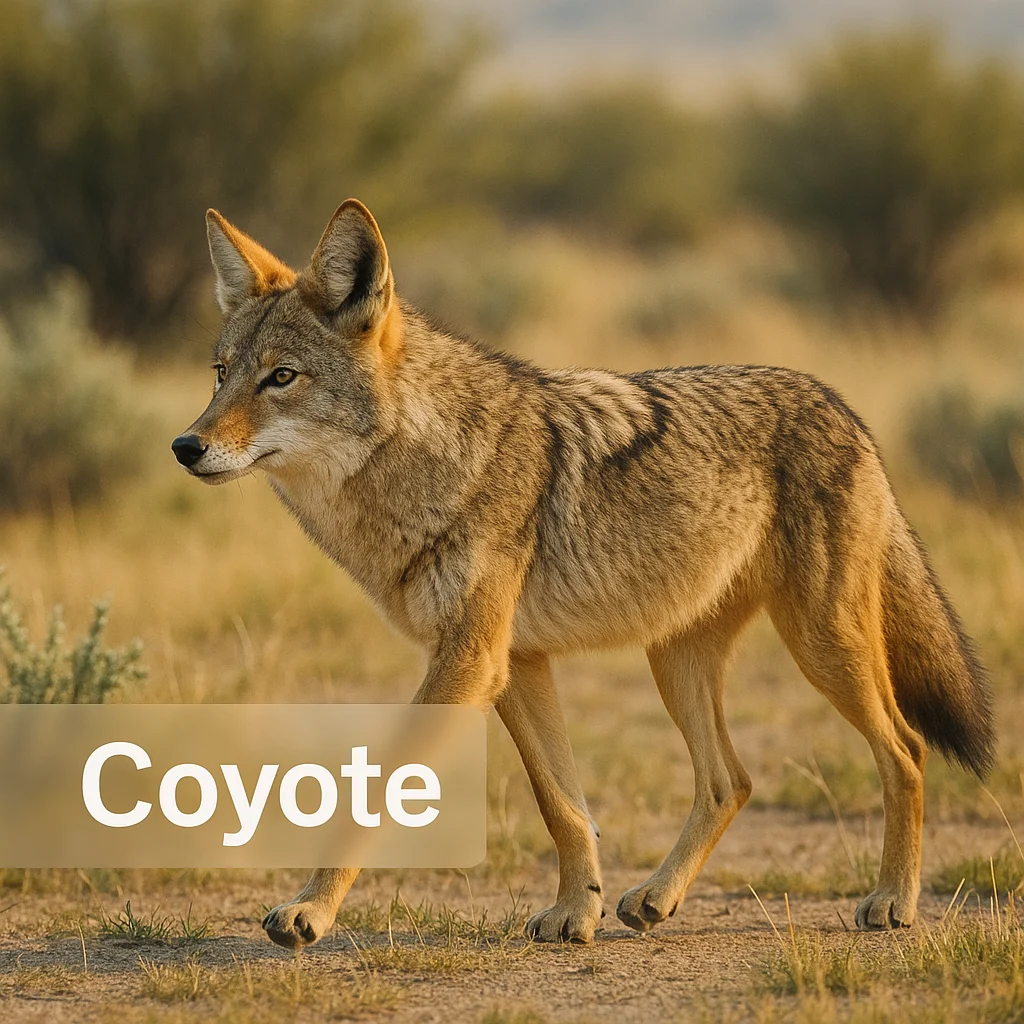
- Common name(s): Coyote
- Scientific name: Canis latrans
- Animal type: Mammal
- Typical adult size: 4-5 ft (including tail); weight ranges from 15-50 lbs
- Typical lifespan: 10-14 years in the wild
- Diet type: Omnivore; includes small mammals, insects, fruits, and carrion
- Activity pattern: Primarily nocturnal but can be active in daylight
- Social structure: Solitary, pairs, or small family groups
- Speed / movement highlights: Capable of running at speeds up to 40 mph
- Intelligence/learning: Highly adaptable with problem-solving skills
- Primary habitats: Forests, grasslands, deserts, urban areas
- Geographic range: North America, from Canada to Central America
- Predators/threats: Predators include wolves and bears; human-related threats include habitat loss and hunting
- Conservation status: Least Concern, but varies by region
🔍 Identification & Appearance
Coyotes can be identified by their slender build, bushy tail often held low, and pointed ears. The coloration varies from grayish-brown to reddish-brown with a blend of black and white patterns.
- Body shape and silhouette: Slender, with a bushy tail
- Key colors/patterns: Variable colors, often grayish-brown
- Distinctive features: Long pointed ears, tapered muzzle
- Tracks/scat: Track resembles a domestic dog but more elongated
- Common look-alikes: Resembles the red fox and domestic dogs; has larger ears and more bushy tail
- Top ID Tips
- Look for a bushy tail held low
- Note the pointed ears and tapered muzzle
- Grayish-brown coloration with potential reddish hues
- Compare tracks - longer and narrower than domestic dogs
- Observe behavior - coyotes are more skittish than dogs
- Listen for vocalizations, distinct howls, yips
🧱 Body Structure & Physical Adaptations
Coyotes have a flexible, elongated body built for speed and endurance. Their sharp teeth are adapted for a varied diet while their powerful senses aid in navigation and hunting.
- Build and proportions: Slender with long limbs
- Teeth/jaw adaptations: Sharp incisors and canines for tearing meat
- Claws: Non-retractable, aiding in digging
- Sensory strengths: Keen sense of smell, excellent hearing
- Key Adaptations
- Long legs for running at high speeds
- Sharp, robust teeth for diverse diet
- Acute sense of smell for tracking prey
- Non-retractable claws for digging and traction
- Remarkable hearing to detect distant sounds
- Thick fur for insulation in varied climates
- Sensitive nose for identifying chemical signals
🌍 Range & Distribution
Coyotes are widespread across North America, adapting to diverse biomes. They can be found from the northern forests of Canada to the arid deserts of Mexico.
- Continents/regions: North America
- Typical countries/biomes: Canada, USA, Mexico, forests, grasslands, deserts
- Elevation range: Sea level to high mountainous regions
- Migration: Mostly resident with some local movements
- Where You Might Find It
- Forests in Canada
- Desert areas in the southwestern USA
- Grasslands of the Great Plains
- Urban and suburban settings across North America
- National parks and natural reserves
🏞️ Habitat & Shelter
Coyotes favor a range of habitats from open plains to urban areas. They often seek shelter in underground dens or existing natural cover to protect from extreme weather and predators.
- Preferred habitats: Forests, grasslands, deserts
- Microhabitats and shelter: Underground dens, thickets
- Weather/season changes: Seek shelter to avoid severe weather
🧭 Behavior & Ecology
Coyotes are both solitary and social, with intricate communication through howls and scent marking. They play an important role in ecosystems as both predators and scavengers.
- Daily routine: Active primarily at night
- Communication: Vocalizations, scent marking
- Interactions with other species: Scavengers, opportunistic hunting
- Role in the ecosystem: Predators and scavengers, help control rodent populations
- Behavior Highlights
- Nocturnal hunting to avoid predators
- Complex vocal communication
- Territorial through scent marking
- Solitary or small family groups
- Scavenge to supplement diet
- Adaptation to urban life
👥 Social Life & Group Dynamics
Coyotes exhibit flexible social structures, often seen in pairs or small family units known as packs. They display cooperative behavior, particularly in hunting and rearing young.
- Solitary vs social tendencies: Both solitary and social
- Group types: Small packs or pairs
- Cooperation: Cooperative hunting, parenting
- Dominance hierarchies: Present, subtle dominance behaviors
- Social Structure Notes
- Typically found in pairs or small family groups
- Exhibit social play among juveniles
- Cooperative in rearing young
- Communicate through vocal interactions within packs
- Temporary alliances for hunting
🍽️ Diet, Prey & Predators
Coyotes have a highly adaptable diet, consuming a variety of foods available in their environment. They are opportunistic hunters and often scavenge as well.
- Diet: Small mammals, birds, fruits, insects, carrion
- Hunting targets and strategies: Hunt alone or in pairs, rely on stealth and speed
- Main natural predators: Wolves, bears, mountain lions
- Feeding Notes
- Omnivorous diet tailored to availability
- Hunt small to medium-sized animals
- Pick fruits and berries seasonally
- Scavenge carrion when present
- Avoids larger predators through stealth and speed
🦌 Hunting, Foraging & Movement
Coyotes are swift runners and use strategic hunting techniques such as stalking and ambushing. They are also agile foragers, often exploiting human-altered environments.
- Locomotion style: Primarily runners, can swim
- Speed and endurance: Can run up to 40 mph
- Typical hunting/foraging times: Primarily nocturnal
- Movement & Strategy
- High-speed running and endurance
- Stealthy stalking for hunting prey
- Agile movement in varied terrains
- Forage in human-dominated landscapes
- Utilize cover and speed to avoid predators
🧠 Intelligence & Senses
Coyotes are known for their adaptability and problem-solving skills, often using their acute senses to thrive in challenging environments.
- Problem-solving and learning: Highly intelligent, adaptable
- Senses: Exceptional hearing and olfaction for navigation and hunting
- Notable Abilities
- Proficient problem-solving skills
- Adept at adapting to urban environments
- Acute auditory and olfactory abilities
- Sophisticated communication through vocalizations
- Quick learners from environmental interactions
🪺 Reproduction, Pregnancy & Parenting
Coyotes have a flexible breeding strategy with both parents involved in rearing young. They typically breed once a year with varying litter sizes.
- Breeding seasonality: Breeds once a year, typically January to March
- Mating system: Monogamous pairs
- Gestation period: Approximately 60-65 days
- Litter size range: 3-7 pups
- Parenting roles: Both parents involved, pups weaned at 5-7 weeks
- Reproduction Snapshot
- Breeds in early spring
- Monogamous mating pairs
- Pups born after about two-month gestation
- Both parents participate in rearing
- Young are dependent until fall
♀️♂️ Male vs Female Differences
In coyotes, sexual dimorphism is minimal, but males are generally larger than females. Behavioral roles can differ slightly, particularly in territorial defense and nurturing young.
- Size differences: Males are slightly larger
- Behavioral roles: Males often more involved in territory defense
- Sex Differences at a Glance
- Males usually larger and heavier
- Both genders participate in care of young
- Similar coloration and markings
- Male dominance in territoriality
🧬 Subspecies & Variation
Coyotes display regional variations due to their expansive range. These variations can include differences in size and color, but consistent subspecies classification is complex and often debated.
- Subspecies: Regional size and coat variations
- Local adaptations: Adapt to diverse habitats and climates
- Variation Notes
- Size variations among populations
- Color variations in different regions
- No widely accepted subspecies classifications
- Adaptations to desert vs forest habitats
⚠️ Threats, Conservation & Human Interaction
While generally not endangered, coyotes face challenges from habitat destruction and human conflict. They have adapted to living near human settlements, sometimes leading to negative interactions.
- Natural challenges: Predation by larger carnivores
- Human pressures: Habitat loss, hunting, road mortality
- Coexistence tips: Avoid feeding and trapping; secure waste to prevent attraction
- Responsible Notes
- Keep environments clean to deter encounters
- Understand and respect their role in local ecology
- Avoid direct interaction and feeding
- Support conservation efforts for natural habitats
✨ Fun Facts & Unique Traits
- Coyotes are often considered a symbol of trickery and intelligence in Native American folklore.
- They can adjust their litter sizes depending on the food availability.
- Coyotes are capable of jumping distances up to 13 feet.
- They have a highly flexible diet and can switch food sources according to availability.
- Coyotes are one of the few species that have expanded their range despite human urbanization.
- Their howls and yips are used to establish territory and communicate with the pack.
📌 Summary
- Coyotes are agile, medium-sized mammals found in North America.
- They are adaptable to a wide range of habitats from deserts to urban settings.
- Their diet is omnivorous, often including small mammals and fruits.
- Natural predators include wolves and mountain lions, though they adapt well to urban areas.
- Coyotes exhibit both solitary and group behaviors, often forming pairs or small packs.
- Reproduction involves monogamous pairs with both parents helping raise the young.
- Key adaptations include keen senses and a swift running ability.
- Notable for their distinctive howls and vocalizations.