🦁 Cougar (Puma)
🧾 Quick Facts
The cougar, also known as the puma, mountain lion, or catamount, is a large feline native to the Americas. Renowned for its adaptability to diverse ecosystems, the cougar is an apex predator across its range.
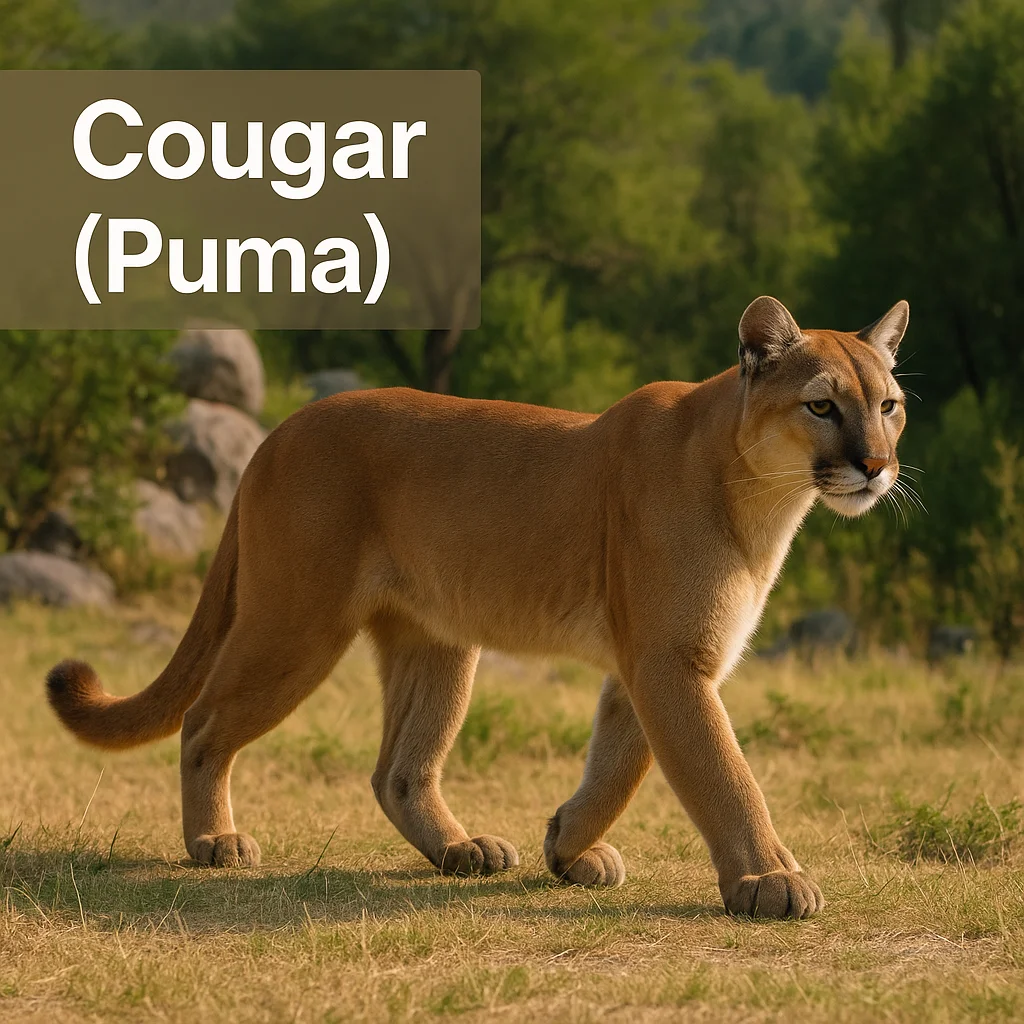
- Common name(s): Cougar, puma, mountain lion, catamount
- Scientific name: Puma concolor
- Animal type: Mammal
- Typical adult size: 5–9 feet from nose to tail; weight varies from 64 to 220 pounds
- Typical lifespan: 8–13 years in the wild, up to 20 years in captivity
- Diet type: Carnivore; primarily deer, but also small mammals and birds
- Activity pattern: Crepuscular and nocturnal
- Social structure: Solitary, except mothers with cubs
- Speed / movement highlights: Capable of bursts up to 50 mph; agile climber
- Intelligence/learning: Known for problem-solving abilities and adaptability
- Primary habitats: Forests, mountains, deserts, and wetlands
- Geographic range: Broad range from Canada to the southern Andes in South America
- Predators/threats: Humans, other large carnivores
- Conservation status: Varies by region; concern mainly due to habitat loss
🔍 Identification & Appearance
The cougar is a large, sleek feline with a robust body and long tail. Their coat is typically tawny or sandy, but can vary from grey to reddish depending on the region. Cubs have spots which fade as they mature. Cougars have a small, round head with rounded ears.
- Body shape and silhouette: Muscular and agile; large tail used for balance
- Key colors/patterns: Tawny with lighter underparts; cubs have spots
- Distinctive features: Long tail, large paws, prominent whiskers
- Tracks and signs: Round paw prints, often without visible claws
- Common look-alikes: Lynx are smaller with tufted ears; jaguars have rosettes
- Top ID Tips
- Look for long tails and uniform color
- Spotty cubs can signal a family group
- No ear tufts distinguish from lynx
- Tawny coat differs from jaguar spots
- Tracks lack claws, unlike canids
- Round ears set them apart from other big cats
🧱 Body Structure & Physical Adaptations
Cougars are built for stealth and strength. They have a flexible spine, powerful hind limbs for jumping, and large paws that help distribute weight for silent movement. Their sharp retractable claws are vital for climbing trees and catching prey.
- Build and proportions: Muscular body, long limbs, thick neck
- Teeth and biting power: Strong jaws with sharp canines
- Claws: Retractable for climbing and gripping
- Sensory strengths: Excellent night vision, acute hearing
- Key Adaptations
- Flexible spine for agility
- Powerful hind limbs for leaping
- Padded paws for stealth
- Sharp retractable claws
- Jaw strength for large prey
- Enhanced night vision
- Keen sense of hearing
- Adaptive camouflage in various environments
🌍 Range & Distribution
Cougars have one of the widest distributions of any terrestrial mammal in the Western Hemisphere. They are found from the Yukon in Canada to the Andes in southern Chile. Although adaptable, their presence is reduced in areas of dense human activity.
- Continents/regions: North and South America
- Typical range: From Canada to South America
- Elevation range: Sea level to mountain ranges
- Migration patterns: Generally resident, territorial movements
- Where You Might Find It
- Western Canada and the United States
- Florida panhandle (isolated population)
- Andes Mountain region
- Open forests and grasslands
- Desert and scrub habitats
- Suburban edges (increasingly sighted)
🏞️ Habitat & Shelter
Cougars thrive in varied habitats, including dense forests, montane deserts, and jungle lowlands. They establish territories with ample cover and available prey. Dens are typically located in rocky outcrops, dense vegetation, or caves.
- Preferred habitats: Forests, mountains, swamps, and deserts
- Shelter: Dens in caves, thickets, or under rock ledges
- Seasonal behavior: May vary territory size based on prey availability
- Survival importance: Habitat impacts hunting success and safety
🧭 Behavior & Ecology
Cougars are solitary and territorial, marking their range with scent and vocalizations. They rely on stealth and strong physical capabilities for hunting. As ambush predators, they play a crucial role in controlling prey populations, thus balancing the ecosystem.
- Daily routine: Primarily active at dusk and dawn
- Communication: Vocal calls, scent marking for territory
- Interactions: Avoidance of humans; competition with other predators
- Ecological role: Apex predator controlling prey populations
- Behavior Highlights
- Territorial defense through vocal calls
- Ambush hunting in forested cover
- Occasional scavenging when prey is scarce
- Tolerant to wide temperature ranges
- Territory overlap mainly in resource-rich areas
- Seasonal behavior changes with prey migration
👥 Social Life & Group Dynamics
Typically solitary outside the mating season, cougars maintain large territories. Males and females only come together for mating. Female cougars will raise the cubs alone, with young staying with their mothers up to two years.
- Solitary tendencies: Strong preference for solitary life
- Group interactions: Mating and short-term family groupings
- Dominance: Territorial disputes rarely physical
- Group size: Female with 2–4 cubs
- Social Structure Notes
- Females nurse and protect cubs solo
- Male territories overlap several females
- Cubs learn hunting skills from mothers
- Independent maturation around 18–24 months
- Short bonding periods during mating seasons
🍽️ Diet, Prey & Predators
Cougars primarily prey upon ungulates like deer, although they are opportunistic feeders and will hunt smaller animals when needed. They have few natural predators but are occasionally preyed upon by wolves and bears. Defensive tactics include climbing and moving stealthily at night.
- Diet: Mainly deer, small mammals, rodents
- Hunting strategies: Ambush predator, stealth expert
- Natural predators: Rarely, wolves and bears
- Anti-predator tactics: Stealth, climbing ability
- Feeding Notes
- Diet largely deer-based
- Flexible diet when necessary
- Territory with sufficient prey crucial
- Role as secondary consumer in food chain
- Self-defense via strategic retreats
🦌 Hunting, Foraging & Movement
Cougars are agile ambush hunters that rely on a combination of patience and burst speed to capture prey. They exhibit versatile movement skills, which include running, climbing, and swimming. Cougars are known to cover several miles a night while patrolling their territories.
- Locomotion style: Stealthy ambush predator
- Speed and endurance: Short bursts at 50 mph
- Hunting tactics: Stalk and pounce
- Navigation skills: Strong memory for territory
- Movement & Strategy
- Exceptional climbing ability
- Long-distance night patrols
- Effective use of terrain
- Quick acceleration for pouncing
- Different tactics for various prey sizes
- Highly territorial nature
🧠 Intelligence & Senses
Cougars possess high intelligence, reflected in their strategic hunting methods and territorial management. Despite their solitary nature, they demonstrate strong problem-solving abilities and keen senses of smell, hearing, and sight, particularly useful for night hunting.
- Problem-solving skills: Demonstrates strategic hunting techniques
- Sensory usage: Relies on night vision and acute hearing
- Research gaps: Understanding of learning in cougars is limited
- Notable Abilities
- Advanced problem-solving capacity
- Exceptional vision, especially at night
- Hearing tuned to detect prey
- Quick learning observed in hunting
- Memory aids in territory navigation
🪺 Reproduction, Pregnancy & Parenting
Reproduction in cougars occurs year-round, with a peak in late winter to spring. They are polygynous, and the gestation period lasts about 91–97 days. Typically, females give birth to 1–6 cubs, which are cared for solely by the mother. Cubs are born blind and rely on the mother for several weeks.
- Breeding seasonality: Year-round, primarily spring
- Mating system: Polygynous
- Gestation period: 91–97 days
- Litter size: 1–6 cubs, usually 2–4
- Parenting roles: Maternal care, teaching hunting skills
- Reproduction Snapshot
- Mating throughout the year
- Cubs stay with mother up to 24 months
- Independent by year 2
- Cubs integrated into mother’s territory while young
- Care focused mainly on learning survival
♀️♂️ Male vs Female Differences
Male cougars are generally larger and more robust than females. Males play no role in cub rearing and maintain larger territories. Both sexes have similar tawny coloring, and behavioral differences are subtle regarding hunting techniques and territory marking.
- Size differences: Males larger than females
- Territorial roles: Males have larger territories
- Behavioral distinctions: No involvement in cub-rearing
- Sex Differences at a Glance
- Males 20–30% heavier
- Territorial sizes significantly larger in males
- Male competition leads to territorial disputes
- Female home range adapted to maternal needs
🧬 Subspecies & Variation
There are debates over the number of cougar subspecies, with most classifications recognizing about six distinct ones. These suggested subspecies are adaptations to local environments, influencing size and coat color. The Florida panther is a distinct population showing unique conservation challenges.
- Known subspecies: Approx. six debated subspecies
- Local adaptations: Sizes and colors adapted to environments
- Classification debates: Varying recognition among scientists
- Variation Notes
- Diverse coat shades across regions
- Wide size range along geographical lines
- Florida panther under unique conservation management
- Disagreement about number of subspecies prevalent
⚠️ Threats, Conservation & Human Interaction
Human-altered landscapes pose the greatest threat to cougars through habitat loss and fragmentation. Conservation efforts focus on securing habitat corridors and public education to minimize human-cougar conflicts. Cougars are occasionally kept in zoos, though such situations prioritize welfare.
- Conservation efforts: Preservation of habitat and corridors
- Natural challenges: Competition with large carnivores
- Human pressures: Land development, vehicle collisions
- Coexistence tips: Avoid approaching and secure livestock
- Responsible Notes
- Encourage habitat preservation
- Educate about non-lethal conflict resolution
- Maintain wildlife corridors
- Avoid disturbing forests and trail systems
- Respect protected areas and alerts
✨ Fun Facts & Unique Traits
- Cougars are the second-largest cats in the Americas after jaguars.
- Cub spots fade as they mature, helping with stalking coloration.
- They can leap up to 18 feet vertically and up to 40 feet horizontally, showcasing extraordinary jumping ability.
- Despite various names, "puma" is the most widely used terminology globally.
- Cougars communicate through a variety of vocal sounds, including yowling and hissing, but do not roar.
- Individual territories can span up to 300 square miles, often requiring extensive prey access.
- Their presence extends close to urban areas, leading to increased sightings.
- The Florida panther is an isolated population of cougars critically endangered due to habitat constraints.
📌 Summary
- The cougar, Puma concolor, is a versatile top predator native to the Americas.
- Able to adapt to various habitats from deserts to rainforests.
- Characterized by a tawny coat, large size, and a long tail.
- Mainly preys on deer but adjusts diet based on availability.
- Solitary animals with occasional female-led familial units.
- Breeding occurs year-round, with females rearing cubs alone.
- Declines mainly due to habitat fragmentation.
- Distinctions between males and females reflect size and territorial range.
- Important ecological role in controlling prey populations.