🦁 Brown Bear
🧾 Quick Facts
The Brown Bear is one of the most recognized and celebrated mammals on the planet. Known for their impressive size and omnivorous diet, these bears inhabit a variety of landscapes across multiple continents. They play a significant role in their ecosystems and show fascinating behavioral adaptations.
- Common name(s): Brown Bear, Grizzly Bear (regional)
- Scientific name: Ursus arctos
- Animal type: Mammal
- Typical adult size: 4.5 to 9 feet in length; 300 to 1,500 pounds in weight
- Typical lifespan: 20 to 30 years in the wild; up to 40 in captivity
- Diet type: Omnivore; includes fish, berries, small mammals, and roots
- Activity pattern: Diurnal during summer; can be nocturnal due to human activity
- Social structure: Mostly solitary; females with cubs often seen together
- Speed: Capable of running up to 35 mph over short distances
- Intelligence/learning: Highly intelligent; excellent problem solvers
- Primary habitats: Forests, mountains, tundra
- Geographic range: North America, Europe, Asia
- Predators/threats: Human-induced habitat loss, climate change
- Conservation status: Varies by region; some populations are vulnerable
🔍 Identification & Appearance
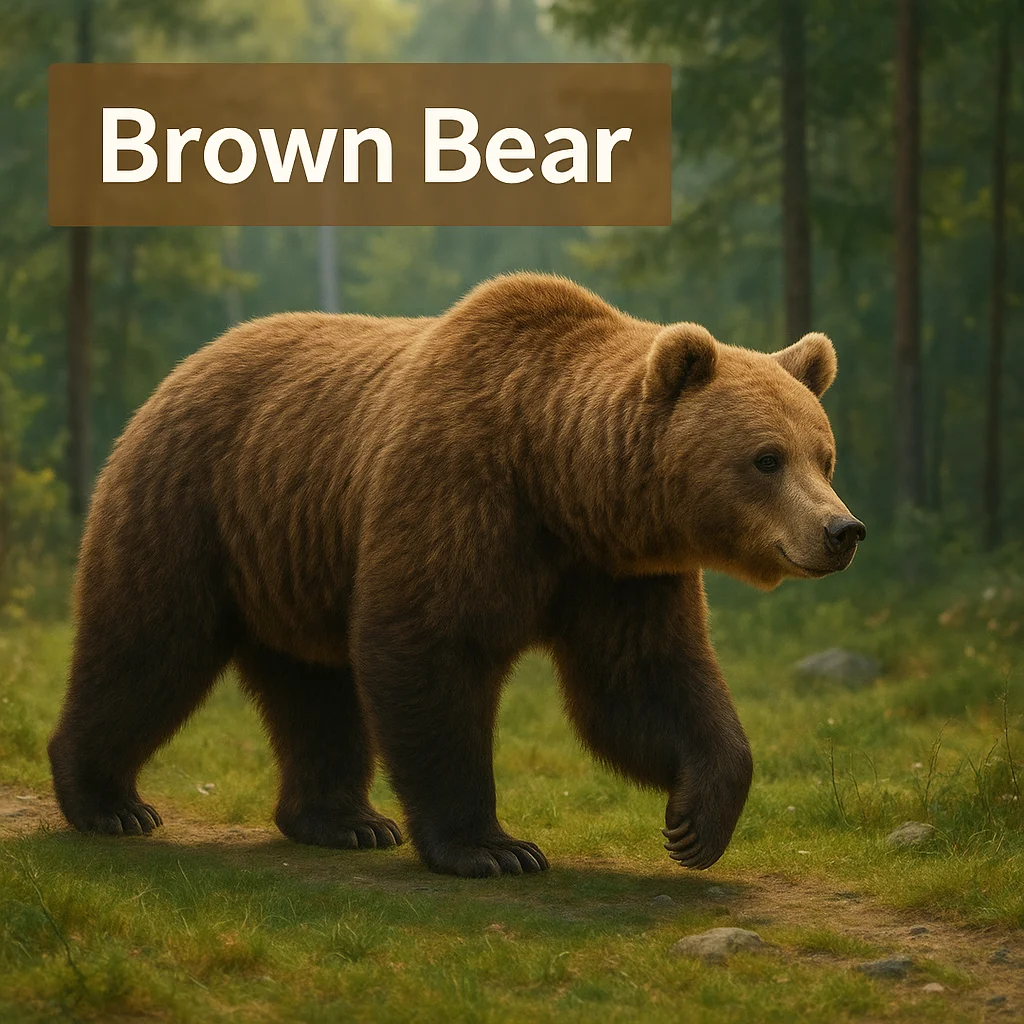
Brown Bears are characterized by their robust build and distinctive pelage. Their coats vary in color but generally range from brown to blonde, with some individuals exhibiting a reddish hue. Notable for their pronounced shoulder hump, broad heads, and relatively short ears, they have a powerful visual presence. Tracks are large and show five toes with an arched claw mark, indicating their impressive digging capabilities.
- Body shape: Stocky with a large shoulder hump
- Color changes: Fur color varies from dark brown to light blonde
- Distinctive features: Prominent shoulder hump, long claws, round face
- Tracks: Large, with five toes and long claw marks
- Common look-alikes: American Black Bear, distinguishable by larger size and hump
- Top ID Tips:
- Look for the large size and hump
- Notice the variation in fur color
- Examine tracks with long claws
- Broad, rounded face differentiates them from other bears
🧱 Body Structure & Physical Adaptations
Brown Bears are robust and equipped with adaptations for a diverse diet. Their strong, muscular legs are ideal for digging and running short distances at surprising speeds. They have a set of powerful jaws and large molars to process both animal and plant materials. Their keen sense of smell is one of the most developed among mammals, aiding in food location and communication.
- Build and proportions: Sturdy frames, with strong limbs and a small tail
- Teeth adaptations: Large, flat molars for grinding, sharp canines for tearing
- Claws: Long, non-retractable claws for digging and climbing
- Sensory strengths: Exceptional sense of smell, good hearing, average vision
- Key Adaptations:
- Powerful shoulder muscles
- Multi-purpose teeth1
- Long claws for multiple uses
- Heightened olfactory senses
🌍 Range & Distribution
Brown Bears have a wide distribution across the Northern Hemisphere. They can be found in North America, Europe, and Asia, inhabiting diverse environments from temperate forests to tundra. Their range includes significant stretches of wilderness in countries like Russia, Canada, and the United States, where they thrive in national parks and remote regions. Seasonal movements are common, as some populations migrate between feeding grounds.
- Where You Might Find It:
- Temperate and boreal forests in North America
- Mountain ranges in Europe
- Tundra regions of Asia
- Protected areas and national parks
- Remote lakesides during peak salmon spawning
🏞️ Habitat & Shelter
Preferences for habitat include dense forests, alpine meadows, and subarctic tundra. Brown Bears are quite adaptable but prefer areas with access to water and abundant food sources. During harsh weather or hibernation, they take shelter in carefully excavated dens, sometimes employing natural caves. Seasonal changes affect their behavior, with many bears entering a state of torpor during winter months.
🧭 Behavior & Ecology
These bears exhibit a complex set of behaviors matched to their environments. Primarily solitary, they establish territories based on food availability and breeding opportunities. Communication is through various means, including vocalizations and scent markings. Brown Bears impact their ecosystem significantly, acting as both predator and seed disperser. They interact dynamically with other species, often competing for resources.
- Behavior Highlights:
- Primarily solitary but tolerate others in abundant food areas
- Use scent marks to communicate presence
- Essential roles in seed dispersion
- Exhibit complex vocalizations
- Adjust diet seasonally for optimal nutrition
👥 Social Life & Group Dynamics
While largely solitary, Brown Bears do exhibit social behaviors, especially during mating or in areas with plentiful food. Groups can form transiently, particularly during salmon runs. Female bears, or sows, are often accompanied by cubs who learn crucial survival skills during their time together. Dominance hierarchies develop primarily in feeding aggregations.
- Social Structure Notes:
- Solitary nature with social tolerance
- Cubs follow mothers closely
- Transient group formation at food sources
- Dominance occasionally established over resources
🍽️ Diet, Prey & Predators
The Brown Bear's omnivorous diet includes plants and animals, demonstrating remarkable adaptability. Seasonal shifts affect their eating habits, with berries, nuts, and vegetation consumed in the summer months. Fish, such as salmon, become a significant food source during seasonal spawning. Natural predators are rare, though young cubs are vulnerable to other large predators.
- Feeding Notes:
- Diverse diet optimizes nutrient intake
- Opportunistic foraging maximizes resource use
- Seasonal focus on high-calorie foods like salmon
- Cubs are occasionally targeted by wolves or other bears
🦌 Hunting, Foraging & Movement
Brown Bears are proficient foragers and opportunistic hunters. Their robust build allows bursts of speed for short pursuits; however, they are primarily scavengers. Foraging is an essential activity, often in riverbanks for fish. Their movement patterns are adapted to optimize feeding and are sometimes dictated by changing environmental conditions. Navigation within their home range is rooted in memory and sensory cues.
- Movement & Strategy:
- Primarily a forager with excellent local knowledge
- Short bursts of speed used for opportunistic hunting
- Bears use memory to repeat successful foraging routes
🧠 Intelligence & Senses
With advanced cognitive abilities, Brown Bears show significant learning and problem-solving skills. They can remember food locations and adapt their strategies for new challenges. Their heightened senses—smell, in particular—enable them to detect food across vast areas. Bears communicate visually and acoustically, although research indicates reliance varies by population and individual bear characteristics.
- Notable Abilities:
- Excellent problem-solving capabilities
- Long-term memory of food sources
- Highly developed sense of smell for locating food
🪺 Reproduction, Pregnancy & Parenting
Breeding occurs in early spring, with a system that varies from polygamous to monogamous, depending on individual encounters. After a gestation period of roughly seven months, typically during hibernation, females give birth to 1 to 4 cubs in the safety of their dens. Cubs are altricial at birth and remain with their mothers for up to three years, learning essential survival skills.
- Reproduction Snapshot:
- Breeding primarily in spring
- Variable mating systems
- Cubs born during winter torpor
- Maternal care extends for multiple years
♀️♂️ Male vs Female Differences
Differences between the sexes include noticeable size disparities, with males generally larger than females. Behavioral roles can also vary; males may roam larger territories, while females focus on cub rearing. Subtle physical distinctions exist, such as a more pronounced shoulder hump in males.
- Sex Differences at a Glance:
- Males significantly larger than females
- Males have broader territories
- Females more involved in cub care
🧬 Subspecies & Variation
Brown Bears encompass a variety of subspecies, which exhibit differences in size, fur coloration, and geographical range. The coastal Alaskan bears, or Kodiak bears, are notably large, whereas the Eurasian populations may display diverse color patterns. Subspecies classification is complex and can vary, reflecting adaptations to local environments.
- Variation Notes:
- Kodiak bears are among the largest
- Eurasian populations may vary in color
- Adaptive size differences among regions
⚠️ Threats, Conservation & Human Interaction
Brown Bears face several natural and human-induced challenges, such as habitat loss and climate impacts. Conservation efforts aim to mitigate these issues, balancing ecological needs with human interests. Understanding bear behavior contributes to coexistence strategies, ensuring the maintenance of bear populations and their habitats.
- Responsible Notes:
- Habitat preservation is crucial
- Climate change impacts habitats
- Responsible tourism can benefit conservation
- Human-bear conflict mitigation essential
✨ Fun Facts & Unique Traits
- Brown Bears have an extraordinary memory for routes and foraging areas.
- Their sense of smell is highly developed, surpassing that of hound dogs.
- Bears undergo a state of torpor, drawing minimally on fat reserves.
- Brown Bears have been known to use tools, such as using their claws to turn over rocks.
- The infamous shoulder hump is due to muscle mass, giving strength for digging.
📌 Summary
- Easily identified by their large size and shoulder hump
- Prefers diverse habitats including forests and mountains
- Has a widespread range across three continents
- Omnivorous diet with seasonal adaptations
- Populations face threats from habitat loss
- Primarily solitary, with seasonal social congregation
- Reproduces with a unique winter birth in dens
- Exhibits impressive problem-solving abilities
- Diverse subspecies with regional adaptations