🦁 Arctic Fox
🧾 Quick Facts
The Arctic Fox, known for its beautiful fur and incredible adaptability, thrives in some of the harshest climates on Earth. It is a remarkable example of nature’s specialization and survival tactics.
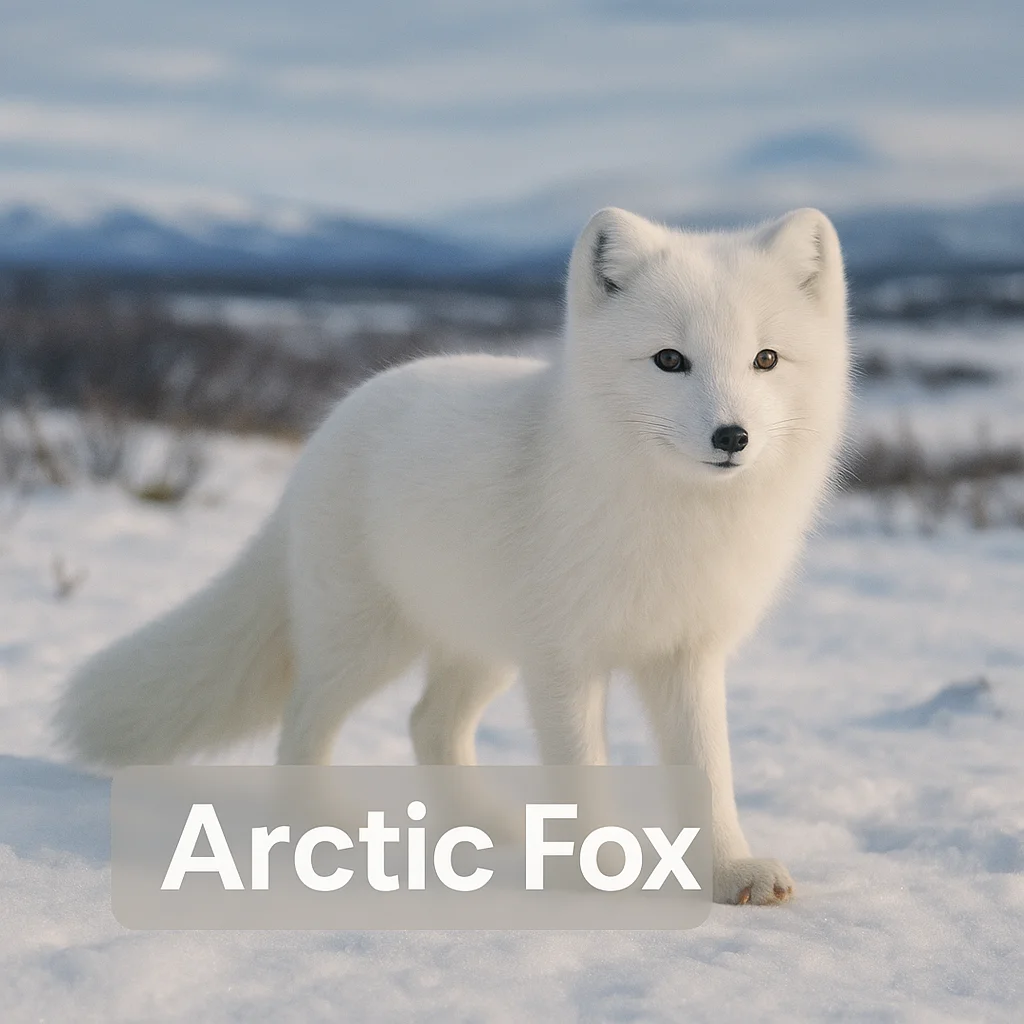
- Common name(s): Arctic Fox, White Fox, Polar Fox
- Scientific name: Vulpes lagopus
- Animal type: Mammal
- Typical adult size: 46-68 cm (18-27 in) in length, excluding tail; tail adds an additional 30 cm (12 in)
- Typical lifespan: 3-6 years in the wild; can live up to 10 years in captivity
- Diet type: Carnivore; feeds on lemmings, rodents, birds, fish, and carrion
- Activity pattern: Diurnal and nocturnal, depending on food availability
- Social structure: Solitary or pair-living, sometimes forming small family groups
- Speed: Capable of running speeds up to 50 km/h (31 mph)
- Intelligence/learning: Highly adaptable; effective at problem-solving
- Primary habitats: Tundra, coastal areas
- Geographic range: Arctic regions of North America, Europe, Asia
- Predators/threats: Polar bears, wolves; significant human pressures include climate change and habitat encroachment
- Conservation status: Least Concern, though climate change impacts are concerning
🔍 Identification & Appearance
The Arctic Fox is easily recognizable by its compact body, short legs, and bushy tail. Its winter coat is pure white, providing perfect camouflage against the snow, while its summer coat turns a brownish-gray to blend with the tundra's rocks and plants.
- Body shape and silhouette: Compact and rounded with short legs
- Key colors/patterns: White in winter; brownish-gray in summer
- Distinctive features: Bushy tail, small rounded ears, and dense fur
- Tracks/scat: Tracks show prints of four oval toes and a small heel pad; scat may contain fur and bones
- Common look-alikes: Red Fox; Arctic Fox is smaller and changes color with seasons
- Top ID Tips
- Compact, small body
- Seasonal coat color change
- Bushy tail for balance
- Small, pointed muzzle
- Short standing ears
- Paws adapted for snow travel
- Notable coat density
- White winter camouflage
- Blends with summer tundra
🧱 Body Structure & Physical Adaptations
The Arctic Fox is robustly built for survival in extreme cold. Its body structure and coat are optimized to reduce heat loss and allow efficient hunting and foraging.
- Build and proportions: Stocky build; short legs, ears, and muzzle
- Teeth/jaw adaptations: Sharp teeth suited for a carnivorous diet
- Claws: Sharp claws for digging and gripping ice
- Sensory strengths: Acute sense of hearing to detect prey under snow; good eyesight
- Key Adaptations
- Dense fur for insulation
- Short limbs reduce heat loss
- Thick, bushy tail for warmth
- Strong hearing for locating food
- Wider footpads for snow walking
- Seasonal coat changes for camouflage
- Lean, muscular body for efficient movement
- Phenomenal cold tolerance
- Efficient fat storage in winter
- Can reduce metabolism during food scarcity
🌍 Range & Distribution
The Arctic Fox resides primarily in northern circumpolar regions, effectively adapted to cold environments far above the timberline. It's mostly stationary year-round, but some populations may migrate locally to find food.
- Typical regions: Northern areas of Greenland, Canada, Norway, Russia, and Scandinavia
- Biomes: Tundra and icepack regions
- Elevation range: Sea level to Arctic highlands
- Seasonal movements: Generally non-migratory, but movements within home ranges occur
- Where You Might Find It
- Greenland tundras
- Northern Canadian coastlines
- Scandinavian polar regions
- Siberian tundras
- Ice-covered seas
- Islands in the Arctic Ocean
- Uninhabited polar deserts
- Rocky Arctic fjords
- Near seabird colonies (for food)
🏞️ Habitat & Shelter
Thriving in open, treeless tundra landscapes, the Arctic Fox finds shelter in complex den systems, built on high ground to avoid the moisture. Its preference for diverse landscapes allows it to adapt to limited food resources throughout the seasons.
- Preferred habitats: Open tundra with minimal vegetation
- Microhabitats and shelter: Dens often consist of intricate tunnels, used year after year
- Weather/seasonal behavior: Remains active year-round; fur changes color based on season
- Importance of habitat knowledge: Understanding habitats aids in comprehension of its ecological roles and survival strategies
🧭 Behavior & Ecology
The Arctic Fox is a solitary and adaptive hunter known for its resourcefulness. Its behaviors reflect a life tuned for survival amidst limited resources and harsh weather.
- Daily routine: Active both day and night, depending on prey availability
- Communication: Uses vocalizations, scent marking, and body language
- Interactions with other species: Competes with larger predators; may scavenge
- Role in the ecosystem: Acts as a primary consumer and scavenger, controlling rodent populations
- Behavior Highlights
- Adapts hunting behaviors seasonally
- Utilizes play in young for learning
- Efficient burrow creation for safety
- Varied vocalizations for communication
- Scavenger instincts reduce food waste
- Confronts resource scarcity adaptively
- Capable of caching excess food
- Tundra navigation utilizing scent
- Coastal foraging during low tide
- Knows home range intricately
👥 Social Life & Group Dynamics
While primarily solitary, Arctic Foxes occasionally form small family groups, especially during the breeding season. This dynamic facilitates efficient raising of young in challenging environments.
- Social tendencies: Mainly solitary but pairs during breeding
- Group types: Breeding pair or small family unit
- Cooperation: Both parents care for the young, especially in harsh climates
- Dominance: Displays minimal hierarchy, interactions based on cooperation rather than dominance
- Social Structure Notes
- Occasional family group formation
- Pairs cooperate in den preparation
- Raising young is a shared role
- Minimal territorial disputes
- Non-aggressive social encounters
- Flexible social structures
- Seasonal solitary behavior
- Temporary pair bonding in harsh seasons
- Promotes young survival collaboratively
🍽️ Diet, Prey & Predators
The Arctic Fox is a specialist predator and opportunistic forager. It primarily hunts small vertebrates and scavenges when necessary, adapting its diet to seasonal and regional availability.
- Diet: Predominantly small mammals like lemmings, supplemented with birds, eggs, berries, and fish
- Predators: Wolves, polar bears; young foxes may fall prey to birds of prey
- Anti-predator defenses: Camouflage, alertness, highly vocal warnings to others
- Scavenging behavior: Reliably scavenges carcasses left by larger predators
- Feeding Notes
- Diet fluctuates with prey cycles
- Consumes berries in summer
- Opportunistic scavenging common
- Predominantly carnivorous diet
- Caches food for later use
- Leverages predator leftovers
- Enhances diet with marine life
- Input to local food web complexity
- Utilizes efficient foraging strategies
🦌 Hunting, Foraging & Movement
An expert forager, the Arctic Fox displays adept hunting strategies adapted to its environment. Its movement is characterized by remarkable agility and endurance for harsh conditions.
- Locomotion style: Nimble runner adapted to snow travel
- Speed/endurance: Sustains moderate speeds over long distances
- Foraging tactics: Employs both active hunting and ambush strategies
- Navigation/spatial behavior: Detailed knowledge of home territory
- Movement & Strategy
- Efficient snow traverser
- Adapts to varied terrains
- Easily navigates dense environments
- Seasonally adjusts movement patterns
- Persistent and strategic hunting
- Intuitive navigation
- Remarkable agility over ice
- Endurance in low-resource climates
- Tracks prey under snow visually and auditorily
🧠 Intelligence & Senses
Displayed intelligence in the Arctic Fox is noted through its problem-solving abilities, adaptability, and resourcefulness. Its senses are well-developed for detecting and securing elusive prey.
- Problem-solving: Exhibits effective strategies in challenging food searches
- Senses: Excellent hearing for subterranean detection; uses visual cues effectively
- Uncertainties: Research opportunities still abound regarding detailed cognitive abilities
- Notable Abilities
- Adaptable problem-solver
- Efficient at detecting prey
- Utilizes acute hearing
- Learned survival tactics
- Effective seasonal adaptation
- Strong territory recognition
- Resource-efficient responder
- Utilizes memory-based caching
🪺 Reproduction, Pregnancy & Parenting
Arctic Foxes exhibit synchronized breeding patterns aligned with environmental conditions. The care of young involves both parents, which is critical in ensuring survivability due to harsh climates.
- Breeding seasonality: Occurs from April to May
- Mating system: Typically monogamous; some variation noted
- Gestation period: Between 49-57 days
- Litter size: 5-10 kits; variations dependent on food availability
- Parenting roles: Shared responsibilities between both parents
- Reproduction Snapshot
- Pair bonding during breeding
- Mating is typically monogamous
- Gestation lasts short, adaptive duration
- Litter sizes are adaptable to resources
- High parental investment
- Both parents engage in kit rearing
- Young are relatively altricial at birth
- Early den rearing provides warmth
- Parental cooperation ensures survival
♀️♂️ Male vs Female Differences
While males and females appear quite similar, subtle distinctions exist, primarily in size and specific roles related to reproduction.
- Size/weight differences: Males slightly larger than females
- Behavioral roles: Both involved in nest building and kit care, though males often protect territories more aggressively
- Other differences: Generally minimal, with size as the most distinct feature
- Sex Differences at a Glance
- Males show slightly greater size
- Both share parenting responsibilities
- Males frequently assert territory
- Main distinctions are behavioral
- Roles more flexible in harsh climates
- Females lead during kit-rearing stages
🧬 Subspecies & Variation
While there's limited recognition of subspecies, certain variations within populations suggest local adaptations to distinct environments.
- Subspecies variation: Debated, but may include region-specific adaptations
- Local adaptations: Possible differences in size and coat thickness by habitat
- Variation Notes
- Subspecies classifications are debated
- Coat thickness reflects local climate
- Size varies slightly between regions
- Coloration changes adaptive for seasons
- Main differences are ecological
⚠️ Threats, Conservation & Human Interaction
Facing both natural and human-induced challenges, the Arctic Fox's resilience is continually tested. Climate change poses significant long-term threats due to the alteration of its traditional habitat.
- Natural challenges: Inherent climate fluctuations and predator relations
- Human-related pressures: Climate change drastically affecting habitat; limited human conflict otherwise
- Conservation status: Currently Least Concern but needs monitoring for impacts of global warming
- Responsible Notes
- Climate shifts alter prey availability
- Essential to monitor human impact
- Coexistence requires awareness of needs
- Protected areas minimize habitat loss
- Climate change presents long-term risks
✨ Fun Facts & Unique Traits
- An Arctic Fox's keen hearing can detect small animals beneath a layer of snow.
- Its fur is the warmest of any animal in the Arctic, keeping it toasty even in extreme temperatures.
- Arctic Foxes can swim short distances, helping them navigate between ice floes.
- They can reduce their metabolic rate during food scarcity, conserving energy.
- In lean times, they often follow Polar Bears, scavenging off their leftovers.
- Arctic Foxes can endure temperatures below -50 degrees Celsius (-58 degrees Fahrenheit) without shivering.
- Their fur color changes seasonally, a rare trait for mammals, providing camouflage.
- They can travel up to 150 km (93 miles) in a single day in search for food.
- Arctic Foxes have a specialized blood protein that serves as antifreeze in the bloodstream.
📌 Summary
- Identifiable by its season-changing coat and compact shape
- Occupies Arctic tundra and coastal ecosystems across several continents
- Diet primarily includes small mammals, with notable scavenging behavior
- Vulnerable to larger predators, adapts via camouflage and burrowing
- Flexible social patterns, often solitary but cooperative when needed
- Reproduction involves significant parental cooperation <