🦁 Red-eyed Tree Frog
🧾 Quick Facts
The Red-eyed Tree Frog is a fascinating amphibian often admired for its striking appearance and vibrant colors. This species is a favorite among wildlife enthusiasts and biologists due to its unique lifestyle and adaptations.
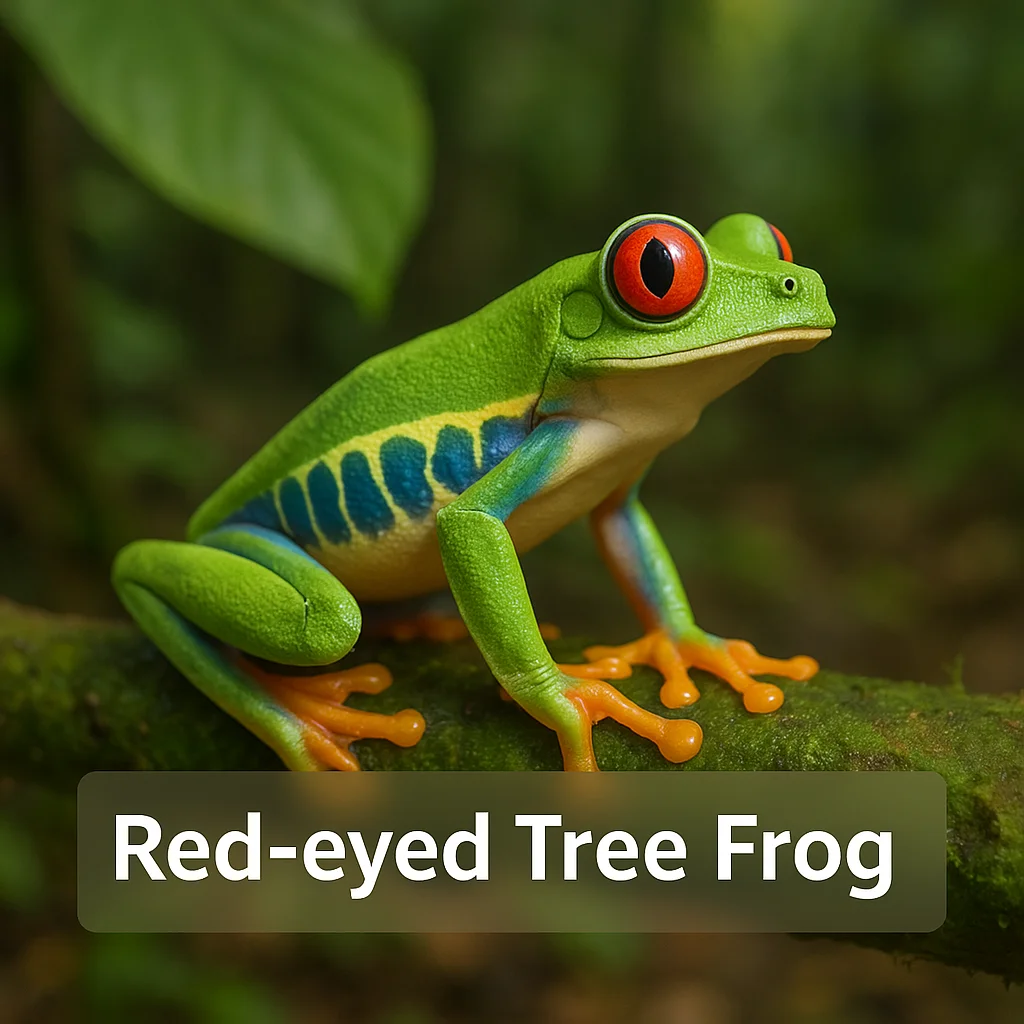
- Common name(s): Red-eyed Tree Frog
- Scientific name: Agalychnis callidryas
- Animal type: Amphibian
- Typical adult size: 2 - 3 inches in length
- Typical lifespan: 5 - 10 years, varying between wild and captive environments
- Diet type: Carnivore; mainly insects
- Activity pattern: Nocturnal
- Social structure: Solitary outside of breeding season
- Speed / movement highlights: Known for agile climbing
- Intelligence/learning: Demonstrates basic learning for foraging and habitat navigation
- Primary habitats: Tropical humid forests
- Geographic range: Central America, from southern Mexico to Panama
- Predators/threats: Birds, snakes, and sometimes large insects; habitat destruction due to human activity
- Conservation status: Not currently threatened but varies by region
🔍 Identification & Appearance
The Red-eyed Tree Frog is best identified by its brilliant red eyes, bright green body, and blue or yellow vertical stripes on its flanks. The frog's slender body is built for life among trees, with long, powerful hind legs enabling impressive jumps.
- Body is long and slender
- Bright red eyes are a key identifying feature
- Prominent green color with blue and yellow stripes
- Suction-cup toe pads for climbing
- White underside with a smooth texture
- Distinguishable from other frogs by its vibrant color pattern and eye size
- Coloration serves as a defense mechanism
- Size and color may vary with age
- When inactive, body coloration can sometimes change to blend with the surroundings
🧱 Body Structure & Physical Adaptations
The Red-eyed Tree Frog is expertly adapted for an arboreal lifestyle. Its body structure and physical adaptations play crucial roles in its survival and efficiency in the canopy.
- Slender body perfect for navigating tree branches
- Toe pads provide suction for gripping surfaces
- Powerful hind legs enable long-distance leaps
- Large eyes optimize nighttime vision
- Skin texture helps prevent water loss in humid conditions
- Bright colors serve as both camouflage and a warning to predators
- Flexible joints for enhanced movement
- Adapted to thrive in humid, leafy environments
- Lateral lines on body aid in sensing movement
🌍 Range & Distribution
The Red-eyed Tree Frog is primarily found in the tropical rainforests of Central America. Its range is influenced by climate conditions favorable to its ecological needs.
- Native to Central American countries, from southern Mexico to Panama
- Usually located in rainforests with abundant vegetation
- Occurs in lowland regions but can be found up to 1,250 meters in elevation
- Most active during the rainy season
- Prefers areas with lush forest canopy
- Found near water sources essential for breeding
- Preserved habitats in protected areas are crucial for survival
- Fragmentation of habitat reduces available range
🏞️ Habitat & Shelter
The Red-eyed Tree Frog's preference for dense forests is integral to its daily activities and reproductive success, as these environments provide the humidity and shelter it requires.
- Prefers lowland tropical rainforests
- Utilizes tree canopies for shelter and hunting
- Breeds in proximity to ponds and slow-moving streams
- Engages in vertical migration based on seasonal shifts
- Stays hidden during the day in foliage for protection
- Microhabitats play a crucial role during dry spells
- Seasonal rains trigger reproductive activities
- Dependence on humidity makes habitat preservation critical
🧭 Behavior & Ecology
The behavioral patterns of the Red-eyed Tree Frog are adapted to maximize survival in its forested ecosystem, playing a significant role in local food chains.
- Primarily nocturnal, resting during the day
- Defensive coloration is used to startle predators
- Communicates through visual displays and calls during breeding
- Vital prey item for birds and reptiles
- Engages in mutualistic relationships with its habitat, like pest control
- Adopts deceptive postures to avoid predation
- Typically solitary outside of breeding 'chorus' groups
- Interspecific competition with other tree frogs for resources
👥 Social Life & Group Dynamics
The Red-eyed Tree Frog is solitary but exhibits unique behaviors during breeding seasons when individuals congregate at water bodies.
- Solitary lifestyle except during mating seasons
- Breeding groups form temporary gatherings
- Male vocalizations attract females and mark territory
- Hierarchical behavior observed among males during mating
- Competition primarily through vocal displays and positioning
- No cooperative behaviors once breeding is completed
- Limited parental investment post-laying
- Minimal social interaction outside of reproductive contexts
🍽️ Diet, Prey & Predators
The Red-eyed Tree Frog thrives on a diet of insects, which are plentiful in its natural habitat. Its role as both predator and prey contributes to the ecosystem's complexity.
- Feeds predominantly on insects like crickets and flies
- Catches prey using a specialized sticky tongue
- Larger adults can consume smaller amphibians
- Avian predators such as owls and raptors pose threats
- Snakes are natural enemies in its environment
- Defensive features include startling color displays and quick escapes
- Rely on habitat camouflage to avoid predators
- Absence of scavenging behavior
🦌 Hunting, Foraging & Movement
With its specialized adaptations, the Red-eyed Tree Frog is a proficient climber and forager, maintaining a critical role in the food web.
- Lives predominantly as a climber in canopy regions
- Utilizes agile jumps to move between branches
- Nocturnal foraging maximizes insect availability
- Camouflage aids in stealth and ambush tactics
- Capable of rapid movements to evade capture
- Little territorial movement beyond localized areas
- Habitat conditions influence activity levels
- Employs crypsis to evade visual predators
🧠 Intelligence & Senses
The Red-eyed Tree Frog displays adaptive behaviors relying on acute senses to thrive in its environment, showcasing a blend of instinctual and learned behaviors.
- Highly developed vision for detecting nighttime movement
- Limited research into more complex cognitive abilities
- Sensitivity to vibrations helps detect predators
- Visual displays play a role in communication and mating
- Navigation primarily observed through familiarity with surroundings
- Understudied in terms of problem-solving and ingenuity
- Rely heavily on environmental cues for foraging behavior
- General adaptability in response to changing environmental conditions
🪺 Reproduction, Pregnancy & Parenting
Reproduction for the Red-eyed Tree Frog involves distinct courtship rituals, which make up a significant part of its life cycle and ecology.
- Breeding season aligns with the start of the rainy season
- Engages in vocal calling and displays to attract mates
- Mating system generally involves temporary pair bonds
- Eggs laid on leaves overhanging water bodies
- Short incubation period for eggs, around 7-10 days
- Tadpoles develop in water, exhibiting rapid growth
- No parental care post-egg laying
- Successful hatching often depends on precise timing and environmental conditions
♀️♂️ Male vs Female Differences
Sexual dimorphism in the Red-eyed Tree Frog is not pronounced, although some differences in size and roles exist during the breeding season.
- Males are generally smaller and lighter than females
- Male vocalizations are distinct for attracting females
- No significant color differences between genders
- Males more likely to exhibit territorial behavior during mating
- Both sexes involved in breeding but roles diverge thereafter
- Subtle behavioral differences in mating displays
- Distinctive calls distinguish genders during courtship
🧬 Subspecies & Variation
The Red-eyed Tree Frog exhibits certain variations across its range, reflecting localized adaptations and evolutionary pathways.
- Subspecies classification is debated in scientific communities
- Variations in size can be observed within different populations
- Color intensity may vary regionally
- Local habitat conditions influence behavior and adaptations
- Altered visual and auditory signaling according to regional environments
- Adaptation to varying levels of humidity and forest cover
- Differences often subtle and not well-understood
⚠️ Threats, Conservation & Human Interaction
The longevity of Red-eyed Tree Frog populations hinges on habitat preservation and sustainable human activities within their natural habitats.
- Habitat loss due to agriculture and urban development
- Susceptible to environmental pollution and pesticides
- Climate change poses an unquantified threat
- Captive breeding programs aid conservation efforts
- Legal and realistic coexistence practices can benefit habitat preservation
- Ecotourism presents opportunities with careful management
- Public education on amphibian roles and habitat importance is essential
- Climate variations impacting breeding cycles
✨ Fun Facts & Unique Traits
- The vibrant red eyes are likely a defense mechanism to startle predators.
- Despite their bright coloring, they are quite skilled at blending into green foliage.
- They close their eyes to obscure their vibrant gaze while resting.
- Red-eyed Tree Frogs can leap many times their body length.
- They play an important role in controlling insect populations.
- Their skin is sensitive and critical for hydration and respiration.
- They are known for their unique choruses during the rainy season.
- Their life begins in water but transitions fully to land as adults.
📌 Summary
- Recognizable by bright red eyes and green body with blue/yellow sides
- Native to Central America’s tropical rainforests
- Relies on dense, humid forest environments
- Carnivorous, feeding mainly on insects
- Predators include birds, snakes, and larger amphibians
- Solitary outside of the breeding season
- Breeds in temporary ponds and water bodies during rain
- Adaptations include powerful leaps and vivid coloration
- Unique for its defensive red-eye display and arboreal lifestyle