🦁 Japanese Giant Salamander
🧾 Quick Facts
The Japanese Giant Salamander, a stalwart of amphibian evolution, fascinates with its massive size and unique adaptations. With a history intertwined with Japanese folklore, this remarkable creature provides valuable insight into ancient amphibian life.
- Common names: Japanese Giant Salamander, Giant Water Dragon
- Scientific name: Andrias japonicus
- Animal type: Amphibian
- Typical adult size: 1 to 1.5 meters in length; up to 25 kg in weight
- Typical lifespan: 30 to 70 years in the wild
- Diet type: Carnivore; mainly fish, crustaceans, insects
- Activity pattern: Nocturnal
- Social structure: Solitary
- Speed / movement highlights: Moves slowly on land; swims more efficiently
- Intelligence/learning: Demonstrates basic problem-solving abilities
- Primary habitats: Freshwater rivers and streams
- Geographic range: Endemic to Japan, found on Honshu, Shikoku, and Kyushu islands
- Predators/threats: Predominantly human-related threats such as habitat loss
- Conservation status: Near Threatened
🔍 Identification & Appearance
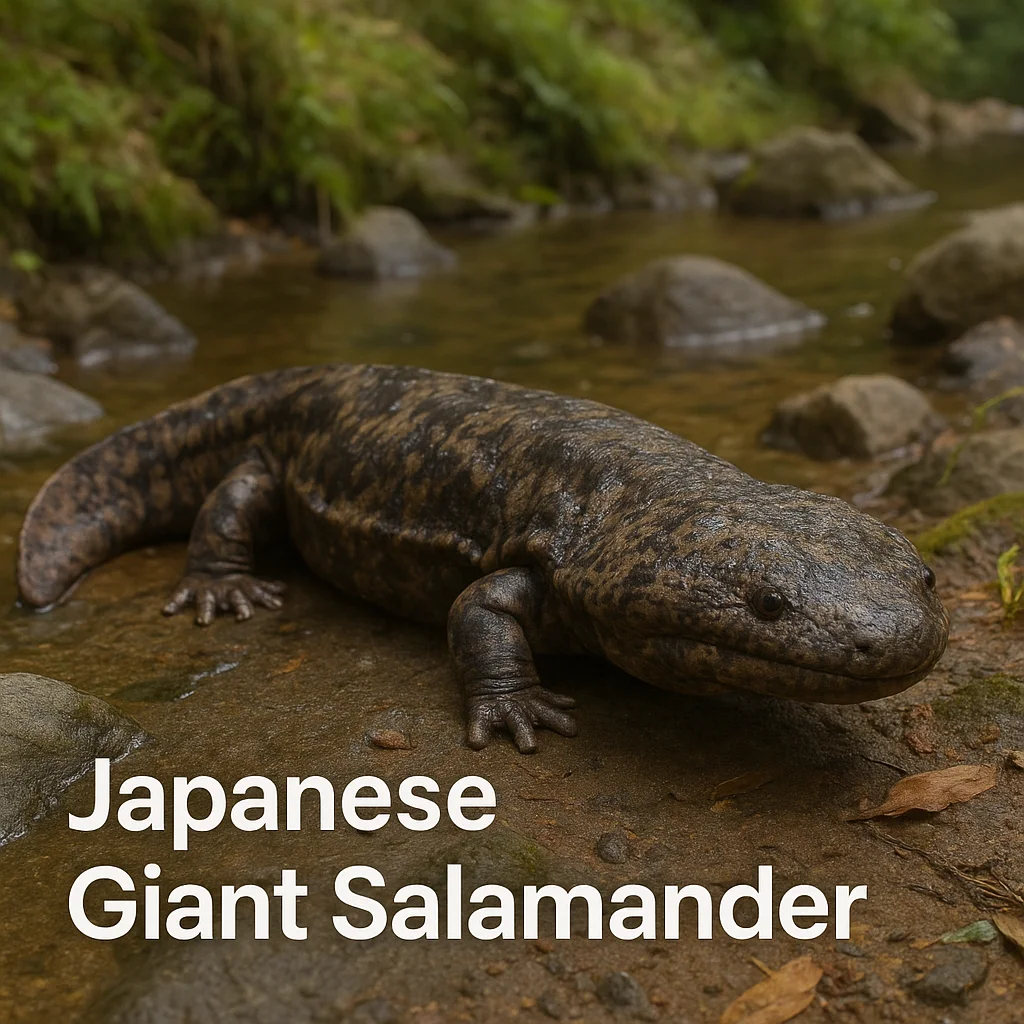
The Japanese Giant Salamander is easily recognized by its large, elongated body and mottled brown and gray skin. Its skin has a wrinkled appearance, which aids in respiration, and it has small, lidless eyes placed near the top of its broad, flat head. These salamanders have strong, muscular limbs and a robust, flattened tail to help them navigate swiftly through water.
- Body shape: Long and flattened with a broad head
- Key colors/patterns: Mottled brown and gray, help in camouflage
- Distinctive features: Wrinkled, porous skin; small, lidless eyes
- Tracks: Rarely leaves noticeable tracks
- Common look-alikes: Chinese Giant Salamander, differentiated by geographic range
- Broad, flattened head with lidless eyes
- Mottled coloration for camouflage
- Compact, muscular body
- Wrinkled skin texture
- Short limbs with blunt digits
- Robust, flattened tail for swimming
🧱 Body Structure & Physical Adaptations
The body of the Japanese Giant Salamander is perfectly adapted for life in swift streams and rivers. This robust amphibian has stout limbs that enable movement across rocky substrates and a powerful tail for propulsion underwater. Its skin is highly vascularized, allowing for cutaneous (skin-based) respiration, a vital adaptation for this mostly aquatic lifeform. Despite its poor eyesight, the salamander possesses an acute sense of smell to locate prey in dark waters.
- Strong limbs with webbed feet for traction
- Flatter, muscular tail enhances swimming agility
- Vascularized skin for cutaneous respiration
- Flattened body allows movement through narrow crevices
- Enhanced olfactory senses compensate for limited vision
- Robust jaw structure with fine teeth for holding prey
🌍 Range & Distribution
The Japanese Giant Salamander is confined to Japan, where it inhabits clean, cool freshwater streams and rivers. This species prefers mountainous regions with fast-flowing waters, typically at elevations ranging from lowland areas to higher mountainous rivers. During periods of heavy rain or increased water flow, they may disperse more widely within their river systems.
- Islands: Honshu, Shikoku, Kyushu
- Environments: Clear, cool streams and rivers
- Elevations: Lowland to mountainous terrain
- Climate: Prefers temperate regions
- Non-migratory: Occupies a specific range
🏞️ Habitat & Shelter
Japanese Giant Salamanders are typically found in mountainous river systems with clean, well-oxygenated water. These areas provide ample food sources and habitat features needed for their survival. They often find shelter under rocks and in submerged crevices to escape predators and avoid direct sunlight, which can dry out their sensitive skin. Seasonal rain may increase their range temporarily as they follow food sources downstream or into tributaries.
🧭 Behavior & Ecology
Being mainly nocturnal, Japanese Giant Salamanders are most active at night, foraging for prey under the cover of darkness. They are solitary animals, relying primarily on their sense of smell to hunt crustaceans, small fish, and insects found in their riverine environment. Their presence in the ecosystem is significant as they help control populations of aquatic invertebrates and small fishes.
- Active primarily during night-time
- Tendency to stay near shelter
- Relies on sit-and-wait hunting strategy
- Plays a role in controlling prey species
- Responds to environmental changes in water flow
👥 Social Life & Group Dynamics
The Japanese Giant Salamander is generally a solitary creature. Apart from the breeding season, these salamanders do not interact much with others, maintaining individual territories along riverbanks and stream beds. During breeding season, males might show aggression towards other males to protect territories or gain access to suitable nesting areas.
- Primarily solitary outside of breeding season
- Defines individual territories
- Males guard burrows during mating seasons
- Breeding territories can be temporarily contested
- No established hierarchies outside of breeding times
🍽️ Diet, Prey & Predators
As a carnivorous amphibian, the Japanese Giant Salamander consumes various aquatic organisms. Its diet mainly consists of fish, crustaceans, and small amphibians, captured using a "sit-and-wait" tactic. Though they have few natural predators, they face threats from introduced species and human activities that disturb their habitats.
- Hunts fish, insects, small amphibians
- Employs ambush strategy with rapid burst movements
- Avoids predators using camouflage and shelter
- Competition from invasive species
- Human impact includes habitat degradation
🦌 Hunting, Foraging & Movement
Japanese Giant Salamanders rely heavily on their camouflage and stealth in their hunting approach. Preferring to ambush, they remain still and blend into the rocky stream beds, quickly striking unsuspecting prey that comes close. Their movement is most efficient in water, using their tails for propulsion. They are less mobile on land and venture out rarely.
- Efficient swimmer using strong tail
- Ambush predator; hides and strikes prey
- Restricted movement on land
- No remarkable speed, relies on precision
- Navigation relies on scent and environmental cues
🧠 Intelligence & Senses
Research into the cognitive abilities of the Japanese Giant Salamander suggests a reliance on instinctual behaviors rather than learned strategies. While their simple brain structure limits complex learning capability, they have evolved sophisticated sensory systems to thrive in their habitats. Their sense of smell is particularly acute, allowing them to detect prey and navigate their surroundings effectively.
- Primarily instinct-driven behavior
- Acute olfactory senses
- Limited eyesight, effective mostly at short range
- Basic problem-solving abilities noted
- Undocumented tool use
🪺 Reproduction, Pregnancy & Parenting
Breeding for the Japanese Giant Salamander typically occurs in late summer. During this period, males establish territories and wait for females near suitable nesting sites. After mating, the fertilized eggs are deposited in hidden nests, where the male remains on guard against intruders. The eggs hatch after several weeks, with larvae developing into miniature versions of adults over time.
- Breeding season in late summer
- Males guard nesting sites
- Eggs are laid in underwater nests
- Incubation period lasts several weeks
- Young are precocial, mini-adults
♀️♂️ Male vs Female Differences
Sexual dimorphism in Japanese Giant Salamanders is subtle but present. Males and females are similar in size and appearance, though males develop slightly larger bodies and more muscular tails during the breeding season. Females lack the swollen cloacal regions seen in males. Behaviorally, males are more territorial compared to females, particularly during mating times.
- Males are slightly larger during breeding
- Muscular tail enhancement in males
- Swollen cloacal region evident in males
- Females' reproductive behavior focuses on nest selection
- Territorial behavior mainly in males
🧬 Subspecies & Variation
The Japanese Giant Salamander does not have recognized subspecies, but certain populations show minor variations in size and coloration, likely due to local ecological pressures and isolated habitats. These variations, however, do not warrant taxonomic division, and all are considered part of a single species complex.
- No formally recognized subspecies
- Minor size variation by location
- Coloration differences linked to microhabitat
- Local adaptations to water flow and temperature
- Variation not enough for separate taxonomic status
⚠️ Threats, Conservation & Human Interaction
The Japanese Giant Salamander faces several threats, primarily from habitat destruction due to human activities such as damming and pollution of waterways. Conservation efforts are crucial to maintain the delicate balance of their river ecosystems. It is important to promote awareness and habitat protection to ensure their continued survival. They are also subjects of cultural importance, symbolizing religious and folkloric significance in Japan.
- Habitat loss due to urban development
- Pollution impacting waterways
- Introduced species competition
- Cultural significance in Japan
- Legal protections in mainland Japan
✨ Fun Facts & Unique Traits
- One of the largest amphibians in the world
- Preferred hiding spots include rock crevices and submerged logs
- Essentially unchanged for millions of years
- Featured prominently in Japanese folklore
- Males exhibit protective parental behavior
- Survive on land but thrive underwater
- Communicate with subtle body movements
- Exhibit individual variations in skin patterns
- Can live in the same habitat for their entire lives
- Considered a national treasure in Japan
📌 Summary
- One of the largest amphibians, known for its impressive size and ancient lineage
- Inhabits clean, cool, fast-flowing mountainous streams and rivers in Japan
- Carnivorous diet, including fish, insects, and small invertebrates
- Faces threats from habitat loss and competition with invasive species
- Solitary, highly territorial during breeding season
- Males exhibit nest guarding behavior, ensuring offspring protection
- Adapted for semi-aquatic life with a strong sense of smell and cutaneous respiration
- No recognized subspecies, despite local variations
- Cultural icons in Japan, signify conservation focus and heritage
- Temperature impacts its activity levels, remaining largely sedentary when cold
- Research highlights potential for various conservation strategies