🦁 Green Frog
🧾 Quick Facts
The Green Frog, often seen in various parts of North America, is a vibrant amphibian known for its adaptability and presence in diverse aquatic environments. Though the term "Green Frog" can encompass several species and subspecies, they share common traits that make them intriguing subjects of study.
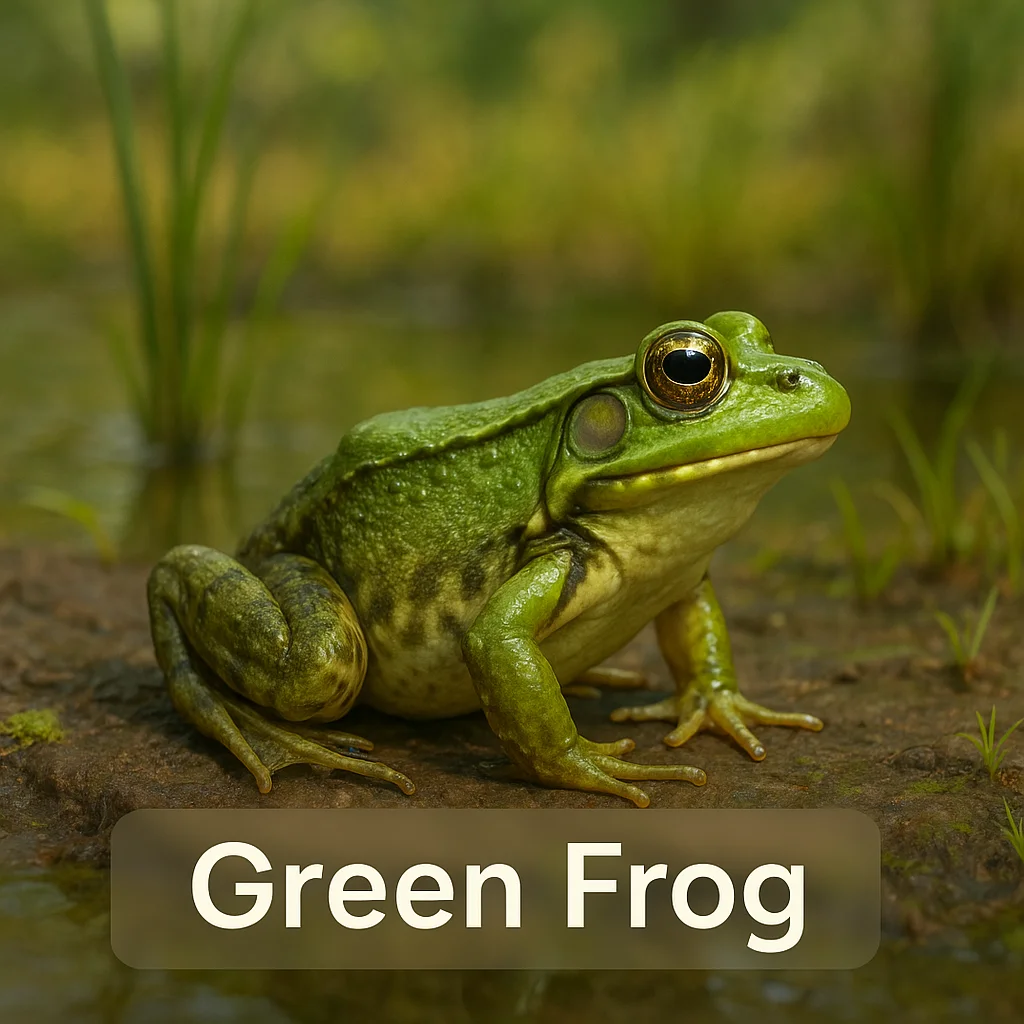
- Common name(s): Green Frog
- Scientific name: Rana clamitans
- Animal type: Amphibian
- Typical adult size: 2.2 to 4 inches (5.5 to 10 cm) in length
- Typical lifespan: 5 to 10 years in the wild
- Diet type: Carnivore; eats insects, spiders, and small aquatic organisms
- Activity pattern: Primarily crepuscular but can be active during the day
- Social structure: Mostly solitary, but may congregate during breeding season
- Speed / movement highlights: Good swimmers with powerful jumps
- Intelligence/learning: Capable of basic problem-solving and learning avoidance behaviors
- Primary habitats: Ponds, marshes, lakes, and slow-moving streams
- Geographic range: Eastern North America from Canada to the southern United States
- Predators/threats: Birds, snakes, raccoons, and human activity
- Conservation status: Stable, but local variations exist
🔍 Identification & Appearance
Recognizing the Green Frog involves looking for its unique features. They have a robust body with relatively long legs. Their coloration is typically green, often with brown or bronze tones. A noticeable ridge runs from behind the eye down each side of the back. Males have a more prominent tympanum (eardrum) than females.
- Robust body with long legs
- Green with possible brown/bronze tones
- Prominent dorsolateral ridges
- Large tympanum in males
- White underside with possible dark spots
- Subtle toe webbing
- Yellow-green throat in mature males
- Look-alikes: Similar to Bullfrogs but smaller
🧱 Body Structure & Physical Adaptations
The Green Frog's body is well-adapted for its aquatic lifestyle. It has muscular legs for jumping and swimming, and partial webbing on its feet aids in swimming. Its jaw is adapted to snap up prey efficiently, and its keen senses, particularly vision and hearing, are crucial for survival.
- Stocky build with muscular legs
- Partially webbed feet for efficient swimming
- Adapted jaw for catching prey
- Highly developed vision for spotting movement
- Keen hearing, with a noticeable tympanum
- Moist skin aids in breathing out of water
- Cryptic coloration for camouflage
🌍 Range & Distribution
The Green Frog is primarily found throughout the eastern United States and Canada. They inhabit regions that provide ample aquatic environments, favoring the borders of ponds, marshes, and streams. They usually stay near water but can wander into damp terrestrial areas during wet conditions.
- Eastern United States
- Southern Canada
- Prefers temperate climates
- Resides at lower elevations
- No seasonal migrations; generally resident
🏞️ Habitat & Shelter
The ideal habitat for the Green Frog includes any freshwater body with abundant vegetation, which they use for shelter and hunting. They often bask in the sun on floating vegetation or the water’s edge. Seasonal changes might push them to hunker down in the mud during colder months to avoid freezing conditions.
Understanding their habitat helps explain their behaviors, especially their hunting style and breeding patterns.
🧭 Behavior & Ecology
Green Frogs are chiefly nocturnal, resorting to hunting in the low light provided by dusk or dawn. They communicate through a series of calls and are known to establish territories during the breeding season. They play a role in controlling insect populations and serve as prey for larger predators in their ecosystem.
- Primarily nocturnal
- Communicate through vocalizations
- Establish breeding territories
- Act as both predator and prey
- Control insect populations
- Important ecological indicators
👥 Social Life & Group Dynamics
Green Frogs are generally solitary, seeking social interaction only during the breeding season. Males are territorial and establish zones by calling. Once breeding concludes, they exhibit limited social behaviors, focusing on foraging and individual survival.
- Mostly solitary
- Form temporary groups during breeding
- Males exhibit territorial calling
- Nocturnal and secretive outside of breeding
- Minimal cooperation beyond breeding
🍽️ Diet, Prey & Predators
The Green Frog is a carnivore, feeding primarily on insects and smaller aquatic creatures. It uses ambush tactics, remaining still before quickly seizing prey. Larger predators, such as birds and snakes, prey on them, and they utilize quick escapes into water as a defense strategy.
- Eats insects, crustaceans, and small fish
- Relies on ambush hunting tactics
- Preyed upon by birds, snakes, and mammals
- Escapes into water when threatened
🦌 Hunting, Foraging & Movement
Green Frogs are ambush predators, leaping unexpectedly to catch their prey. They are adept swimmers and use their powerful hind legs for quick leaps. Typically, they hunt during low light conditions but can be active at any time when undisturbed.
- Ambush-style hunting
- Powerful jumpers
- Expert swimmers
- Forages primarily at night
- Navigates by sight and recall of pond edges
🧠 Intelligence & Senses
Green Frogs have a strong sense of sight and sound, which they use for locating prey and mates. While not known for advanced problem-solving, they learn and adapt to local threats. Research on cognitive abilities is limited but suggests moderate learning capabilities.
- Strong visual acuity
- Excellent hearing
- Basic learning from experiences
- Vigilant to environmental changes
🪺 Reproduction, Pregnancy & Parenting
Breeding occurs in the spring and early summer. Males call to attract females, and fertilization occurs externally. Females can lay several hundred eggs in clusters attached to vegetation. The young develop in water and become independent shortly after hatching.
- Breed from spring to early summer
- External fertilization
- Lay hundreds of eggs
- Tadpoles metamorphose in warm seasons
- Minimal parental care after egg laying
♀️♂️ Male vs Female Differences
In Green Frogs, males and females can be distinguished by size and certain features. Males are generally smaller but have a larger tympanum compared to the diameter of their eyes. They also have a yellow throat, which is distinct from the females' white throat.
- Males are smaller in overall size
- Enlarged tympanum in males
- Yellow throat in mature males
- Females have a white throat
- Males more vocal during breeding
🧬 Subspecies & Variation
There are some regional variations in Green Frogs, often attributed to environmental adaptations. While subspecies classification can be complicated, they generally show variations in coloration and size depending on habitat and geography.
- Coloration varies by habitat
- Size differences noted regionally
- Adaptations to local climates
- Subspecies classification is debated
⚠️ Threats, Conservation & Human Interaction
The Green Frog faces habitat loss and pollution as significant threats. While generally stable, local populations may decline due to these challenges. Conservation efforts focus on maintaining water quality and preserving wetland habitats. Being common in many areas, they are familiar to humans and often observed in natural settings.
- Sensitive to habitat destruction
- Pollution impacts water quality
- Stable overall populations
- Preservation of wetlands is crucial
- Familiar species to humans
✨ Fun Facts & Unique Traits
- Green Frogs can change color slightly depending on temperature and humidity
- Their call is often compared to the sound of a plucked banjo string
- They can absorb water and oxygen through their skin
- Play a critical role in mosquito population control
- Their hind legs are about twice the length of their body
- Young frogs initially have tails like their tadpole stage
📌 Summary
- Recognizable by their green and bronze tones
- Found throughout eastern North America
- Inhabit freshwater bodies like ponds and streams
- Ambush predators eating insects and small animals
- Solitary except for breeding gatherings
- Breeding involves external fertilization in water
- Males have a yellow throat and larger tympanum
- Face threats from habitat loss and pollution
- Known for their banjo-like call