🦁 Caecilian
🧾 Quick Facts
Caecilians are fascinating limbless amphibians that often go unnoticed due to their burrowing lifestyle. Despite their worm-like appearance, caecilians possess unique adaptations that suit their underground habitat.
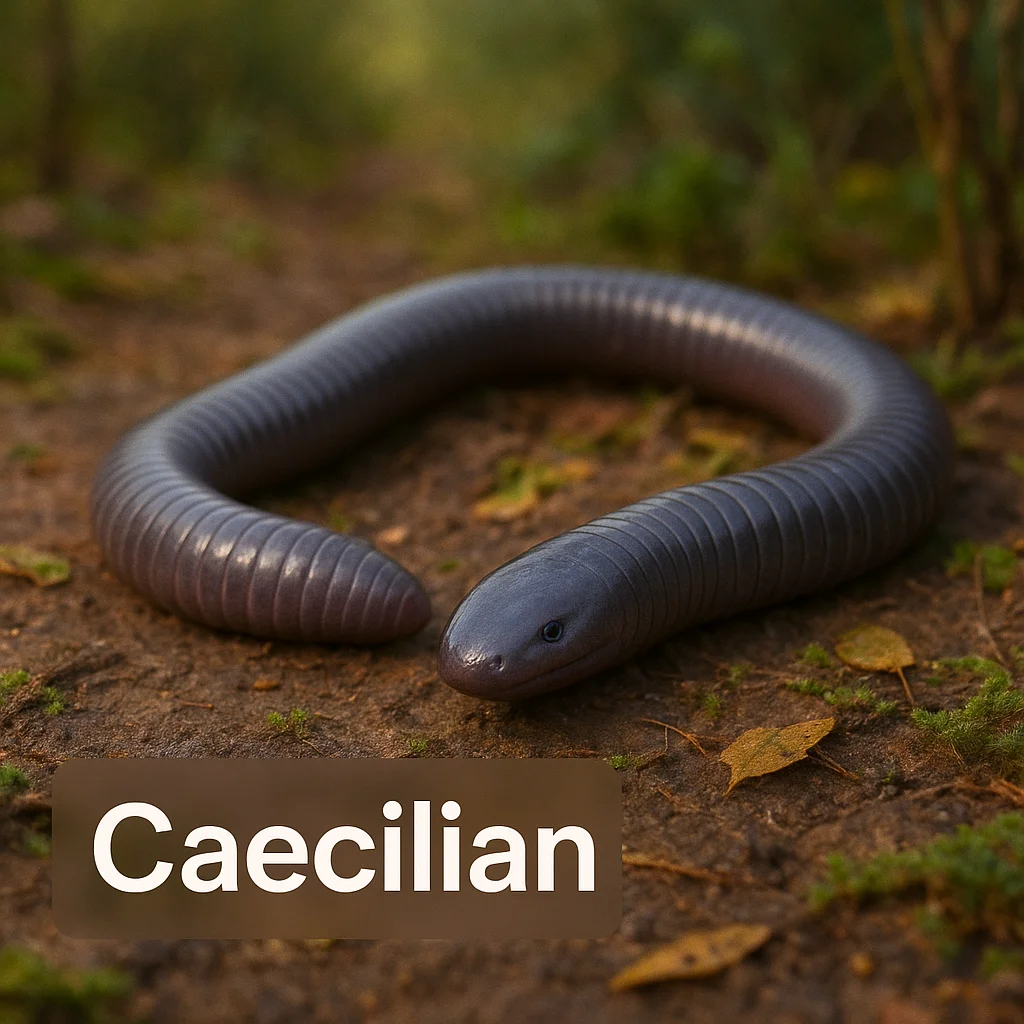
- Common name(s): Caecilian
- Scientific name: Varies; often classified under the order Gymnophiona
- Animal type: Amphibian
- Typical adult size: 7 cm to 1.5 m (varies by species)
- Typical lifespan: Often ranges from 5 to 20 years
- Diet type: Carnivore; primarily consumes earthworms, ants, and small invertebrates
- Activity pattern: Mostly nocturnal
- Social structure: Generally solitary
- Speed / movement highlights: Efficient burrowers with undulating movement
- Intelligence/learning: Limited studies; believed to rely more on instinct than learning
- Primary habitats: Tropical and subtropical regions
- Geographic range: Central and South America, Africa, South Asia
- Predators/threats: Birds, snakes, and larger mammals; also impacted by habitat loss
- Conservation status: Varies by region; some species threatened
🔍 Identification & Appearance
Caecilians are notable for their elongated, limbless bodies resembling that of snakes or worms. They exhibit a wide range of sizes, with shades that typically blend into their environment. Their skin is segmented, aiding in locomotion, and they possess a pair of tentacles located between their eyes and nostrils which help in sensory perception.
- Body shape and silhouette: Cylindrical, elongated body without limbs
- Key colors/patterns: Ranges from dark gray to brown, some with banding
- Distinctive features: Tentacles for sensing the environment
- Tracks, scat, or other field signs: Rarely visible due to their subterranean habits
- Common look-alikes: Earthworms, but distinguished by their segmented skin and larger size
- Top ID Tips:
- Look for a long, limbless body
- Note the tentacle between eye and nostril
- Check for segmented, shiny skin
- Observe coloration matching soil or leaf litter
- Watch their undulating underground motion
🧱 Body Structure & Physical Adaptations
Caecilians possess a body structure highly adapted to a life spent mostly underground. Their skulls are strong and solid, allowing them to dig efficiently. The skin contains embedded scales similar to those of reptiles, which provide protection and assist in burrowing.
- Build and proportions: Slender cylindrical body optimized for burrowing
- Teeth/jaw adaptations: Small, backward-curving teeth for gripping prey
- Sensory strengths: Keen chemosensory abilities through specialized tentacles
- Key Adaptations:
- Robust skull for burrowing
- Skin with protective scales
- Tentacles for environment sensing
- Streamlined body for soil movement
- Chemosensory perception for locating prey
🌍 Range & Distribution
Caecilians are found mostly in tropical and subtropical regions, favoring moist, warm climates. They are prevalent in areas where loose soil or leaf litter is abundant, facilitating their subterranean lifestyle.
- Central America, including Costa Rica and Panama
- South America, notably Amazonian Brazil and Colombia
- Africa, particularly within forested regions
- South Asia, including India and Sri Lanka
- Generally at low to middle elevations
- Where You Might Find It:
- Tropical rainforests
- Subtropical woodlands
- Riverbanks with soft soil
- Forest floors with leaf litter
- Moist, shaded gardens or plantations
🏞️ Habitat & Shelter
Caecilians thrive in humid environments where the soil remains soft enough for burrowing. They may inhabit rainforests, woodlands, and agricultural lands, choosing areas that provide ample cover and a consistent supply of prey.
Seasonal changes can influence their burrowing depth as they seek optimal moisture levels. Understanding their habitat preferences aids in conserving the ecosystems they inhabit, as caecilians play a role in soil health by aerating it during their burrowing activities.
🧭 Behavior & Ecology
Caecilians are primarily subterranean, spending most of their lives beneath the surface. Their behavior is largely driven by the need to find food and maintain moisture levels. While generally solitary, caecilians may engage in occasional social interactions during breeding seasons.
- Daily routine: Active at night, primarily feeds and moves underground
- Communication: Limited vocalizations; relies on tactile and chemical cues
- Interactions with other species: Preys on invertebrates; may compete with small mammals for food
- Role in the ecosystem: Soil aeration through burrowing; predator control by consuming invertebrates
- Behavior Highlights:
- Nocturnal activity peaks
- Solitary except during breeding
- Infrequent surface appearances
- Relies on sensory tentacles
- Tactile and chemical communication
👥 Social Life & Group Dynamics
Caecilians are predominantly solitary but may display variations in social structure during reproductive periods. These periods of interaction tend to occur underground, where they can safely mate and care for offspring without threats from predators.
- Primarily solitary lifestyle
- Occasional grouping during breeding season
- Brief pair bonding for mating
- Minimal cooperation or social hierarchies observed
- "Social Structure Notes:"
- Solitary by nature
- Short-term mating pairs
- Burrow sharing during reproduction
- Weak social bonds outside mating
- Little evidence of cooperation
🍽️ Diet, Prey & Predators
Caecilians are carnivorous, primarily feeding on a diet of earthworms, insects, and small invertebrates. Their keen sense of smell helps them locate prey underground, where they use their teeth to grasp and subdue their catch.
Natural predators include birds, larger reptiles, and mammals that may dig them out of their burrows. To avoid predation, caecilians remain concealed underground, venturing above only during heavy rains or when forced by environmental conditions.
- Feeds mainly at night
- Relies on smell to detect prey
- Utilizes teeth to hold slippery prey
- Main predators include birds and snakes
- Feeds on earthworms and termites
- "Feeding Notes:"
- Effective underground hunters
- Prefers soft-bodied invertebrates
- Vulnerable when surfaced
- Possesses backward-pointing teeth
- Seeks prey in loose soil
🦌 Hunting, Foraging & Movement
Caecilians are adapted to a life of burrowing, using their muscular bodies and ossified skulls to tunnel through soil. They primarily forage at night, when their prey is most active. Their movement is characterized by smooth, undulating motions that allow them to navigate efficiently underground.
While not fast, they are effective ambush predators, lying in wait for unsuspecting prey that wanders close to their burrow entrance. Home ranges are typically small, given their secretive and localized nature.
- Uses skull and body to burrow
- Ambushes prey at burrow openings
- Motions resemble swimming through soil
- Relies on tactile senses for navigation
- Confined to small home ranges
- "Movement & Strategy:"
- Efficient underground movement
- Ambush predator
- Small, overlapping territories
- Tactile-based navigation
- Active primarily at night
🧠 Intelligence & Senses
Caecilian intelligence is not extensively documented; their lifestyle suggests a reliance more on instinctual behaviors rather than advanced problem-solving abilities. They possess specialized tentacles for perceiving chemical changes around them, which is crucial for locating prey and navigating their environment.
Their sensory adaptations, including the tentacles, make up for their limited eyesight, which is less functional due to their subterranean habitat.
- Relies on instinct for survival
- Adapted senses for underground life
- Limited visual acuity
- Sense of smell through tentacles
- Limited research on cognitive abilities
- "Notable Abilities:"
- Strong chemosensory perception
- Tactile sensation via skin and tentacles
- Burrowing with efficient muscle use
- Minimal visual input required
- Subterranean sensory adaptation
🪺 Reproduction, Pregnancy & Parenting
Reproductive behaviors in caecilians vary by species but generally involve internal fertilization. Females often lay eggs in moist environments, while some species give live birth. Gestation periods and clutch sizes are species-dependent.
Caecilian parenting can involve significant maternal investment. In oviparous species, the female may guard and moisturize the eggs until hatching. In viviparous species, the young are born developed. Parental care duration varies, with some species providing skin feeding for offspring.
- Internal fertilization practiced
- Egg-laying or live birth dependent on species
- Maternal care often significant
- Young may feed on mother's skin in some species
- Gestational periods unknown for many species
- "Reproduction Snapshot:"
- Eggs laid in moist areas
- Some practice live births
- Internal fertilization common
- Maternal guarding of eggs
- Skin feeding in some species
♀️♂️ Male vs Female Differences
In many caecilian species, sexual dimorphism tends to be subtle. Males and females are often similar in size and coloration, making differentiation difficult without close examination or during specific breeding behaviors.
Some species may show size differences or slight variations in body proportions, but these are not universally observed. Breeding season behaviors can sometimes provide clues to gender differences.
- Subtle size distinctions in some species
- Occasional variations in body proportions
- Coloration generally similar between sexes
- "Sex Differences at a Glance:"
- Limited sexual dimorphism noted
- Males sometimes slightly larger
- Similar coloration patterns
- Behaviors differ seasonally
- Physical examination often needed
🧬 Subspecies & Variation
Caecilians exhibit significant variation across their range. While subspecies classification is not robust due to limited studies, local adaptations to environmental conditions have been observed, influencing behavior, size, and coloration.
Such adaptations could include changes aiding moisture retention, camouflage in specific soil types, or variations in reproductive strategies.
- Observed local adaptations to habitat
- Size and coloration vary with environment
- Limited subspecies classification
- "Variation Notes:"
- Adaptations for moisture-rich environments
- Concealment in native soils
- Slight size variations across range
- Different reproductive strategies detected
- Habitat-driven behavioral changes
⚠️ Threats, Conservation & Human Interaction
Caecilian populations face several threats, primarily habitat destruction from agriculture, urban development, and deforestation. Human activities detrimentally impact their hidden environments, while climate change alters moisture levels critical to their survival.
Conservation efforts focus on habitat protection and ecological studies to better understand and support their survival. Human encounters are rare, but general care is advised in preserving natural habitats and avoiding undue interference with their ecosystems.
- Threatened by deforestation and land conversion
- Climate change impacting viable habitats
- Conservation status varies; generally poorly understood
- "Responsible Notes:"
- Protect natural habitat areas
- Researchers continue to document species
- Encourage ecosystem appreciation
- Support local conservation initiatives
- Avoid disruptive activities in their habitats
✨ Fun Facts & Unique Traits
- Caecilians are one of the least understood groups of amphibians.
- Some species possess a sharply defined lateral line which helps in navigating dark, aquatic environments.
- They are capable of molting, where they shed their skin in a single piece.
- Caecilians can survive in surprisingly varied altitudes, thriving below 2,000 meters.
- The maternal "skin feeding" habit exhibits an unusual form of parental care among amphibians.
- They have a specialized muscle that allows them to hear underground vibrations.
- Many species are highly elusive, rarely seen by humans.
- Caecilians have transitioned to varied environments, both aquatic and terrestrial.
- The word "caecilian" comes from the Latin word for blind, although most species do possess functional eyes.
📌 Summary
- Caecilians are limbless amphibians with elongated bodies.
- Predominantly found in tropical and subtropical regions.
- Primarily burrowers, using their bodies and sensory tentacles to navigate underground.
- Carnivorous, relying on a diet of invertebrates.
- Face natural predation from birds and mammals, and threats from habitat loss.
- Exhibit primarily solitary behavior, with brief social interactions during breeding.
- Reproduction involves internal fertilization, with some species practicing unique maternal care.
- They participate in the ecosystem by aerating soil and controlling invertebrate populations.
- Conservation varies but often involves habitat preservation efforts.
- Unique due to their subterranean lifestyle and specialized adaptations.