🦁 Axolotl
🧾 Quick Facts
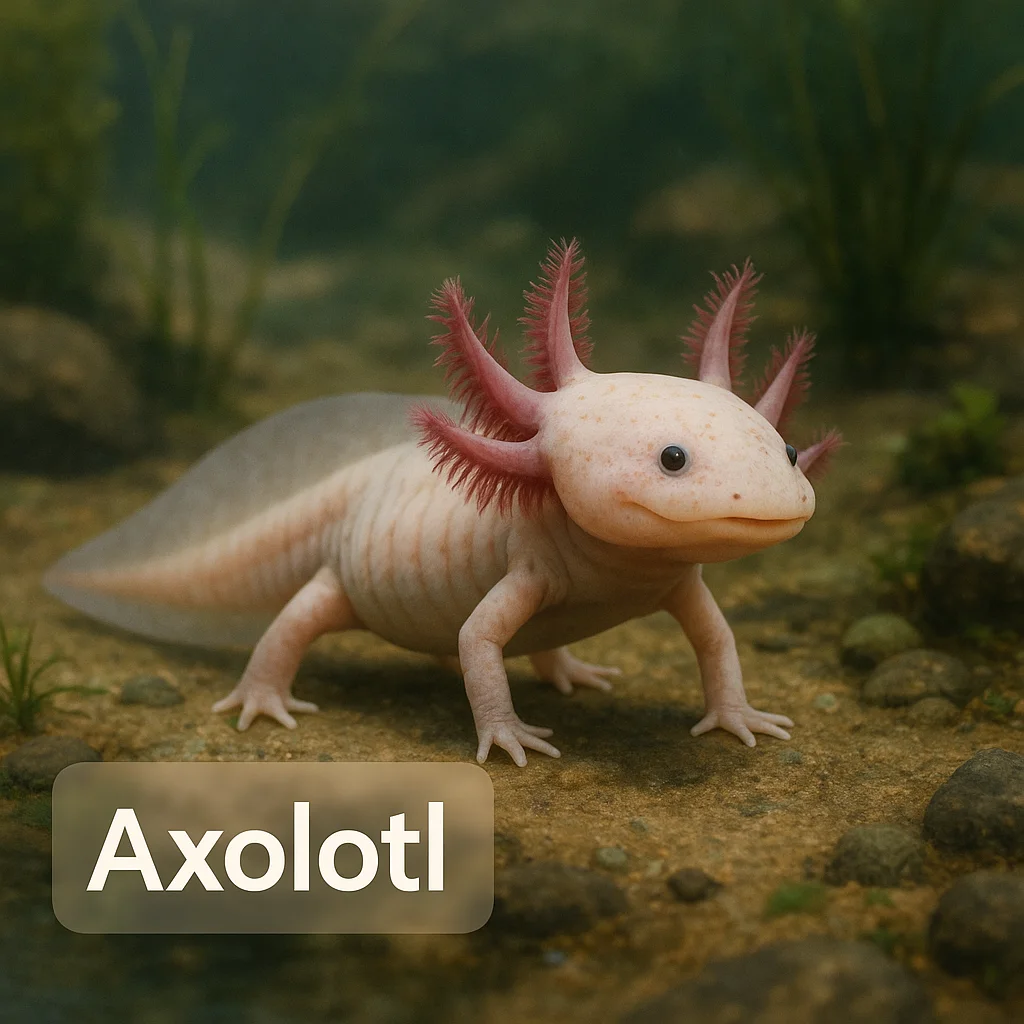
The axolotl is a unique and fascinating amphibian known for its distinctive appearance and remarkable regenerative abilities. Often referred to as the "Mexican walking fish," this species is not a fish but rather a type of salamander. Found almost exclusively in the lakes and canals of Mexico City, the axolotl is of great interest to scientists and hobbyists alike.
- Common name: Axolotl
- Scientific name: Ambystoma mexicanum
- Animal type: Amphibian
- Typical adult size: 15–25 cm (6–10 inches) in length
- Typical lifespan: 10–15 years in captivity, shorter in the wild
- Diet type: Carnivore; primarily consumes worms, insects, small fish
- Activity pattern: Nocturnal
- Social structure: Solitary
- Speed/movement highlights: Slow-moving; uses limbs for walking and tail for propulsion in water
- Intelligence/learning: Capable of learning simple tasks; often studied for its regenerative capabilities
- Primary habitats: Freshwater lakes and canals
- Geographic range: Primarily found in Xochimilco, Mexico City
- Predators/threats: Birds, larger fish, habitat loss, pollution
- Conservation status: Critically Endangered
🔍 Identification & Appearance
The axolotl is easily recognized by its unusual appearance. This amphibian sports a salamander-like body, with a wide head and smooth skin. One of its most notable features is the feathery external gills that protrude from both sides of its head, giving it a unique and endearing look.
- Body shape: Elongated body with a flattened head
- Key colors/patterns: Typically shades of brown, black, gray, or leucistic (white with black eyes)
- Distinctive features: Prominent external gills, long tail
- Common look-alikes: None, due to unique external gills
- Top ID Tips:
- Look for feathery gills extending from head
- Note the wide, flattened head
- Observe the elongated, slender tail
- Check for small, lidless eyes
- Watch for smooth, moist skin texture
- Coloration can vary, often dark or light variants
🧱 Body Structure & Physical Adaptations
The axolotl exhibits several unique adaptations, particularly its incredible ability to regenerate lost body parts. Its body is well-suited to its aquatic lifestyle, with limbs and a tail optimized for swimming and walking underwater.
- Build and proportions: Slender body with moderately sized limbs and a long tail
- Teeth/jaw adaptations: Small teeth used for gripping prey
- Claws/limbs: Limbs are adapted for walking on the lake bed
- Sensory strengths: Good sense of smell and lateral line system for detecting water movements
- Key Adaptations:
- Regeneration of limbs, spinal cord, and even parts of brain
- Feathery gills for underwater breathing
- Strong lateral line for sensing water disturbance
- Adapted eyesight for murky water
- Robust immune system to promote regeneration
🌍 Range & Distribution
The axolotl's distribution is incredibly limited, found mainly in the remnants of lakes such as Xochimilco in Mexico City. Once widespread, the encroachment of urban environments and pollution has drastically reduced its natural habitat.
- Continents/regions: Central America
- Typical countries: Mexico
- Elevation range: Found at or near water level in aquatic environments
- Where You Might Find It:
- Xochimilco canals
- Marshy areas in central Mexico
- Aquariums and controlled environments worldwide
🏞️ Habitat & Shelter
The axolotl prefers to inhabit freshwater environments with plenty of vegetation and cover where it can hunt for food and hide from predators. Its habitat needs have made it vulnerable to environmental changes and pollution.
Understanding its habitat is crucial to addressing its conservation needs. The axolotl's requirement for clean, oxygen-rich water directly impacts its survival.
🧭 Behavior & Ecology
Axolotls are mostly nocturnal, spending their nights hunting for food. They have a rather peaceful existence, limiting their interactions with other species to occasional competition for resources.
- Daily routine: Active at night, resting in sheltered spots during the day
- Communication: Limited; relies on chemical cues in water
- Ecosystem role: Mid-level predator and prey species
- Behavior Highlights:
- Solitary except during breeding
- Regenerates lost body parts
- Uses camouflage to avoid predators
- Primarily nocturnal hunting behavior
- Feeding on crustaceans and small fish
👥 Social Life & Group Dynamics
Axolotls are notably solitary creatures. Unlike many amphibians that may form groups during certain periods, the axolotl tends to remain alone, except when breeding.
- Solitary tendencies: Generally remains alone
- Group types: No specific social groupings
- Social Structure Notes:
- Occasional encounters during breeding seasons
- No large gatherings or shoaling behavior
- Interaction mostly limited to mating
🍽️ Diet, Prey & Predators
Axolotls are carnivorous, feeding on worms, insects, and small fish. They use a suction technique to draw prey into their mouths.
- Main foods: Worms, aquatic insects, small fish
- Main predators: Larger fish, birds, and some mammals
- Feeding Notes:
- Active hunters at night
- Relies on stealth to capture prey
- Vulnerable to fish stocked by humans in habitat
🦌 Hunting, Foraging & Movement
The axolotl is a methodical hunter with a unique way of capturing prey. Unlike other fast-moving predators, the axolotl employs a sit-and-wait strategy, using the element of surprise and its natural camouflage. This strategy suits its energy-efficient lifestyle, demanding less exertion to capture food.
- Locomotion style: Swimmer and walker
- Typical foraging times: Night (nocturnal)
- Movement & Strategy:
- Steady, slow swimming in search of prey
- Uses camouflage and stealth for hunting
- Dependence on gills while submerged
- Energy efficient to avoid waste
🧠 Intelligence & Senses
The axolotl may not top intelligence charts, but its survival strategy in a niche habitat signifies an evolutionary success. With well-adapted sensory systems, it can effectively hunt and navigate murky waters despite its generally slow demeanor.
- Senses: Moderate; primarily smell and water currents
- Cognitive abilities: Simple learning, adaptation to environments
- Social intelligence: Limited due to solitary nature
- Notable Abilities:
- Ability to regenerate complex structures
- Good adaptation to environmental changes
- Camouflage with environment
🪺 Reproduction, Pregnancy & Parenting
The breeding of axolotls isn't bound by specific seasons unlike other amphibians; however, water temperature largely influences their reproduction rates. Female axolotls lay eggs that they adhere to substrates underwater, allowing embryos to develop under safely guarded environments.
- Breeding seasonality: No strict season; varies by temperature
- Clutch size: 100–300 eggs
- Incubation: Approximately 2–3 weeks
- Reproduction Snapshot:
- External fertilization via egg-laying
- No parental care post-egg laying
- Development in controlled conditions improves survival
♀️♂️ Male vs Female Differences
In axolotls, the differences between males and females can be subtle. Generally, males have longer tails and more prominent cloacal regions, which may not be immediately noticeable to casual observers.
- Size differences: Negligible; slight tail length variation
- Behavioral roles: Both sexes engage in similar behaviors
- Sex Differences at a Glance:
- Males with slightly more elongated tail tips
- Clarity in physical differences requires close inspection
🧬 Subspecies & Variation
There is little subspecies diffusion in axolotls due to their isolated habitats and limited geographic disperse. However, selective breeding in captivity has led to a variety of colors and patterns, although these do not represent wild subspecies.
- Selective breeding has led to variation in color
- Natural and bred morphological variety can be intriguing
- Variation Notes:
- Limited natural subspecies
- Wide phenotypic variation due to captivity breeding
⚠️ Threats, Conservation & Human Interaction
Axolotls face numerous threats, predominantly from urban development and polluted waterways, reducing their natural range significantly. Conservation efforts are underway to preserve their native habitats and genetic diversity, but the challenges remain substantial. Additionally, the pet trade’s demands risk unregulated collection, which could deplete their already sparse wild populations.
- Primary threats: Habitat loss, invasive species
- Conservation status: Critically Endangered
- Responsible Notes:
- Efforts focused on habitat restoration
- Encourage ethical acquisition for captivity conditions
- Research-driven approaches to conservation
✨ Fun Facts & Unique Traits
- The axolotl is capable of regenerating entire limbs, spinal cord, and heart.
- Their name "axolotl" is derived from the Nahuatl word that means "water dog."
- Axolotls remain in their larval stage for life (neoteny).
- Though rare in the wild, axolotls are common in research and aquariums.
- Unlike most amphibians, axolotls do not undergo full metamorphosis.
- Their developmental biology has made them a significant model for scientific study.
📌 Summary
- The axolotl is a unique amphibian native to the lakes of Mexico City.
- Recognized by their external gills and distinct feathery appearance.
- Critically Endangered; conservation efforts are crucial for survival.
- Prefers freshwater habitats, often at risk due to pollution.
- Carnivorous, primarily consuming worms, insects, and small fish.
- Highly solitary creatures with limited natural enemies apart from environmental degradation.
- Capable of remarkable regeneration, aiding scientific research significantly.
- No significant sexual dimorphism, though females have slightly lesser tail lengths.
- Captive breeding leads to a range of color morphs not naturally found in the wild.