🦁 Australian Green Tree Frog
🧾 Quick Facts
The Australian Green Tree Frog, scientifically known as Litoria caerulea, is a popular amphibian native to Australia and New Guinea. Known for its distinctive green color and docile nature, this frog has become a beloved species among nature enthusiasts and herpetologists alike.
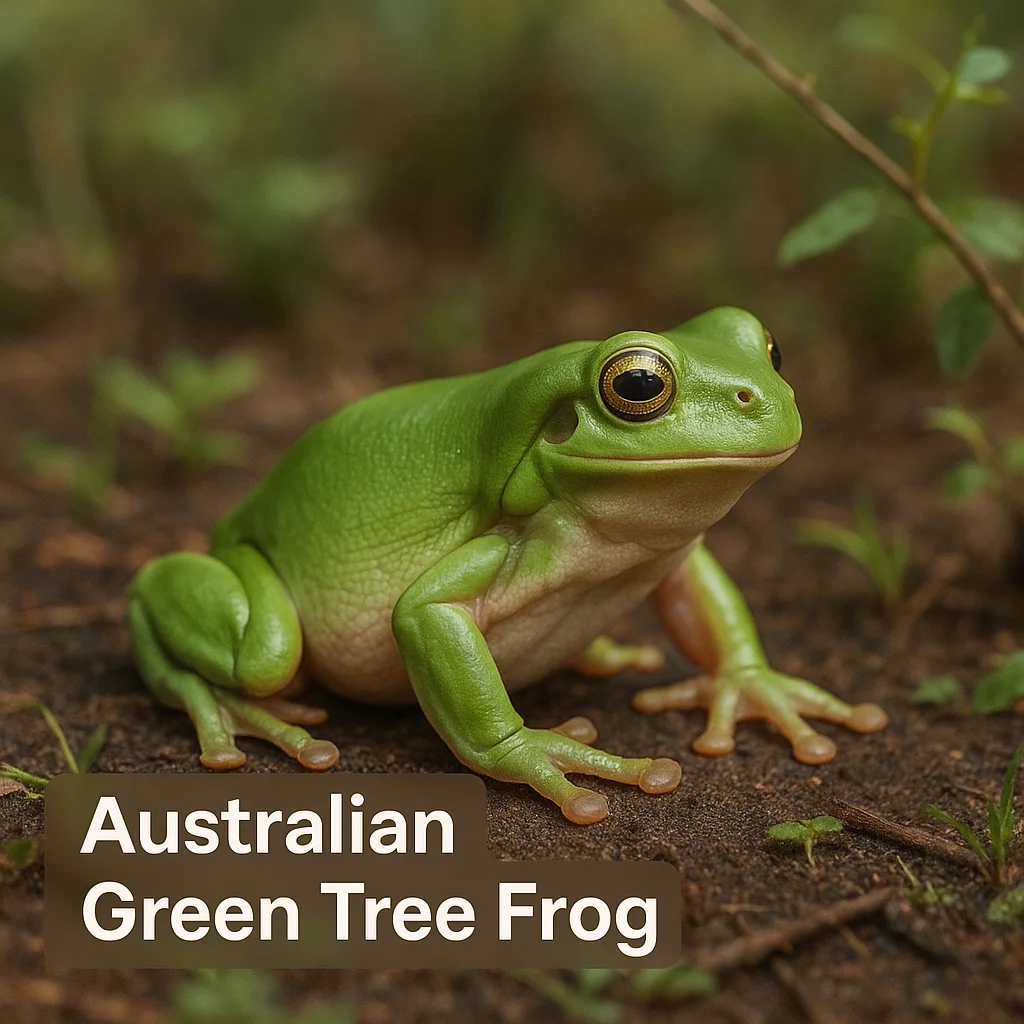
- Common name(s): Australian Green Tree Frog, Green Tree Frog
- Scientific name: Litoria caerulea
- Animal type: Amphibian
- Typical adult size: 7–11 cm (2.7–4.3 inches) in length
- Typical lifespan: 10–15 years in the wild; up to 20 years in captivity
- Diet type: Carnivore; primarily insects and small invertebrates
- Activity pattern: Nocturnal
- Social structure: Solitary
- Speed/movement highlights: Strong jumpers, capable of leaping over impressive distances relative to their size
- Intelligence/learning: Displays basic learning ability and response to environmental changes
- Primary habitats: Rainforests, swamps, and urban areas near permanent water sources
- Geographic range: Northern and eastern parts of Australia, New Guinea
- Predators/threats: Birds, snakes, larger mammals, and introduced species; habitat loss and pollution by humans
- Conservation status: Not currently threatened, but varies by region due to habitat changes
🔍 Identification & Appearance
The Australian Green Tree Frog is easily recognizable by its robust and smooth body, vibrant green skin, and creamy white underbelly. Occasionally, it might appear bluish-green due to lighting conditions. These frogs have large, prominent eyes with horizontal pupils and adhesive pads on their fingers and toes to aid in climbing.
Adult frogs can sometimes develop small white or gold spots on their backs. These amphibians can alter their skin color to some extent depending on temperature and humidity, ranging from light green to darker olive.
The species is often confused with other tree frogs, but its size and color patterns help distinguish it.
- Top ID Tips:
- Robust, smooth body shape
- Vibrant green to olive skin with possible spots
- Large eyes with horizontal pupils
- Creamy underside
- Adhesive toe pads for climbing
- Generally larger than other tree frogs
🧱 Body Structure & Physical Adaptations
Constructed for a life of climbing, the Australian Green Tree Frog possesses a sturdy build that balances strength and flexibility. The frog's limbs are well developed, with long digits equipped with sticky pads, making it an exceptional climber in its arboreal environment.
Litoria caerulea has a wide mouth and a strong jaw suited for quickly capturing prey. The frog's tympanic hearing is well refined, essential for detecting predators and mates, while its vision is attuned to moving prey.
- Key Adaptations:
- Strong adhesive toe pads
- Robust build assists in powerful jumps
- Wide mouth for capturing a variety of prey
- Tympanic membrane sensitive to sound
- Large eyes adapted for low-light environments
🌍 Range & Distribution
The Australian Green Tree Frog is native to the northeastern and eastern coastal regions of Australia and extends into parts of southern New Guinea. They predominantly inhabit warm, moist environments but can adapt to urban areas with sufficient water and vegetation.
- Where You Might Find It:
- Northeastern coastal Australia
- Eastern Australia
- Southern New Guinea
- Tropical and subtropical rainforests
- Swamps and riverbanks
🏞️ Habitat & Shelter
Australian Green Tree Frogs favor wet and humid habitats such as rainforests, marshes, and swamps. They are commonly found in forested areas near streams or ponds but have also adapted to human-altered environments, finding shelter in gardens and residential areas.
The frogs rely on water bodies not only for hydration but as breeding sites. Seasonal rains influence their breeding behaviors, prompting increased activity and spawning during rainy months.
🧭 Behavior & Ecology
Primarily nocturnal, the Australian Green Tree Frog spends its nights hunting for food and mates. During the day, it seeks refuge in damp, shady areas to avoid dehydration. Mating calls, which resemble low-pitched "barks," fill the air during breeding seasons. These calls also serve as territorial markings.
The relationship of these frogs with their environment is one of both predator and prey: they help control insect populations while also serving as food for birds and snakes.
- Behavior Highlights:
- Nocturnal activity focused on foraging and reproduction
- Mating calls are an important part of their behavior
- Plays a role in controlling insect populations
- Seeks damp, cool areas in daylight
- Adapts to urban habitats with sufficient moisture
👥 Social Life & Group Dynamics
Australian Green Tree Frogs are solitary creatures, coming together mainly during breeding seasons. They do not form structured social groups but congregate loosely around water sources to mate. Post-mating, interactions generally limit to competition for food and territory display among males.
- Social Structure Notes:
- Primarily solitary except during breeding
- Loose aggregation near water bodies
- Males may compete for mating rights
- No parental care beyond egg-laying
- Little to no cooperative behavior observed
🍽️ Diet, Prey & Predators
The Australian Green Tree Frog primarily consumes insects, including moths, crickets, and caterpillars. They employ a "sit-and-wait" hunting strategy, relying on their excellent night vision. Occasionally, they may eat smaller amphibians or other small invertebrates.
In the wild, they face threats from birds, snakes, and mammals like feral cats. A natural anti-predator tactic includes inflating their bodies to appear larger and secreting sticky mucus.
- Feeding Notes:
- Insectivorous diet focusing on terrestrial insects
- Sit-and-wait hunting technique
- Rely on vision and subtle movement detection
- Natural predators include birds and snakes
- Employ body inflation and mucus secretion for defense
🦌 Hunting, Foraging & Movement
As a nocturnal hunter, the Australian Green Tree Frog is primarily active at night. Its hunting strategy involves remaining motionless in high-traffic insect areas and quickly snatching up prey with its sticky tongue. The frog's adaptive locomotion involves arboreal climbing and impressive leaps across water and vegetation.
- Movement & Strategy:
- Nocturnal foraging aligns with insect activity peaks
- Arboreal climber using sticky pads
- Strong jumper with targeted leaps
- Stationary hunting posture
- Home range primarily focused around dependable water sources
🧠 Intelligence & Senses
The Australian Green Tree Frog shows basic problem-solving skills, mostly related to navigating environments and finding food. Although not renowned for cognitive complexity, the frog has adapted well to changing environments. Its senses are finely tuned for survival; sensitive hearing and exceptional night vision are critical.
- Notable Abilities:
- Responsive to environmental changes
- Uses senses to locate prey and avoid predators
- High adaptability to urban settings
- Effective use of night vision in low light
- Basic problem-solving in food procurement
🪺 Reproduction, Pregnancy & Parenting
The breeding season of the Australian Green Tree Frog coincides with the rainy season, usually between October and March. Males call to attract females, and mating occurs in or near water. Females lay eggs in clusters on vegetation or still water.
Eggs typically hatch within a week, and tadpoles undergo rapid development, becoming froglets in about two months. There is no parental involvement post-laying.
- Reproduction Snapshot:
- Breeding season aligns with rainy months
- Males produce advertisement calls
- Egg clusters laid in water or moist ground
- Tadpoles develop quickly within several weeks
- No parental care after egg deposition
♀️♂️ Male vs Female Differences
In the Australian Green Tree Frog, males and females are similar in appearance, with males potentially being smaller or possessing darker throat skins due to calling. Males also exhibit pronounced vocal cords for mating calls. Females are generally slightly larger and can carry more body mass when laden with eggs.
- Sex Differences at a Glance:
- Males typically smaller than females
- Darker throat skin in calling males
- Females larger with eggs
- Similar overall coloration in both sexes
- Mating call structures appear in males
🧬 Subspecies & Variation
While traditionally recognized as a single species, variations in the Australian Green Tree Frog across its range include differences in size and coloration. Morphological adaptations may occur in isolated populations, but subspecies classification remains debated among scientists.
- Variation Notes:
- Variable size and shade of green
- Possible isolated adaptations in Australia
- Debate over specific subspecies classification
- Climate impacts coloration intensity
- No clearly defined subspecies as of now
⚠️ Threats, Conservation & Human Interaction
While currently not endangered, the Australian Green Tree Frog faces threats from habitat loss, pollution, and climate change. In urban areas, frog populations may suffer from introduced predators like cats and pollution from pesticides.
Human interactions often involve keeping these frogs as pets; however, responsible care requires replicating their natural habitats and ensuring they are not sourced from wild populations.
- Responsible Notes:
- Habitat conservation is crucial
- Avoid pollution and pesticide use in frog areas
- Keep cats indoors to protect urban frog populations
- Promote ethical pet ownership practices
- Support conservation initiatives to preserve natural habitats
✨ Fun Facts & Unique Traits
- Australian Green Tree Frogs are known for their calm demeanor, making them suitable for educational settings.
- They have a unique vocal sac under their throat used during their distinctive mating calls.
- Their skin secretes antimicrobial peptides, which are studied for potential medical applications.
- They can survive in semi-arid climates by sitting in shaded, moist environments.
- Despite their name, they can display a range of colors, including blue or brown, depending on environmental moisture and temperature.
- Green Tree Frogs can "play dead" by remaining motionless when threatened.
- This species often inhabits human-designed water structures like backyard ponds.
- Males engage in "chorus battles" to demonstrate dominance and attract females.
- Litoria caerulea has been introduced to New Zealand as a pet species.
- Their ability to change skin tone helps them blend into various environments.
📌 Summary
- The Australian Green Tree Frog can be identified by its smooth green skin and large eyes.
- Found in northeastern and eastern Australia, they adapt well to various moisture-rich habitats.
- Primarily feeds on insects through a sit-and-wait hunting method.
- Faces natural threats from predators and pressures from habitat loss and pollution.
- Typically solitary, gathering near water sources only during breeding seasons.
- Breeds during rainy months with eggs laid in water or moist areas.
- Exhibits strong climbing and jumping abilities, helped by adhesive toe pads.
- Identifiable by resilient skin known for its protective peptide secretion.
- Shows adaptability toward urban environments and human-altered landscapes.
- Responsible interaction includes habitat conservation and ethical pet care.